


Description
What the Ear (a) Are
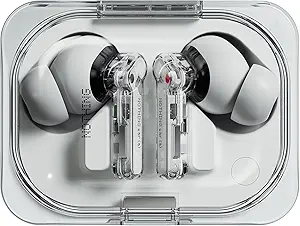
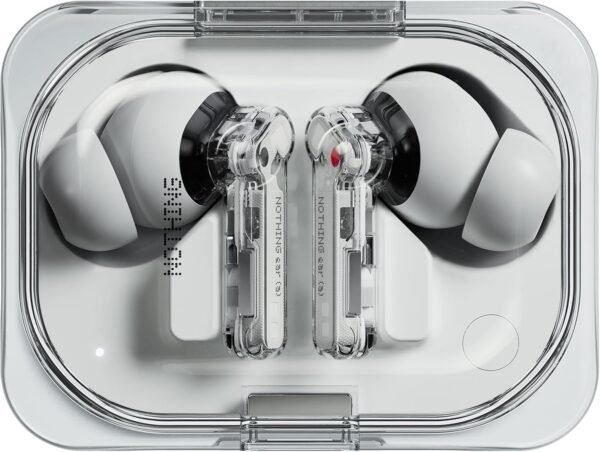
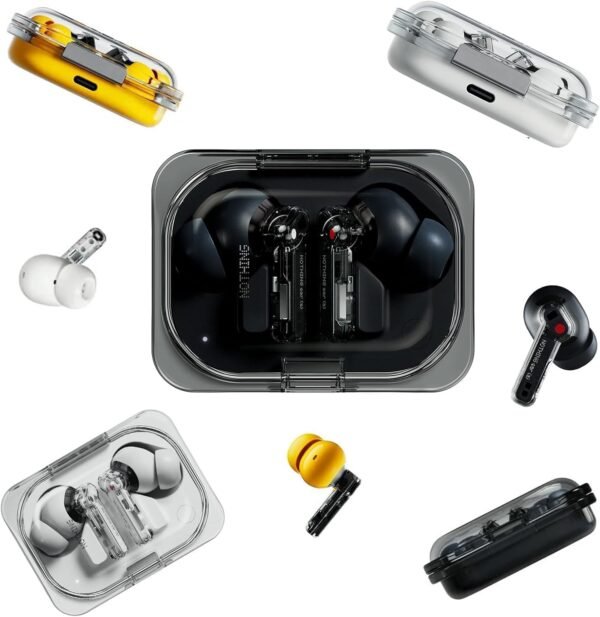
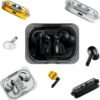
The Nothing Ear (a) are true wireless earbuds released in 2024, using 11 mm dynamic drivers with active noise cancellation and app based control. Nothing is a comparatively young British consumer electronics company, and its products are known for a transparent design language that exposes internal components, which is as much a part of the proposition here as the audio specification.
The Ear (a) sit below the standard Nothing Ear in the range, and the (a) designation marks the more affordable line rather than a different generation. The listing dates the product to September 2024 and gives the compatible devices as Android and iOS, so these are not tied to a single phone ecosystem the way some manufacturer earbuds are. Buyers comparing across brands should look at the Samsung Galaxy Buds FE and the Redmi Buds 5 Pro.
Drivers and Sound
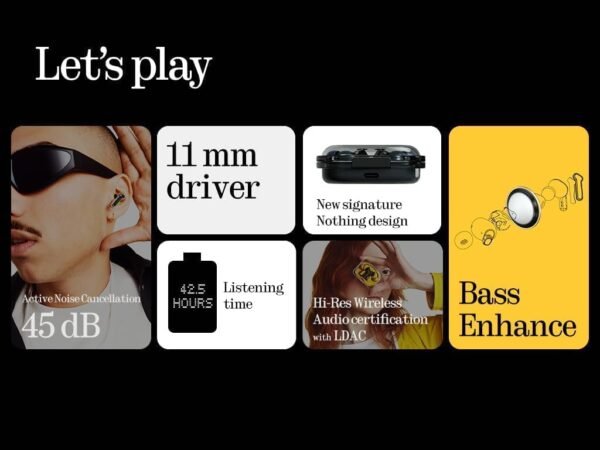
Each earbud carries a single 11 mm dynamic driver, which is large for a true wireless design; many competitors use drivers between 6 and 10 mm. Driver diameter is not the whole story, but a larger diaphragm moves more air, which generally correlates with more low frequency capability from a sealed in ear fit. The earpiece shape is listed as rounded tips, indicating a conventional sealing in ear design rather than an open fit, and the stated frequency range is 20 Hz to 20,000 Hz.
Control is handled through an app, which is where the equalizer, the cancellation modes and any additional features are configured. Nothing has built a reputation for putting more control in its app than most manufacturers at this level, including customizable equalizer curves rather than a fixed set of presets. The site title for this product also references ChatGPT integration, a feature Nothing offers through its own app and phone software rather than through the earbuds themselves; the listing data attached to this product does not document it, and buyers who specifically want that integration should confirm the requirements with Nothing.
Noise Cancellation, Calls and Battery
Cancellation is the feature that separates these from the cheapest wireless earbuds, and it is described in general terms rather than measured ones. Active noise cancellation is included, and the product information describes it as adaptive, adjusting to the surrounding environment rather than applying a fixed amount of processing. The same information cites a figure of up to 45 dB of reduction, which is a peak laboratory measurement at a particular frequency rather than a reduction achieved across the whole spectrum; low frequency drone from engines and air conditioning is always reduced far more effectively than speech.
For calls, the product information describes voice isolation and reduced wind interference, both of which are microphone side processing that improves what the caller hears. Charging time is listed as 10 minutes, which is a quick charge figure rather than a full charge, and three lithium ion batteries are listed as included, counting the two earbuds and the case. The product information cites more than 42 hours of combined playback with the case. Listeners who want longer runtime in a larger format should compare the over ear headphones category.
Highlights
- 11 mm dynamic drivers, larger than most true wireless designs use.
- Adaptive active noise cancellation rather than a fixed setting.
- Voice isolation and wind noise reduction for calls.
- App based control including equalizer adjustment.
- Quick charge listed at 10 minutes.
- Compatible with both Android and iOS rather than a single ecosystem.
- Sealing in ear fit with rounded tips.
- Distinctive transparent design language from a comparatively new manufacturer.
- Charging case supplied, listed with its own battery alongside the two earbuds.
- Stated frequency range of 20 Hz to 20,000 Hz.
- App based control of the equalizer rather than a fixed set of presets.
- Released in September 2024, so a current model rather than an older design.
Things To Consider
This listing has no manufacturer description and no feature bullets, only a short attribute table, which leaves a great deal undocumented. There is no Bluetooth version, no codec list, no per charge battery figure, no case capacity, no confirmation of multipoint connection to two devices and no statement of what is in the box beyond the earbuds themselves. Codec support in particular matters, since it determines whether an Android phone can send a higher bitrate stream, and it is absent.
Several fields are also misleading. The charging time of 10 minutes describes a quick charge rather than a full one. The item weight of 2.16 ounces is the packaged weight, not the weight of an earbud. The product dimensions of 1.87 by 2.49 by 0.89 inches describe the charging case. And the water resistance level reads simply Water Resistant with no IP rating, so there is no way to know whether these survive sweat during exercise or a walk in rain.
On practical grounds, the more capable features of Nothing earbuds have historically been tied to the Nothing phone software, and a buyer using another Android phone or an iPhone may find some functionality reduced. The cancellation figure of 45 dB should be treated as a peak rather than a broadband reduction. And a sealing in ear fit, while better for isolation, is less comfortable over many hours than an open design for some listeners. Buyers who want a documented IP rating and published codec support should compare the Samsung Galaxy Buds 3 or browse the earbud headphones selection.
Who It Suits
The Ear (a) suit a listener who wants adaptive cancellation, large drivers and genuine app based equalizer control at an accessible price, and who values a design that looks different from the uniform white and black of the category. Cross platform compatibility makes them a reasonable choice regardless of which phone is being used.
They are a weaker choice for anyone who needs a confirmed water rating for training, anyone who wants documented codec support before buying, and anyone hoping for the full feature set without a Nothing phone. Buyers wanting a simpler and cheaper pair should compare the Soundcore A30i.