
Description
What the Godox Magic XT1 Is and Who It Suits
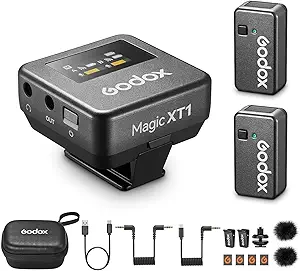
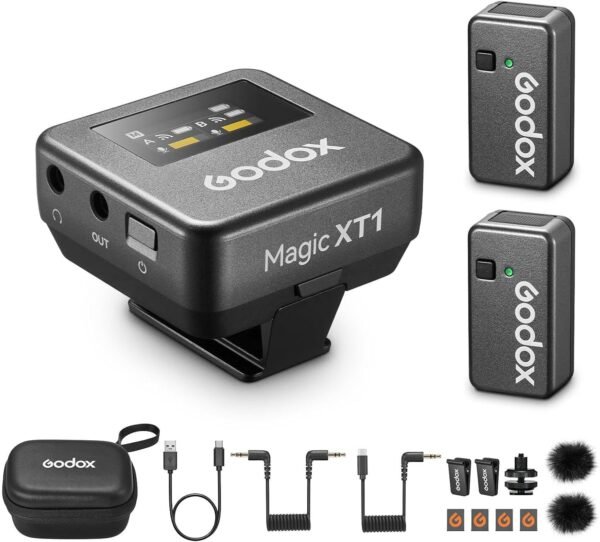
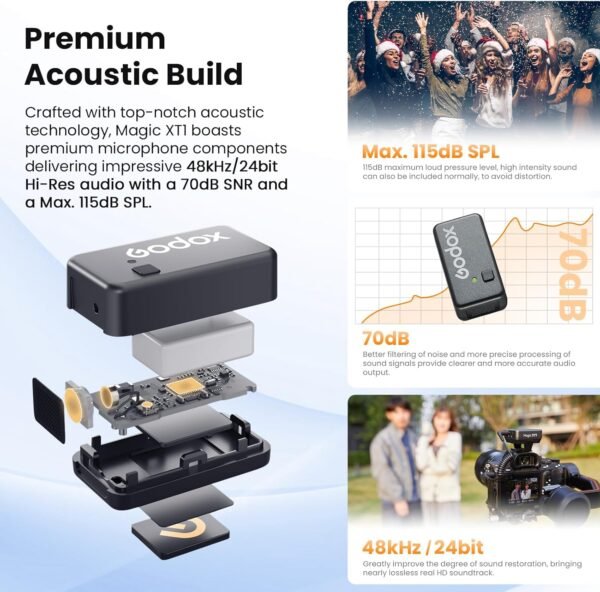
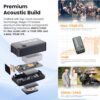
The Godox Magic XT1 is a wireless lavalier microphone system aimed at video creators. The listing gives a lavalier form factor, two channels, a frequency range of 20 Hz to 20 kHz, a signal to noise ratio of 70 dB, battery power from two included lithium ion cells, and a hardware platform list covering camera, smartphone, computer and tablet. The complete kit is listed at 7.1 ounces with dimensions of 5.79 x 4.02 x 2.8 inches. Godox is primarily a lighting manufacturer that has expanded into audio, and this product sits in that newer line.
The buyer is someone recording talking on video: a vlogger, an interviewer, a course creator, a wedding videographer. The problem being solved is specific. A camera’s built-in microphone sits several feet from the subject, and sound level falls with distance while the room’s reverberation does not, so a camera microphone captures a thin voice in a boomy room. A lavalier clipped to a shirt sits inches from the mouth and captures the voice cleanly. Readers comparing systems should look at the Rode Wireless PRO, and those who need a microphone that mounts on a camera rather than on a person can consider the Shure MV88.
Two Channels and What That Enables
Number of Channels is listed as 2, which is the specification that defines this product’s usefulness. A two channel system means two transmitters and one receiver, so two people can be recorded simultaneously into one camera or phone. That covers interviews, two person podcasts filmed on camera, and any dialogue scene, and it is the difference between a system that handles real work and one that only records a single presenter.
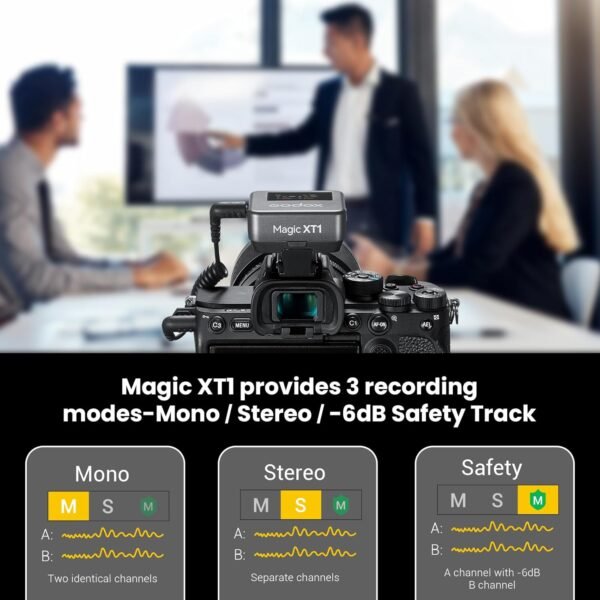
Two channel systems normally offer a choice of how the audio is combined. Mono mixes both transmitters into a single track, which is simplest but cannot be fixed later if one speaker is too loud. Stereo places each transmitter on its own track, which allows separate level adjustment in editing and is almost always the better choice. The listing does not state which modes this system supports, so buyers who need separate tracks should confirm that before purchasing. Creators working with music instead of speech will find options across the vocal microphone section.
Connection, Platforms and Practical Recording
The hardware platform list covering camera, smartphone, computer and tablet points to a receiver with multiple output options, which is standard for the category and usually means a 3.5 mm output for cameras plus a USB-C or Lightning connection for phones and computers. Buyers should confirm which specific connectors are supplied, because a system that requires an adapter for a particular phone is a system that will be forgotten at home at the worst moment.
The stated signal to noise ratio of 70 dB is a modest figure by professional standards but adequate for spoken word, where the voice sits well above the noise floor. The 20 Hz to 20 kHz frequency range is the standard full band claim and tells a buyer little, since a lavalier capsule’s useful response is voice focused regardless of the number printed on the box. What actually determines results with a lavalier is placement: roughly a hand’s width below the chin, clipped so that clothing does not rub against the capsule, and with the cable secured so movement does not transmit through it. Creators building a fuller recording chain should also look at the MAONO PD200X.
Portability and Power
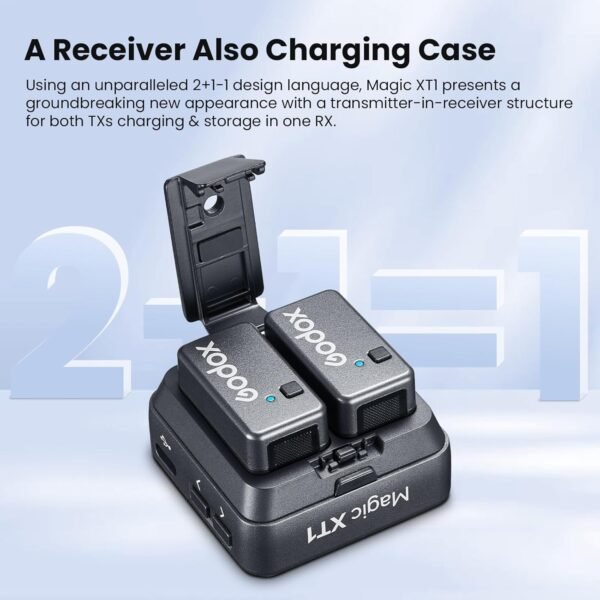
At 7.1 ounces for the complete kit, this is a genuinely pocketable system, and that is the main practical advantage of modern compact wireless microphones over the belt pack systems that preceded them. The listing records two lithium ion batteries included, which corresponds to the two transmitters, and the receiver presumably carries its own cell. Batteries in systems of this kind are normally built in and charged from a case, which means the runtime per charge and the number of charges the case holds are the two numbers that determine a working day. Neither appears in this listing.
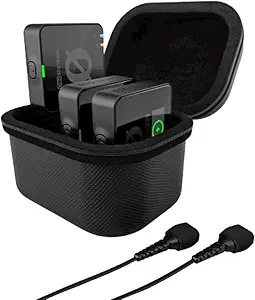
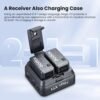
Godox lists a color of black and gives dimensions consistent with a small charging case containing all three units. That case format has become standard because it solves storage, charging and pairing at once. Buyers who also need a wireless link for an instrument rather than a voice can compare the Xvive A58 wireless system, which solves a similar problem in a different domain, or browse the wireless lavalier microphones category.
Highlights
- Two channel system, so two people can be recorded at once.
- Compact kit listed at 7.1 ounces including the case.
- Hardware platform list covers cameras, smartphones, computers and tablets.
- Frequency range listed at 20 Hz to 20 kHz.
- Two lithium ion batteries included with the system.
- Lavalier capsules sit close to the mouth, which fixes the distance problem a camera microphone has.
Things To Consider
The specification block has a contradiction that makes both numbers unusable. Audio Sensitivity is listed as 115 dB and Noise Level is listed as 115 dB, the same figure in two fields that measure entirely different things. A noise level of 115 dB would make a microphone completely unusable, so this is one value duplicated into the wrong field rather than two measurements. The signal to noise ratio is separately recorded as 7E+1 dB, scientific notation for 70 dB, which is at least a plausible figure.
The listing also omits nearly everything a buyer needs. There is no wireless range figure, no battery runtime, no transmission frequency band, no confirmation of recording modes, no statement of whether onboard recording as a backup is supported, no gain control detail and no itemized list of the box contents. Range and runtime in particular decide whether a system suits a specific shoot. The Product Dimensions and Item dimensions fields are identical, suggesting the packaged size rather than any individual component.
Two further points. The listing shows no customer rating or ratings count at all, so there is no aggregate buyer feedback available from this data on a product first available in April 2024. And wireless microphone systems operate on shared radio bands, so performance in a crowded venue with many other wireless systems is a real variable that no specification sheet predicts.
Who Should Buy It, and Who Should Not
This suits a creator who films two people talking and wants a compact system that works with both a camera and a phone. The two channel design is the feature that matters, and the small size means it actually gets carried.
It does not suit anyone who needs published range and battery figures before committing, because this listing provides neither, and it does not suit a professional shoot where onboard backup recording is a requirement, since that capability is not confirmed here. Buyers in either group should choose a system with a fully published specification.