







Description
What the Redmi Buds 6 Play Are
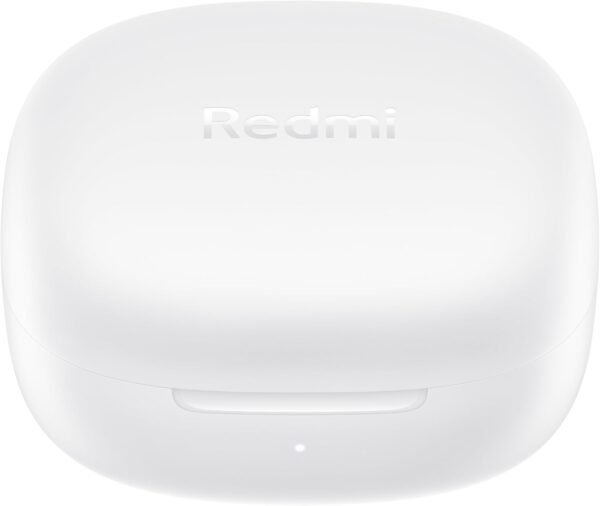
The Xiaomi Redmi Buds 6 Play are the entry level model in the Redmi Buds 6 family, sold here as the Global Version in white. The specification is deliberately simple: a single 10 mm dynamic driver in each earbud, Bluetooth 5.4, touch controls, five preset equalizer modes and a stated 36 hours of total battery life with the charging case. The Play suffix marks it as the most affordable branch of the range rather than a variant with different features.
Understanding where it sits in the family avoids disappointment. Above it, the Xiaomi Redmi Buds 6 and the considerably more advanced Redmi Buds 5 Pro add features that the Play does not have. This model is aimed at a buyer who wants a competent, very light pair of wireless earbuds for calls, podcasts and everyday listening without paying for noise cancellation or high resolution codecs.
Weight, Driver and Sound Options
The headline physical specification is weight. Xiaomi states each earbud weighs 3.6 grams and describes the goal as reducing pressure in the ear canal. That figure is genuinely low, and weight is the variable that decides whether earbuds are comfortable over several hours more than any material or shape does. The earpiece shape is described as bean shaped, a form that sits in the concha rather than inserting deep into the canal.
Each earbud carries a single 10 mm dynamic driver, which Xiaomi states has been tuned by its acoustic lab. Ten millimeters is large for a true wireless driver and generally correlates with more low frequency capability. Five preset EQ modes are provided, which is the usual approach at this level: rather than a parametric equalizer, the user selects a voicing. The stated frequency range is 20 Hz to 20,000 Hz, and the case is described as clean and sleek in design. Listeners who want a fuller sound from a larger enclosure should compare the over ear headphones category.
Battery, Connection and Calls
Battery figures are given as up to 7.5 hours from a single charge and up to 36 hours in total with the charging case, which holds 600 mAh. Those are strong numbers for the class, and the 7.5 hour per charge figure is more useful than the headline 36 hours, since it determines how long a single listening session can run. Bluetooth is version 5.4, which is current and brings improvements in connection stability and power efficiency over older versions. Range is listed at 10 meters and control is by touch.
It is worth putting the 36 hour figure in context, because total battery numbers on true wireless earbuds are quoted differently by different brands. The 36 hours here counts every recharge the case can provide before the case itself needs power, which works out to roughly four full refills of the earbuds. The number that governs daily use is the 7.5 hour per charge figure, and that is long enough to cover a working day of intermittent calls or a long flight without returning the earbuds to the case.
The AI noise reduction feature needs care in interpretation. Xiaomi describes it as an AI voice algorithm that distinguishes human voices from ambient noise so that conversations are clear in noisy environments. That is call processing: it cleans up the microphone signal for the person on the other end of the line. It is not active noise cancellation, and it does not reduce what the wearer hears during music playback. Anyone shopping specifically for cancellation should look at models that state it explicitly, such as those in the earbud headphones category that carry an ANC specification.
Highlights
- 3.6 grams per earbud, notably light for a true wireless design.
- 10 mm dynamic driver, large for the format, tuned by the Xiaomi acoustic lab.
- Up to 7.5 hours per charge and up to 36 hours total with the case.
- Bluetooth 5.4, one of the more current versions available.
- Five preset EQ modes for adjusting the voicing.
- Touch controls on the earbuds themselves.
- AI voice processing to improve call clarity in noisy places.
- 600 mAh charging case listed in white.
Things To Consider
The most important limitation is the one the marketing language obscures. There is no active noise cancellation here. The AI noise reduction improves what callers hear, not what the wearer hears, and a buyer expecting quiet on a train will be disappointed. Passive isolation from a bean shaped earbud that sits in the concha is also lower than from a design that seals in the ear canal, so ambient noise will be more audible than with an in ear tip.
Several listing fields are unreliable. The charging time is given as 1E plus 1 minutes, scientific notation for 10 minutes, which presumably refers to a quick charge rather than a full one. The item weight of 1.59 ounces contradicts the stated 3.6 grams per earbud and evidently describes the packaged product. The listing states four USB 2 ports and gives the language as Italian. Product dimensions of 3.94 by 3.94 by 1.22 inches describe the box.
Water resistance is listed only as water resistant with no IP rating, so the actual level of protection is undocumented and these should not be treated as sweatproof for training. There is also no mention of codec support beyond the Bluetooth version, no wireless charging for the case, and no app named for firmware updates or EQ management beyond the five presets. For most buyers at this level none of that is decisive, but it should be understood before purchase. Those wanting a more featured pair should compare the Skullcandy Indy Evo or the JVC Gumy at similar levels.
Who It Suits
The Redmi Buds 6 Play suit someone who wants very light earbuds for calls, podcasts and casual listening, who values long battery life and a current Bluetooth version, and who does not need noise cancellation. The 3.6 gram weight in particular makes them a sensible choice for anyone who finds heavier earbuds uncomfortable after an hour.
They are a weaker choice for commuters who want quiet, for exercise where a documented water rating matters, and for listeners chasing audio quality through higher bitrate codecs. Those buyers should move up the same family or look at models that publish ANC depth and an IP rating explicitly.