


Description
What the SR-B30A Is
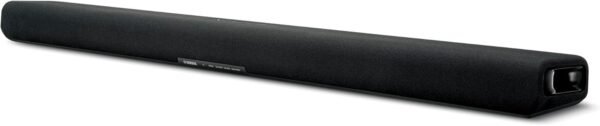
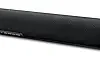
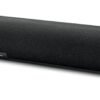
The Yamaha SR-B30A is a single body sound bar with subwoofers built into the same enclosure, which is the defining decision behind the product. Most bars in this class ship with a separate wireless subwoofer, and Yamaha has instead fitted dual internal subwoofers so that only one object needs a position and a power socket. For a household where floor space is limited, or where a subwoofer would simply not be tolerated in the room, that is the whole argument for this bar.
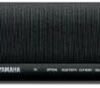
Yamaha lists the bar at 35.88 inches wide, 5.25 deep and 2.63 high, weighing 8.6 pounds, which suits a television of roughly 50 inches or larger. Setup is described as a single HDMI connection from the television, with optical as an alternative, and an HDMI cable is supplied along with a wall mounting template and the remote. Buyers comparing single body designs against separate subwoofer systems should look at the Klipsch Flexus CORE 100 and the Hisense HS5100.
Dolby Atmos and Audio Formats
The listing gives the audio encoding support as Dolby Digital, Dolby Digital Plus 7.1, Dolby Atmos and Dolby TrueHD 7.1, which is a broad set covering broadcast, streaming and disc sources. Dolby Atmos on this bar is processing rather than a physical height layer: there are no upward firing drivers listed, and the driver sizes given are 1.8 inch woofers and 1 inch tweeters alongside 3 inch subwoofer drivers. Yamaha describes the result as spacious sound, and the honest way to read that is as a widened and heightened presentation created by processing rather than by sound physically arriving from above.
That is not a criticism of the implementation so much as a description of what a bar without height drivers can do. Buyers who specifically want overhead effects should look for a bar with upward firing drivers and a ceiling flat enough to reflect from, such as the configurations found across the sound bars category. Those wanting a full physical Atmos layer with rear channels should compare the Samsung HW-Q910C.
Clear Voice, Bass Extension and Control
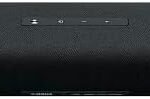
Bars in this class live or die on their sound modes, because a single enclosure has to cover speech, music and film effects with the same drivers. Two are called out here. Clear Voice is Yamaha’s dialogue enhancement, lifting speech relative to effects and music, which addresses the most common complaint about television audio. Bass Extension does the reverse, pushing the low frequency output of the internal subwoofers. Having both as separate switchable modes rather than a single tone control is sensible, because they serve opposite purposes and different content.
Bluetooth is provided for streaming music, audiobooks and podcasts, with a stated range of 10 meters. A remote is included, powered by a CR2 battery that Yamaha supplies, and a free app is available for iOS and Android for control and setting adjustment. The country of origin is listed as Vietnam. At the time this listing data was captured it showed 273 ratings at an average of 4.4 stars, which is a reasonable sample for a product of this age and suggests steady rather than spiking sales.
Highlights
- Dual subwoofers built into the bar, so only one object needs placing and powering.
- Dolby Atmos processing plus Dolby TrueHD 7.1 and Dolby Digital Plus decoding.
- Clear Voice mode for dialogue and Bass Extension for low frequency output.
- Single cable setup by HDMI, with optical as an alternative and an HDMI cable supplied.
- Bluetooth streaming with a stated 10 meter range.
- Free control app for iOS and Android alongside the supplied remote.
- Wall mounting template included in the box.
- Light at 8.6 pounds and slim at 2.63 inches high.
- Remote supplied with its CR2 battery already included.
Things To Consider
The specification block contradicts the product description in two places. It gives the surround sound channel configuration as 5.1, while the product is a single body bar that Yamaha describes as having built in subwoofers and no separate speakers; there are no rear channels and no separate bass cabinet. It also lists the subwoofer connectivity technology as wireless, when the subwoofers are inside the bar and connect to nothing. The speaker size field of 35.88 inches is the width of the bar rather than a driver dimension.
The internal subwoofer approach carries a real trade off. Two 3 inch drivers in a bar 2.63 inches high cannot move the air that a separate cabinet with a 6 or 10 inch driver moves, and no amount of processing changes that. Bass Extension will make the low end more present, but the physical limit is set by driver area and enclosure volume. Buyers who want cinematic low frequency impact should accept a separate subwoofer or look at the subwoofers category to add one later, if the bar supports it.
Other practical points: there is no rear speaker option listed, so this cannot be expanded into a true surround system. The bar has no upward firing drivers, so the Atmos support is processing rather than physical height. And at 35.88 inches wide it will overhang the stand of a smaller television. Households wanting a more compact option from the same manufacturer should compare the Yamaha SR-C20A. It is also worth noting that the listing gives no total power output and no frequency response, so the only way to judge what the internal subwoofers achieve is to hear them.
Who It Suits
The SR-B30A suits a household that wants a substantial improvement over television speakers, has no room or tolerance for a separate subwoofer, and values a single cable installation. The combination of Clear Voice for dialogue, Bass Extension for films and Bluetooth for music covers the three things most people actually use a bar for.
It is a weaker choice for anyone who wants genuine overhead effects, real cinematic bass or the ability to add rear speakers later. Those buyers should look at bars with upward firing drivers and separate subwoofers, and accept the additional boxes that come with them.