

Description
What the HW-Q910C Is
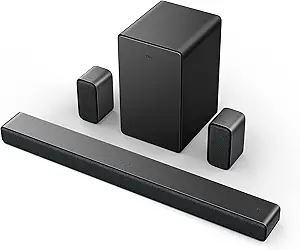
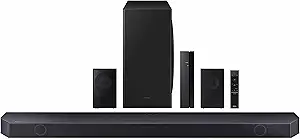
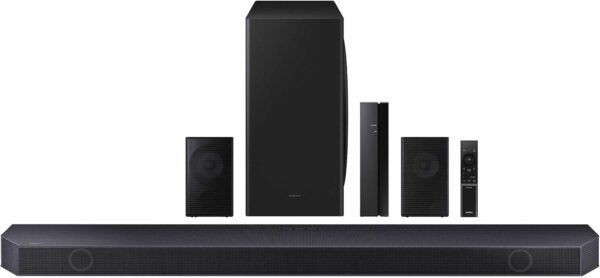
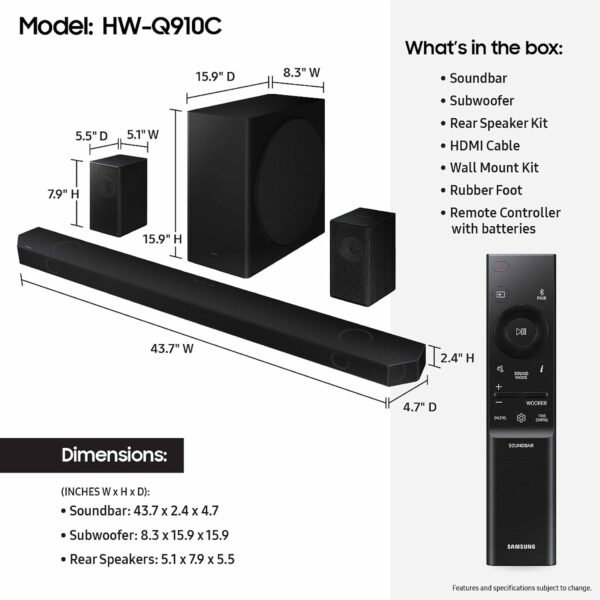
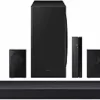
The Samsung HW-Q910C is a 9.1.2 channel sound bar system sold as a complete package: the bar itself, a wireless subwoofer, and a rear speaker kit, along with a wall mount kit, an HDMI cable and a remote. Samsung lists six items in the box. The channel count breaks down as nine horizontal channels spread across the bar and the rear speakers, one subwoofer channel, and two upward firing drivers for Dolby Atmos height information. That is a large configuration for a bar based system, and it puts the Q910C at the point where a sound bar starts competing with a modest separates setup.
The intended buyer is someone who already owns or is buying a recent Samsung television, because several of the headline features are conditional on that. Samsung is upfront about it in the fine print, and the conditions are worth reading before purchase. For households outside that ecosystem, comparable bars such as the Yamaha SR-B30A and the Hisense HS5100 deliver their features regardless of what brand of television is on the wall.
Dolby Atmos, Q-Symphony and Wireless Rears
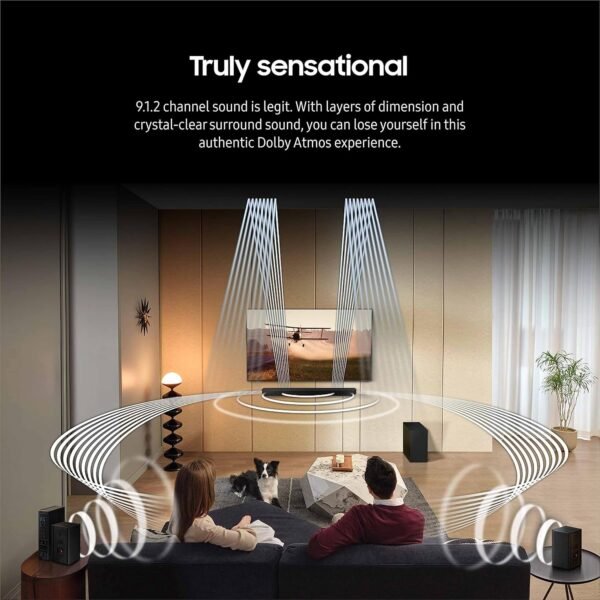
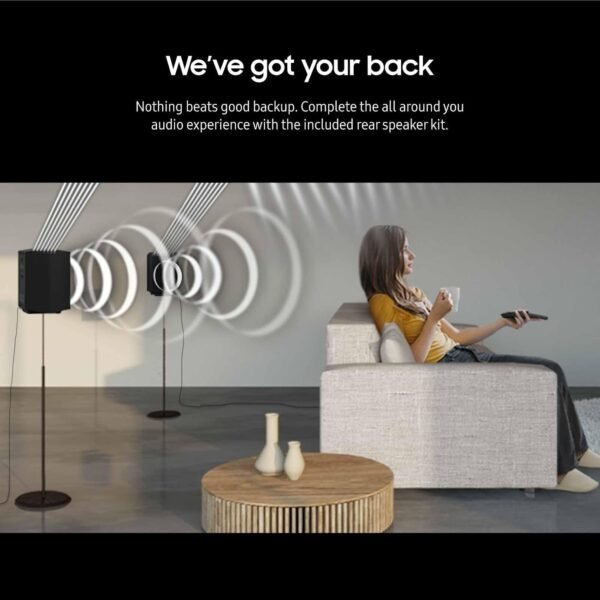
Samsung describes the Q910C as delivering true Dolby Atmos rather than a virtualized approximation, and the two upward firing drivers plus the included rear speakers are what support that claim. Physical rear speakers are the single biggest difference between this and a bar only system, because surround effects come from behind the listener instead of being bounced off a side wall. The rears connect wirelessly to the bar, though they still need mains power at their positions, which is the usual practical constraint.
Q-Symphony is the Samsung feature for playing the television speakers in concert with the sound bar rather than muting them, effectively adding height and width from the panel. It requires a compatible Samsung television from the 2020 to 2023 range. Wireless Dolby Atmos, which sends the Atmos signal to the bar without an HDMI cable, is narrower still: Samsung states it is compatible with select 2022 and 2023 Samsung televisions. Both features are genuinely useful and both are unavailable to anyone with a television from another brand.
Room Calibration, Voice and Gaming Features
SpaceFit Sound Pro is the automatic room calibration system. The bar analyzes the acoustic environment and adjusts output to suit it, which addresses the most common reason a sound bar disappoints: a room that reinforces or absorbs frequencies unevenly. Adaptive Sound works on content rather than the room, analyzing scenes in real time to lift dialogue and important audio at low volumes, which is aimed at the familiar complaint of speech being buried under effects.
Game Mode Pro engages automatically in sync with a compatible television and applies 3D optimized processing using the up firing drivers and woofers. Samsung notes it works with its Gaming Hub and select consoles including Xbox Series X and PlayStation 5, sold separately. On the connectivity side, Alexa is built in for hands free control of the bar and television, and AirPlay 2 is supported for streaming from an iPhone running iOS 11.4 or later. Bluetooth is listed with a 10 meter range. Anyone considering the alternative of a full receiver based system should compare against the Pioneer Elite VSX-LX305.
Highlights
- 9.1.2 channels with wireless subwoofer and rear speaker kit included, not sold separately.
- True Dolby Atmos with two upward firing drivers rather than virtualization alone.
- Q-Symphony combines bar and Samsung television speakers into one output.
- SpaceFit Sound Pro calibrates automatically to the room.
- Adaptive Sound targets dialogue clarity at low listening levels.
- Game Mode Pro engages in sync with a compatible Samsung television.
- Alexa built in, AirPlay 2, and Bluetooth with a stated 10 meter range.
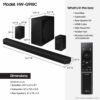
- Bar measures 43.7 inches wide by 4.7 inches deep by 2.4 inches high.
Things To Consider
The conditional features are the main caveat. Q-Symphony, Wireless Dolby Atmos and the automatic Game Mode Pro handoff all depend on owning a specific Samsung television from a specific model year range. A buyer pairing this with an LG, Sony or TCL set still gets a capable 9.1.2 Atmos system over HDMI, but loses three of the eight headline features. Samsung also notes that content services vary by region and can change without notice, which applies to the voice assistant integration.
Some of the listed specifications need interpreting rather than reading literally. The speaker size is given as 43.7 inches, which is the width of the bar rather than a driver dimension, and the item weight of 50 pounds is the full shipping weight of all six boxes rather than the bar itself. Neither is wrong exactly, but neither means what the field name implies. The listing also gives no amplifier power figure and no frequency response, so there is no way to compare output on paper.
Practical considerations remain. A 43.7 inch bar needs a television stand at least that wide or a wall mount, the rear speakers need mains sockets at the back of the room, and the subwoofer needs floor space. This is a system that changes the layout of a living room rather than sitting quietly under a screen. At the time this data was captured the listing showed 53 ratings at an average of 4.2 stars, which is a small sample for a product in this class.
Who It Suits
The HW-Q910C makes the most sense for a household that already owns a recent Samsung television, wants genuine rear channels without running speaker cable, and would rather buy one complete package than assemble a system. The included rears and subwoofer mean there is nothing further to buy, and Q-Symphony plus SpaceFit make it one of the more integrated options in the sound bars category.
It is a poorer fit for owners of non Samsung televisions, for small rooms where the bar physically will not fit, and for anyone who wants published power ratings before buying. Buyers on a tighter budget who mainly want dialogue clarity and some bass will get most of the practical benefit from a simpler bar such as the Samsung HW-T400 paired with a separate unit from the subwoofers range.