



Description
What the Hisense A620 Is and Who It Suits
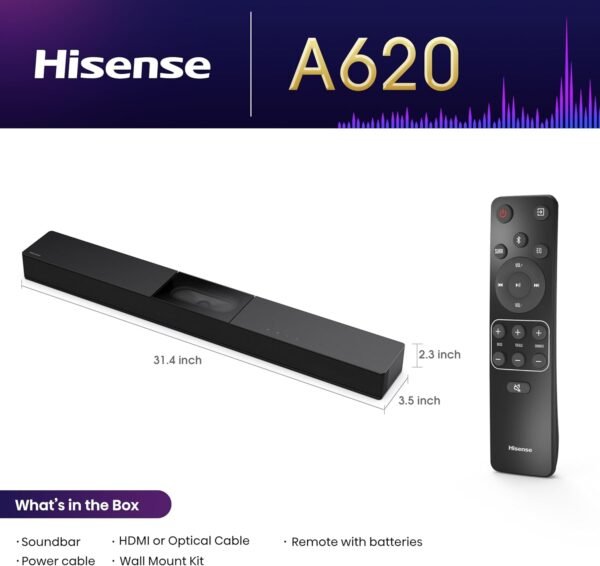
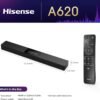
The A620 is a single bar 2.1 channel soundbar with the low frequency driver integrated into the bar itself rather than supplied as a separate wireless subwoofer. The listing gives the dimensions as 31.5 inches wide by 4.1 inches high by 2.4 inches deep, a weight of 7.68 pounds, a speaker size of 4.75 inches, Bluetooth connectivity, a USB port, and a style field describing it as 240W with built-in subwoofer. It ships with an HDMI cable, a remote control and two AAA batteries, and was listed in July 2024 with a one year warranty.
The buyer this suits is someone who wants to improve television sound with the least possible disruption: one box, one cable, nothing else on the floor. That is a genuinely large audience, and integrating the bass driver into the bar is the design choice that serves it. Anyone who wants deeper bass and has floor space should choose a bar with a separate subwoofer such as the Hisense AX3120G or the TCL Q6510.
What a Built-in Subwoofer Means
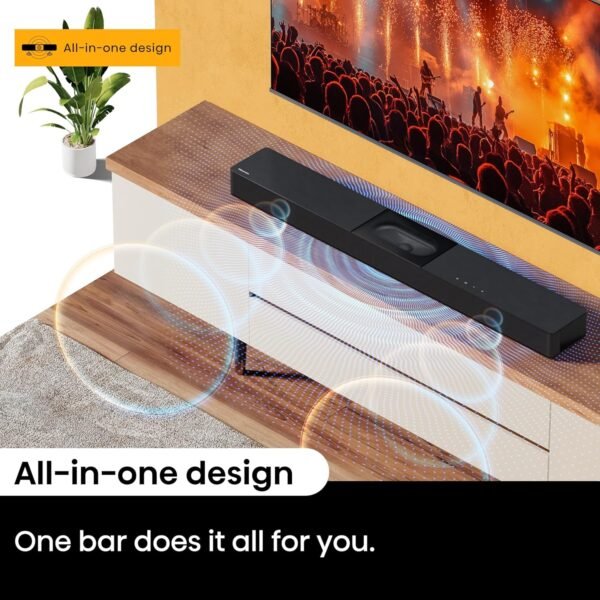
The 2.1 designation means two main channels plus a low frequency channel. In this product all three sit inside the same enclosure, which is the important distinction from most bars sold as 2.1.
The advantage is entirely practical. A separate subwoofer needs floor space, a mains outlet and a wireless pairing that occasionally drops. An integrated design removes all three problems and reduces the installation to placing one bar and running one cable. For an apartment, a bedroom or a room where a subwoofer box would be unwelcome, that is a real benefit.
The limitation is physics. Low frequency output depends on how much air a driver can move and how much enclosure volume sits behind it. A bar 4.1 inches high and 2.4 inches deep has very little internal volume, so the bass extension available from a built-in driver is fundamentally less than a standalone subwoofer cabinet can produce. Buyers should expect fuller sound than a television’s own speakers and should not expect the low end that a separate subwoofer delivers.
The 240W Figure and the 4.75 Inch Driver
The wattage appears only in a style field rather than as a formal specification, and as with every soundbar rating the listing does not say whether it is continuous or peak power. It positions the product rather than measuring it.
The listed speaker size of 4.75 inches is more informative. In a bar of these dimensions, that figure most likely refers to the bass driver, and a 4.75 inch driver in a slim enclosure is a reasonable compromise for a built-in design. The listing does not describe the main channel drivers, tweeters or crossover arrangement at all.
Connections, Control and What Is Missing
An HDMI cable is included, which points at HDMI ARC as the intended connection: the television handles all sources and sends audio back to the bar over one cable. That is the simplest installation available and the correct approach for this product’s audience. A USB port is listed as a special feature, though the listing does not say whether it supports media playback, service use or power.
Bluetooth handles wireless streaming from a phone, tablet or laptop, and the listing names those as compatible devices. Control is by the supplied remote, with two AAA batteries included, and the mounting type is listed as bar mount.
The gaps in this listing are substantial. There is no manufacturer description and no feature bullets at all, so everything above comes from the attribute table. Critically, the listing does not document any audio format support. Dolby Digital, DTS and any virtual surround processing are simply absent from the product data, so a buyer wanting confirmation of format decoding will not find it here and should check Hisense’s own specification.
Also missing: the number of HDMI ports, whether eARC is supported, whether an optical input exists, the Bluetooth version, whether wall mounting hardware is included, and any customer rating information. The subwoofer connectivity field says wired, which is consistent with an integrated driver but is not a meaningful specification.
Highlights
- Integrated bass driver, so there is no separate subwoofer box to place or power.
- Slim at 4.1 inches high and 2.4 inches deep, which suits placement in front of a television.
- HDMI cable and remote with batteries included, so no extra purchases are needed.
- Bluetooth streaming from phones, tablets and laptops.
- 31.5 inch width, well matched to televisions of roughly 43 to 55 inches.
- One year manufacturer warranty stated in the listing.
Things To Consider
Bass extension is limited by the enclosure. An integrated design cannot match a separate subwoofer, and buyers whose main complaint about television sound is a lack of weight should consider a bar with an external sub instead.
The listing documents no audio format support. Dolby and DTS decoding are not mentioned anywhere in the product data, which is a significant gap for a home theater product.
There is no manufacturer description, no feature bullets and no customer rating data. The technical picture rests entirely on an attribute table that describes only the basics.
The number of HDMI ports, eARC support and the presence of an optical input are all unstated, and those determine how the bar fits into an existing setup. The 240W figure is unqualified. Buyers should compare across the sound bars category, including dialogue focused designs such as the ZVOX AV157 and compact options such as the Yamaha SR-C20A, and should look at the subwoofers category if low end output is the priority.
Who Should Buy It and Who Should Not
The A620 fits someone who wants a straightforward upgrade over television speakers with a single box and a single cable, who has no space or appetite for a subwoofer, and who values simplicity over specification. The included HDMI cable and remote make it a complete purchase.
It is the wrong soundbar for anyone who wants real low frequency impact, for a buyer who needs confirmed Dolby or DTS decoding before purchase, or for a room where surround sound is the goal. Those buyers should look at a system with separate rears and a subwoofer, such as the Samsung HW-T400 for a simpler alternative or a full 5.1 package.