Description
What the Orange Crush Bass 25 Is and Who It Suits
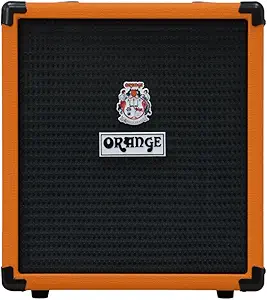
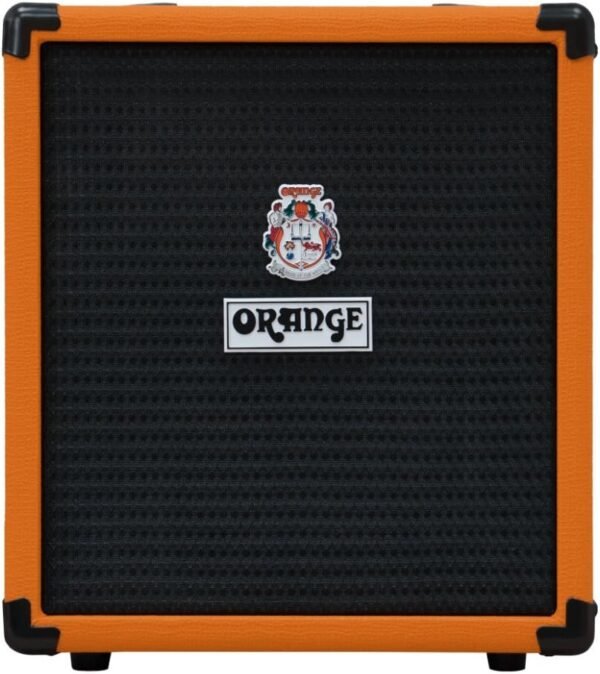
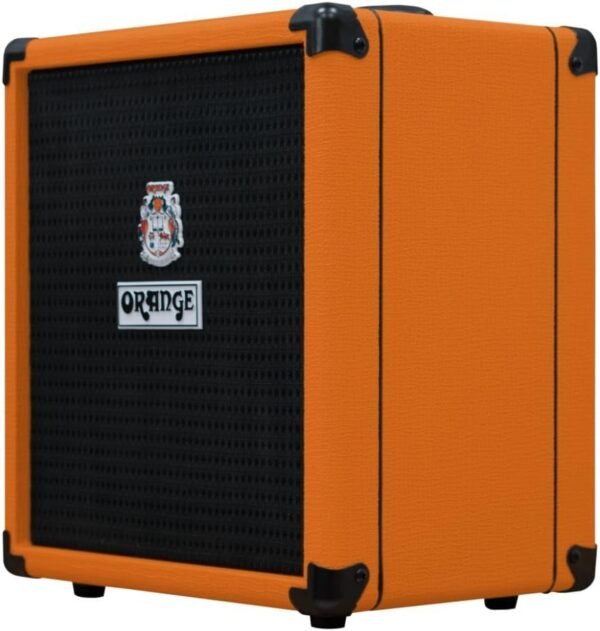
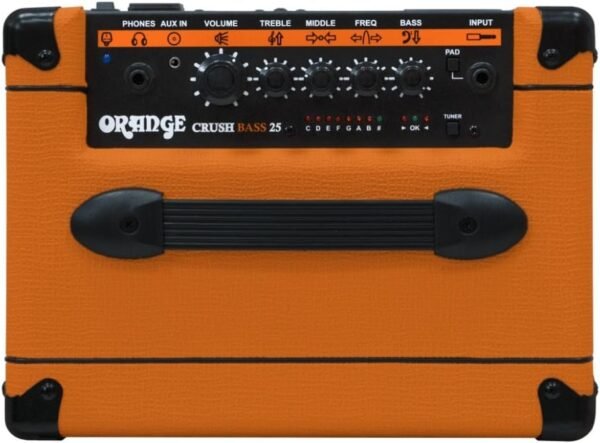
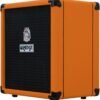
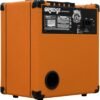
The Crush Bass 25 is a compact solid state bass combo amplifier: an amplifier and a speaker in one cabinet. Orange rates it at 25 watts driving an 8 inch speaker in a ported reflex enclosure, with an all analog signal path and a three band EQ. The listing gives the weight as 18.3 pounds, the dimensions as 18 by 11 by 17 inches, the connector as a quarter inch jack and the compatible instruments as bass and double bass. It was listed in October 2018 and shows only 3 ratings at an average of 5.0 stars.
The buyer this suits is a bassist practicing at home, taking lessons, or rehearsing quietly. Twenty five watts through an 8 inch speaker is a practice amplifier, and honest expectation setting matters here: bass needs far more power than guitar to reach the same perceived volume, so a 25 watt bass amp is quieter in practical terms than a 25 watt guitar amp such as the Vox AC4C1-12. Anyone playing with a drummer needs considerably more.
One categorization note: this site files the product under cabinets, and Amazon’s own ranking places it in bass guitar amplifier cabinets. That is misleading. A cabinet contains speakers only and requires a separate amplifier head. This is a combo, with the amplifier built in, and it belongs alongside other combo amps.
The All Analog Signal Path
Orange states the signal path is entirely analog, which in a market full of modeling amplifiers is a deliberate positioning choice rather than a limitation. An analog path means no digital conversion, no modeled amplifier voices and no effects processing; what the amplifier does is amplify and shape the instrument signal directly.
The practical consequences cut both ways. There are no presets to build, no menus and no firmware, so the amplifier does one thing and does it immediately. There is also no versatility beyond the tone controls, no built in effects, and no direct output modeling for recording. Orange describes the resulting sound as fat and rounded, which is consistent with the brand’s general voicing across its range.
The Sweepable Mid Control
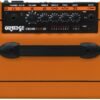
The most interesting feature on this amplifier is the mid band control, which sweeps from 300Hz at one extreme to 2.7kHz at the other. That deserves explanation, because it is unusual at this size.
A conventional three band EQ has fixed bass, mid and treble bands. The mid control raises or lowers a preset frequency range, and the player has no say in which range that is. A sweepable mid lets the player choose the center frequency being adjusted, which changes what the control actually does. At 300Hz it works on the lower midrange where a bass sits against a kick drum; at 2.7kHz it works on string attack and definition.
Orange states this gives greater control than a traditional EQ, and that is accurate rather than marketing. For a bass player, midrange is where the instrument either cuts through a mix or disappears into it, so control over which midrange is being shaped is genuinely useful.
Cabinet, Power and Practical Use
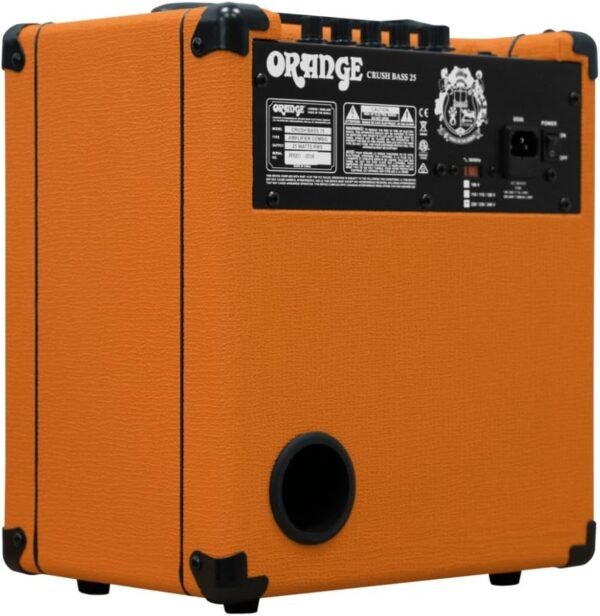
The 8 inch speaker sits in a cabinet with a reflex port, which Orange states improves low end response. Porting is the standard technique for extending bass output from a small enclosure, and on a bass amplifier it does meaningful work, because the fundamental of the low E string sits at around 41Hz and a small sealed box cannot approach that.
Twenty five watts and an 8 inch driver together define the ceiling. This will fill a bedroom or a small practice room and will hold its own against an acoustic guitar or a quiet drummer. It will not compete with a full band at volume, and pushing it there produces distortion rather than volume.
The stated compatibility with double bass is worth noting. Upright bass has a different output characteristic and often uses a piezo pickup with high impedance, so amplifier compatibility is not automatic. Orange listing it explicitly is helpful for players in that position, though the listing does not confirm the input impedance.
The listing is otherwise thin. There is no feature bullet section at all, and the description text contains an obvious error, describing the amplifier as housing an 8 inch speaker port with a reflex port, apparently conflating the speaker and the port. There is no headphone output stated, no aux input for practicing along with music, no direct or line output for recording, and no information about a footswitch. Those are the features that most affect a practice amplifier’s usefulness, and none are documented.
Highlights
- All analog signal path with no digital conversion or modeling.
- Sweepable mid control from 300Hz to 2.7kHz, unusual at this size.
- 8 inch speaker in a ported reflex cabinet for extended low end.
- Stated compatibility with both bass guitar and double bass.
- Compact and manageable at 18.3 pounds.
- Orange’s distinctive appearance and voicing in an entry level format.
Things To Consider
Three customer ratings is effectively no sample at all. A 5.0 average from three reviews tells a buyer nothing about reliability or consistency.
Twenty five watts is a practice level for bass. Anyone intending to rehearse with a drummer will find it insufficient, and no EQ setting compensates for a lack of power.
The listing does not confirm a headphone output, an aux input or a line output. For a practice amplifier those are the three most useful features, and their absence from the documentation is a real gap.
The description contains a transcription error conflating the speaker with the port, and the product is categorized as a cabinet when it is a combo. Players wanting something even smaller should compare the Orange Crush Mini or the LEKATO mini amplifier, though both are guitar rather than bass amplifiers. A bassist wanting a direct recording path should look at a preamplifier such as the Tone Hammer instead.
Who Should Buy It and Who Should Not
The Crush Bass 25 fits a bassist who practices at home, values a simple analog amplifier with genuinely useful tone shaping, and does not need effects or modeling. The sweepable mid is the feature that justifies it over cheaper practice amplifiers, and the double bass compatibility widens its audience.
It is the wrong amplifier for band rehearsal, for gigging, or for anyone who needs a direct output for recording or a headphone jack for silent practice, since neither is documented. Players in those situations should look at higher powered combos or at a preamplifier and powered cabinet approach such as the Behringer Eurolive B210D.