

Description
What the Xvive A58 Is and Who It Suits
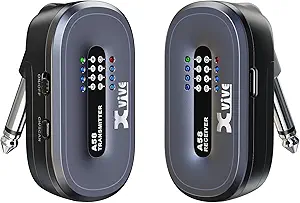
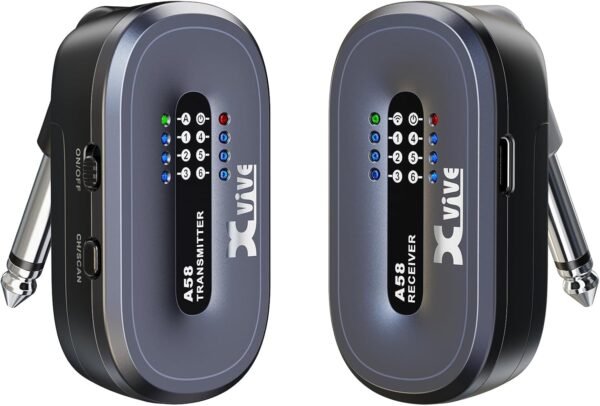
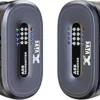
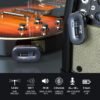
The A58 is a wireless system for guitar and bass: a transmitter plugs into the instrument jack, a receiver plugs into the amplifier, and the cable between them disappears. The listing gives the weight as 3.2 ounces, the dimensions as 2.7 by 2.2 by 2 inches, the color as black, and states that two rechargeable lithium ion batteries are included. It was listed in June 2024 with a country of origin of China, and it ranks inside the top twenty in Amazon’s wireless microphone transmitter and receiver category, which indicates real sales rather than a marginal listing.
The buyer this suits is a guitarist who moves on stage, a player who is tired of tripping over a cable at rehearsal, or anyone playing in a space where cable routing is awkward. It is also useful for practice: a wireless link means the player can sit anywhere in a room relative to the amplifier. Players wanting a wireless system for voice rather than instrument should look at the RODE Wireless PRO or the Godox Magic XT1 instead.
What a Guitar Wireless System Has To Get Right
Three things determine whether an instrument wireless system is usable, and it is worth stating them plainly because this listing documents none of them.
The first is latency. A guitar signal converted to digital, transmitted and converted back takes time, and a player hears the result through the amplifier. Delay above a few milliseconds is perceptible and interferes with timing, which is why wireless systems publish latency figures and why cheap systems are often unusable for anything demanding.
The second is dynamic range and frequency response. A guitar pickup produces a wide dynamic signal, and a transmission system that compresses it changes the instrument’s response to playing dynamics. Systems aimed at players publish bit depth and sample rate for this reason.
The third is impedance matching. Passive magnetic pickups expect to see a high impedance load, and a transmitter that presents the wrong impedance changes the tone, usually by dulling the top end. Systems designed for guitar handle this; generic wireless systems often do not.
Range and Battery Life
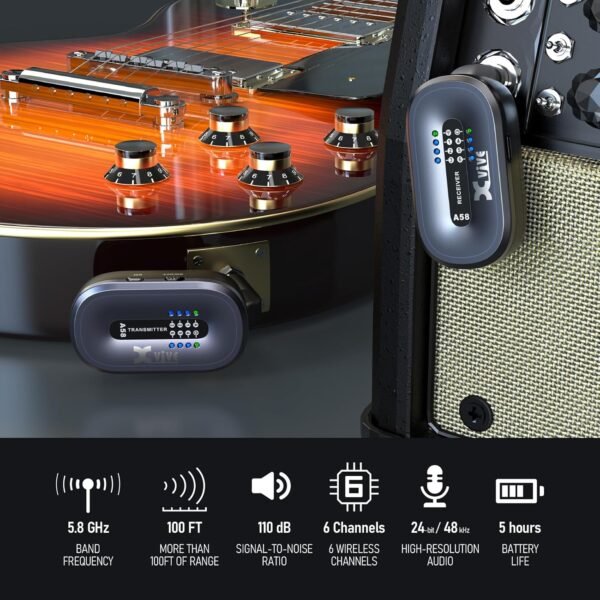
Two further specifications matter in use. Range determines how far a player can move from the receiver, and on a stage that means line of sight across a venue rather than through walls. Battery life determines whether the system lasts a rehearsal or a full set, and rechargeable systems are normally quoted with both a runtime and a quick charge figure.
Neither appears in this listing. The only battery information given is that two lithium ion batteries are included, one presumably in each unit.
What This Listing Does and Does Not Publish
This is the most sparsely documented listing in this section of the catalog, and being direct about that is more useful than filling the gaps with assumption.
There is no product title in the Amazon data, no manufacturer description and no feature bullets at all. The attribute table contains eleven fields, and most of them are administrative: ASIN, model number, availability date, country of origin, color and battery type. The only substantive entries are the physical dimensions, the weight and the fact that two lithium ion batteries are included.
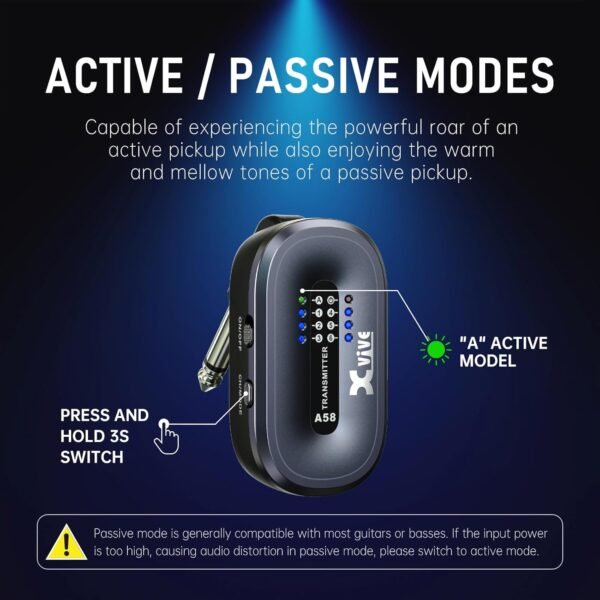
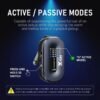
Nothing states the operating frequency band, the transmission range, the latency, the audio resolution, the battery runtime, the charging method or time, the number of available channels for avoiding interference, whether the system supports active and passive pickups, or what the connector orientation is. Connector orientation matters more than it sounds: guitars have jack sockets on the face, the edge or the side, and a transmitter that cannot rotate will not fit every instrument.
There is also no customer rating data in the product record. The high category ranking suggests the product sells well, but that is a sales signal rather than a quality one.
Buyers should obtain the specification from Xvive directly before purchase. The company publishes full figures for its wireless range, and the A58 is a current product, so the information exists; it simply is not on this listing.
Highlights
- Removes the instrument cable between guitar and amplifier, in a very small package.
- Compact at 2.7 by 2.2 by 2 inches and 3.2 ounces per the listing.
- Rechargeable lithium ion batteries included rather than disposable cells.
- Suited to both electric and acoustic instruments with a standard quarter inch jack.
- High ranking in its Amazon category, indicating consistent sales.
- Recent product, first listed in June 2024.
Things To Consider
The listing publishes no range, no latency, no battery runtime and no audio resolution. Those are the four specifications that determine whether a wireless system is usable, and none are available here.
Connector orientation is not documented. Guitars vary in jack placement, and a transmitter that does not rotate will not fit every instrument comfortably, particularly Stratocaster style angled jacks and acoustic guitars with endpin sockets.
There is no customer rating data in the product record, so there is no owner feedback to assess against.
Wireless systems operating in shared frequency bands can suffer interference in venues where several are in use, and the listing does not state how many channels are available or how they are selected. A player using a floor processor such as the Boss GX-100 or the Valeton GP-100 should also confirm where in the signal chain the receiver belongs. Comparable products can be found in the wireless microphone transmitters and receivers category.
Who Should Buy It and Who Should Not
The A58 fits a guitarist who wants freedom from a cable at rehearsals or on small stages, in the smallest possible package, and who is willing to obtain the technical specification from the manufacturer rather than the marketplace listing. Xvive is an established name in compact guitar wireless and the product sells steadily.
It is a difficult recommendation for anyone who needs to compare latency and range figures before buying, for a player working in venues where interference is likely, or for anyone whose guitar has an unusual jack orientation. Those buyers should verify compatibility and specifications first, or use a cable.