



Description
What the Aftershokz OpenRun Is and Who It Suits
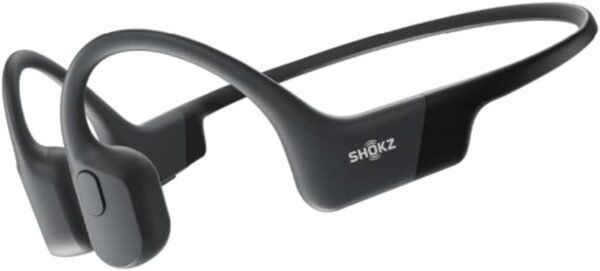
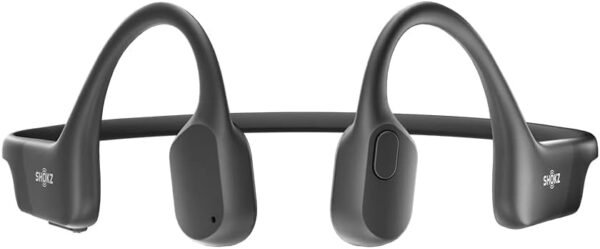
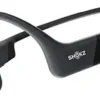
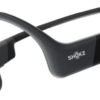
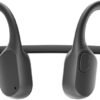
The OpenRun is a bone conduction headphone, which means it does not go in or over the ears at all. Transducers rest on the cheekbones just in front of the ears and transmit sound through the skull to the inner ear, leaving the ear canals completely open. The listing gives the model number as S803, the weight as 0.917 ounces, which is the 26 grams the manufacturer description states, and an IP67 rating. It was listed in March 2022 with 410 ratings at an average of 4.5 stars.
The buyer this suits is a runner, cyclist or outdoor athlete who needs to hear traffic, other people and their surroundings while listening. This is a safety driven purchase more than an audio driven one. Anyone who wants isolation and sound quality should be looking at conventional earbuds such as the JLab Epic Air Sport ANC 3, which seal the ear and block outside noise entirely.
How Bone Conduction Works and What It Trades
Sound normally travels through the air, into the ear canal, and vibrates the eardrum. Bone conduction skips that path: the transducer vibrates the skull directly, and those vibrations reach the cochlea without passing through the outer or middle ear. The result is audible sound with the ears entirely unobstructed.
The trade is significant and should be stated honestly. Bone conduction cannot produce the low frequency response of a sealed earbud, because generating bass through bone requires far more energy than through air, and the energy that does get delivered is felt as vibration on the face. Aftershokz addresses this by tilting the transducers 30 degrees against the face, which the manufacturer states allows more bass dynamic range with less vibration sensation. That is a design response to a real limitation rather than a claim that the limitation is gone.
Sound leakage is the second trade. Because the transducers vibrate against the outside of the head, people nearby can hear what is playing, particularly at higher volumes. In a quiet office or on public transport that is a genuine problem, and it is why this design belongs outdoors.
The IP67 Rating
IP67 is a specific and meaningful rating rather than a marketing word. The 6 covers complete dust protection, and the 7 covers immersion in one meter of water for thirty minutes. For a running headphone that means rain, heavy sweat and accidental submersion are all within scope, and it is a considerably stronger rating than the unqualified water resistant claims common across this category.
It is worth noting that IP67 does not cover swimming. Sustained submersion, water pressure at depth and chlorine or salt exposure are outside the test conditions, and the manufacturer sells separate products for swimming use.
Fit, Comfort and Practical Use
The wraparound band sits behind the head and over the tops of the ears, holding the transducers against the cheekbones by spring tension. That design has two consequences. It stays in place through running, cycling and gym work far more reliably than any in-ear design, because retention does not depend on ear canal geometry. And it is a fixed size, so head shape determines fit rather than interchangeable tips.
Twenty six grams is light for a headphone with a full band, and weight is the main comfort factor over a long run. The band also means these can be worn with sunglasses and most hats, though it conflicts with some helmet retention systems and with anything worn tight at the back of the head.
The listing is thin beyond this. The manufacturer description is written entirely in capital letters and makes an unverifiable comparative claim about audio quality relative to other bone conduction products, which should be read as marketing. There are no feature bullets at all.
Critically, the listing does not state the battery life, the charging method, the charging time, the Bluetooth version, whether multipoint connection is supported, or whether a quick charge function exists. Battery life is the specification a runner most needs, and its absence from this listing is a real gap. The listing also does not confirm whether a microphone is included for calls, which is standard on this product family. The product dimensions of 9.45 by 27.17 by 0.98 inches are not credible for a headphone worn on a human head and appear to be a data error.
Highlights
- Open ear design that leaves the ear canals unobstructed for situational awareness.
- IP67 dust and immersion rating, a genuine specification rather than an unqualified claim.
- Light at 26 grams with a wraparound band that stays put during exercise.
- Transducers tilted 30 degrees, which the manufacturer states reduces vibration sensation.
- No ear tips to lose or size, so fit does not depend on ear canal shape.
- 410 ratings at 4.5 stars, a reasonable feedback base.
Things To Consider
Bass response is limited by the physics of bone conduction. Anyone expecting the low end of a sealed earbud will be disappointed, and no amount of tuning changes that.
Sound leaks to people nearby. These are outdoor headphones, and using them in a quiet shared space is inconsiderate rather than merely suboptimal.
The listing does not state battery life, charging time, Bluetooth version or microphone capability. For a running headphone, runtime is the number that matters most, and it is simply absent.
The manufacturer description is in capitals and makes an unverifiable superiority claim, and the listed product dimensions are impossible. The brand has also since been renamed to Shokz, so buyers searching for support or accessories under Aftershokz may find the naming confusing. Anyone wanting a similar open ear approach without bone conduction should look at the open-ear headphones category and the MINISO MS162, or at a clip on design such as the Koss KSC35.
Who Should Buy It and Who Should Not
The OpenRun fits a runner or cyclist who trains on roads and needs to hear traffic, or anyone who finds in-ear headphones uncomfortable over long periods. The IP67 rating and the secure band make it genuinely suited to hard outdoor use, and situational awareness is a safety benefit that no sealed earbud can offer. Shoppers can compare it against sealed alternatives across the earbud headphones category.
It is the wrong purchase for anyone who wants bass, for use in offices, libraries or on public transport where leakage is a problem, or for swimming. It is also difficult to recommend without confirming the battery life independently, since this listing does not state it.