Description
What the Arturia PolyBrute Is and Who It Suits
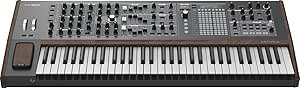
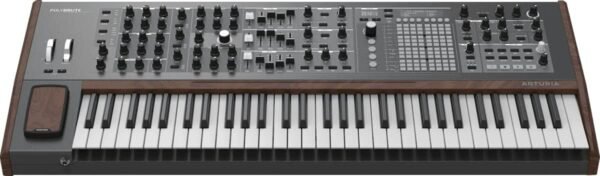
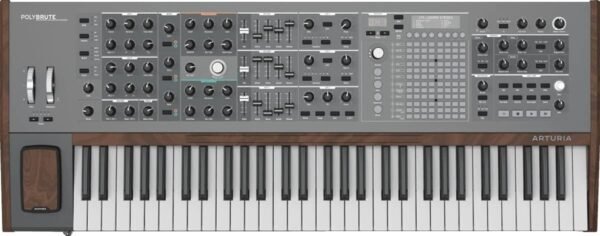
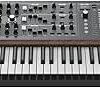
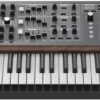
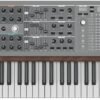
The PolyBrute is a six voice polyphonic analog synthesizer built around the idea of morphing: every preset has two complete states, and the instrument can move continuously between them. Arturia fits a 61 note keyboard with velocity and aftertouch, a wood body, and a set of physical controllers that includes a ribbon and a three dimensional touch and pressure pad called the Morphee. The listing gives the weight as 46 pounds and the dimensions as 44.37 by 18.98 by 8.46 inches, in a natural wood finish, first listed in September 2020 with 12 ratings at an average of 4.4 stars.
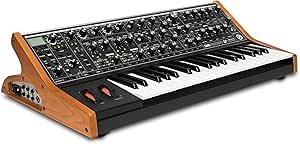
The buyer this suits is a serious electronic musician or sound designer who wants a true analog polysynth as a centerpiece instrument. This is a large, expensive, deep instrument, and it is not a first synthesizer. Someone wanting analog monophonic character should look at the Moog Subsequent 37, and someone who needs a production workstation rather than a synthesizer should compare the Akai MPC Key 61.
One note on categorization: this site files the PolyBrute under tabletop synthesizers, and Amazon’s own ranking does the same. That is incorrect. A 61 key instrument weighing 46 pounds is a keyboard synthesizer, not a tabletop module, and buyers browsing for desktop units will find it out of place.
Six Voices of Analog Polyphony
Polyphony is the specification that separates this from most analog synthesizers on the market. Six voices means six notes can sound simultaneously, each with its own complete analog signal path. That is expensive to build, because every voice needs its own oscillators, filter and amplifier circuitry, which is why analog polysynths cost several times what analog monosynths do.
Arturia offers three voicing modes. Mono uses one voice, Unison stacks all six on a single note for maximum thickness, and Poly distributes them across played notes. Single, Split and Layer modes then determine how presets are assigned across the keyboard: Split places two sounds on different key ranges, and Layer stacks them, at the cost of dividing the six voices between them.
Morphing and the Modulation Matrix
Sound morphing is the instrument’s defining concept. Each preset holds a part A and a part B, and the PolyBrute interpolates between them across every parameter simultaneously. That is fundamentally different from switching presets or crossfading two sounds: the synthesizer moves through the intermediate states, so the transition itself becomes a musical event.
The 12 by 32 modulation matrix is what makes deep sound design possible. A modulation matrix connects sources such as envelopes, LFOs and controllers to destinations such as filter cutoff, oscillator pitch and effect parameters. Twelve sources against thirty two destinations is a large matrix by hardware standards, and it means routings that would require patch cables on a modular system can be made in software on the panel.
Alongside it sits a 64 step polyphonic sequencer. Polyphonic sequencing, as opposed to monophonic, means chords and multi note patterns can be sequenced rather than only single note lines, which suits an instrument with six voices.
Physical Controllers and Build
Arturia lists four expressive controllers: a pitch bend wheel, a modulation wheel, a ribbon controller and the Morphee. The Morphee is the unusual one, a pad that responds to position on two axes plus pressure, giving three simultaneous dimensions of control from one gesture. Assigned through the modulation matrix, that allows a performer to move several parameters at once in a way that no combination of knobs permits.
A ribbon controller provides continuous position sensing along a strip, historically used for pitch glides and filter sweeps. Together with velocity and aftertouch on the keyboard, the instrument offers an unusually rich set of real time control surfaces.
The wood body and polished finish are part of the positioning. At 46 pounds and 44 inches wide this is furniture as much as equipment, and it needs a dedicated stand or table. Moving it is a considered operation rather than a casual one.
The listing is thin beyond the five bullets. There is no manufacturer description, and no specification appears for the oscillator count per voice, the filter types, the effects section, the connection panel, MIDI implementation, or whether a sustain pedal input and CV connections are provided. For an instrument at this level those omissions matter, and buyers should work from Arturia’s own documentation. Twelve customer ratings is also a very small sample.
Highlights
- Six voices of true analog polyphony, each with a complete signal path.
- Morphing between two complete preset states across all parameters simultaneously.
- 61 keys with velocity and aftertouch, plus Split and Layer modes.
- Morphee three dimensional touch and pressure controller alongside a ribbon.
- 12 by 32 modulation matrix for extensive routing without patch cables.
- 64 step polyphonic sequencer, so chords can be sequenced as well as single lines.
Things To Consider
Six voices is polyphonic but not generous. Layering two presets halves that to three notes each, and players used to digital instruments with 128 note polyphony will find the limit noticeable when using sustain.
The instrument is large and heavy at 46 pounds and 44 inches wide. It needs dedicated space and is not a portable performance keyboard.
Twelve customer ratings is far too small a sample to say anything about reliability, and analog instruments with many voice cards have more components that can drift or fail than digital equivalents.
The listing documents almost nothing beyond the five bullets: no oscillator, filter, effects, connection or MIDI detail appears. The category placement under tabletop synthesizers is also wrong. Buyers should browse both the tabletop synthesizers and synthesizer and workstation keyboards categories, since instruments of this type appear in both, and should compare against stage instruments such as the Roland RD-88 EX if playability matters more than synthesis.
Who Should Buy It and Who Should Not
The PolyBrute fits an experienced electronic musician who wants an analog polysynth with a genuinely distinctive concept behind it, and who will use the morphing and the modulation matrix rather than playing presets. The controller set is among the most expressive available on a production instrument.
It is the wrong instrument for a beginner, for anyone who needs portability, or for a player whose main requirement is a wide palette of ready made sounds. A drummer or producer building a hybrid rig would be better served by a module such as the Roland TD-11 alongside a simpler keyboard.