Description
What the Boss DD-8 Is and Who It Suits
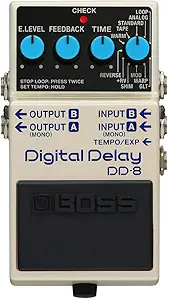
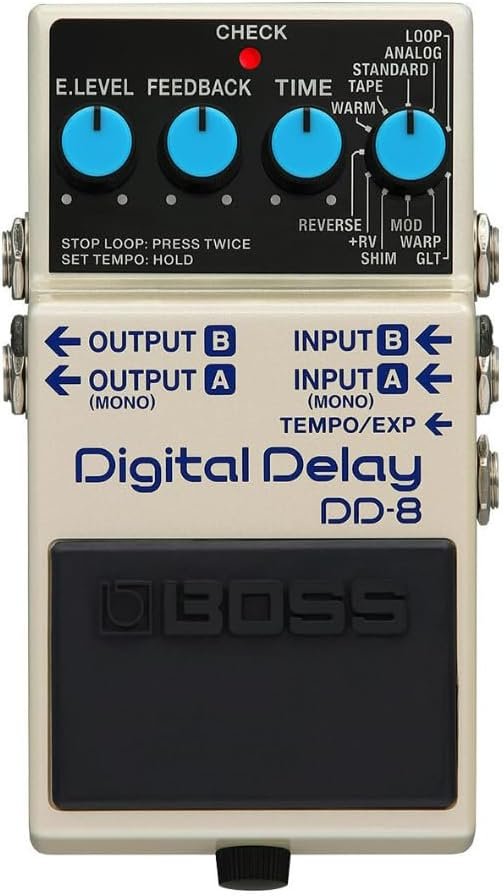
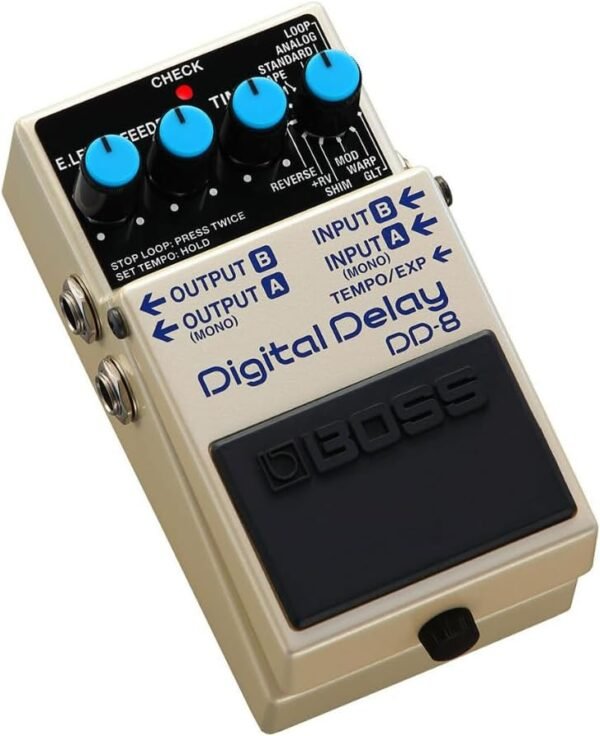
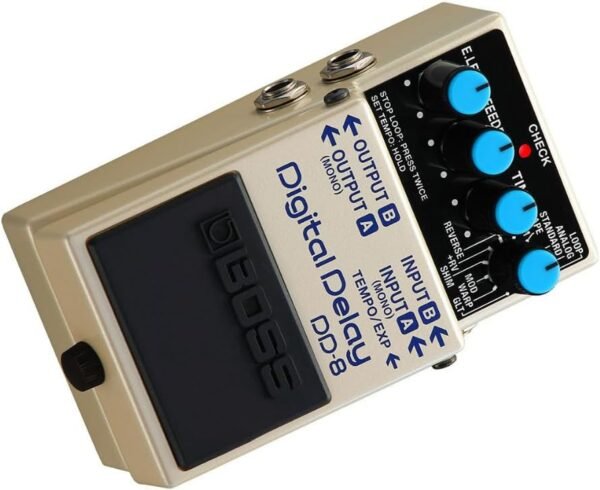
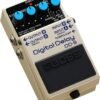
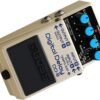
The Boss DD-8 is a compact digital delay pedal. The listing describes eleven modes, three delay types, full stereo input and output support, a built-in looper and external control support. It runs on 9 volts, comes in black, and first became available in September 2019. The DD series is one of the longest running product lines in guitar effects, and the DD-8 continues a design lineage that dates back to the early 1980s.
Delay is arguably the most useful effect after distortion, because it does two entirely different jobs. A short delay thickens a sound and adds space; a long delay creates rhythmic repeats that become part of the composition. The buyer is any guitarist building a pedalboard, from a beginner adding a first time based effect to a professional wanting a reliable workhorse. Players looking at larger multi effect units instead should compare the Boss GX-100 and the TC Electronic Plethora X3.
Eleven Modes and Three Delay Types
The three delay types are the important structural feature. Digital delay reproduces the repeats faithfully, which suits precise rhythmic work. Analog delay emulation degrades each repeat, rolling off high frequencies so the echoes fall away into the background, which is why it sits better under a busy mix. Tape delay emulation adds the pitch wobble and saturation of a mechanical tape machine, which is a strong character rather than a neutral effect.
The eleven modes layer additional behaviors on top: reverse, modulation, shimmer style effects and dedicated settings for specific playing situations. Boss does not itemize them in this listing, so the full list should come from the manual. What matters practically is that one compact pedal covers the range that once required three, which is a real saving in pedalboard space and power. Players who want an amp and cabinet sound in the same format can read the Boss IR-2.
Stereo Operation and the Looper
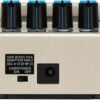
Full stereo input and output is a more significant feature than it appears on a compact pedal. In stereo, the delay repeats can be spread across two amplifiers or two channels of a recording, which creates a sense of width that mono delay cannot. It also means the pedal can be placed in a stereo signal chain without collapsing everything after it back to mono, which is the usual problem when adding a mono pedal to a stereo rig.
The built-in looper is the second feature worth having. A looper records a phrase and repeats it, which turns a practice session into playing along with oneself and allows a solo performer to build layers live. Having it inside the delay pedal rather than as a separate box saves space and power, at the cost of the longer record times and multiple track features a dedicated looper offers. External control support allows a footswitch or an expression pedal to be added for tap tempo or real time parameter control, which is how delay is actually used on stage. Players building a fuller board can look at the delay and reverb category.
Format, Power and Pedalboard Integration
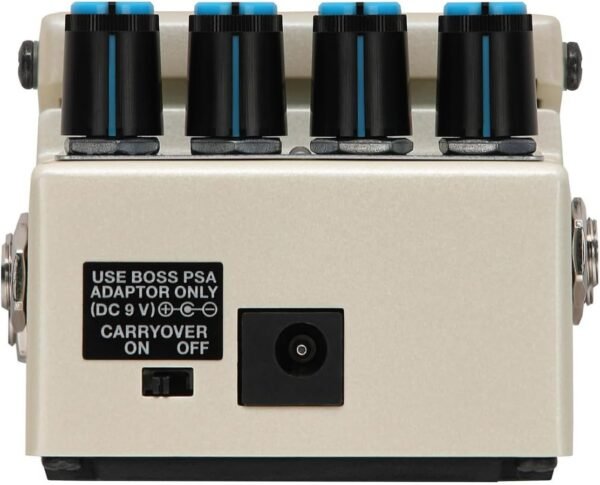
The DD-8 uses the standard Boss compact enclosure, which is the most widely copied pedal format in existence and for good reason: it is small, it is close to indestructible, and its dimensions are what every pedalboard and every power supply is designed around. Voltage is listed as 9 volts, the pedalboard standard.
Digital pedals draw more current than analog ones, and a stereo digital delay with a looper draws more than most. Anyone adding this to a crowded board should check the current requirement in the manual against the available milliamps on each output of their power supply, because an overloaded supply produces noise rather than a clean failure. The listing shows a 4.6 star rating across 257 ratings, which is a strong score on a reasonable sample. Guitarists comparing across the floor multieffects section will find both simpler and more elaborate options.
Highlights
- Eleven delay modes covering digital, analog and tape emulations.
- Full stereo input and output, so it fits a stereo rig without collapsing it.
- Built-in looper for practice and for solo performance layering.
- External control support for tap tempo and expression pedal use.
- Standard Boss compact enclosure that fits any pedalboard.
- Carries a 4.6 star rating across 257 ratings on the source listing.
Things To Consider
The specification block contains several plain errors. Item Weight is listed as 0.01 ounces, which is impossible for a metal enclosure pedal and is off by several orders of magnitude. Signal Format is listed as Analog on a pedal whose name and function are both digital. Product Dimensions of 7 x 3 x 5 inches describe the retail package rather than the compact enclosure. The power fields also contradict each other: Batteries reads 1 9V battery required and included, while Power Source reads Corded Electric, and both appear alongside a Voltage entry of 9 volts. In practice a pedal of this kind accepts either a battery or a 9 volt adapter, but the listing states it confusingly.
The listing also omits the specifications a buyer might want: the maximum delay time, the number of storable presets, whether the looper’s record time is stated, the sample rate and bit depth of the digital path, and the current draw. Maximum delay time and looper record time in particular decide whether the pedal suits a specific use.
Practically, the limitations of the format apply. A compact pedal with many modes means fewer physical knobs than functions, so some parameters are accessed by holding or combining controls, which is slower on stage than a dedicated control. An onboard looper in a delay pedal is a convenience rather than a replacement for a dedicated unit. And a digital pedal on a crowded board needs its power budget checked.
Who Should Buy It, and Who Should Not
This suits a guitarist who wants one reliable delay covering digital, analog and tape characters, with stereo capability and a looper included, in a format that fits any board. For most players building a first serious pedalboard, a pedal in this line is the default choice for good reason.
It does not suit a player who wants deep editing with a screen and stored presets, or one who needs a dedicated looper with long record times and multiple tracks. Those players should look at a floor multi effects unit or a separate looper pedal instead.