
Description
What the Klipsch The Three Plus Is and Who It Suits
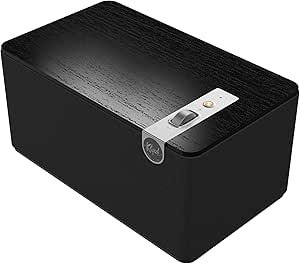
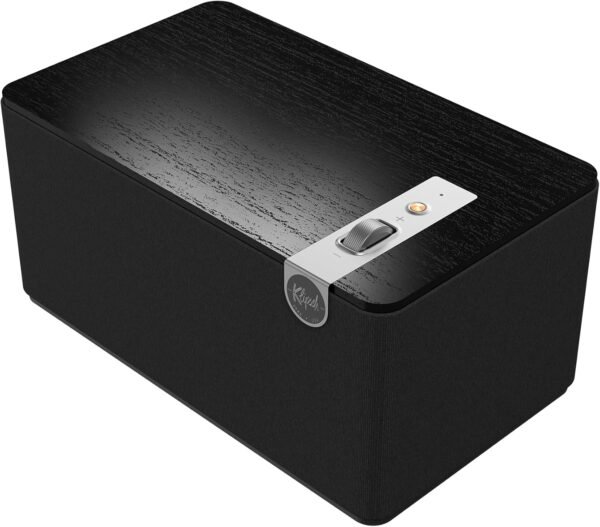
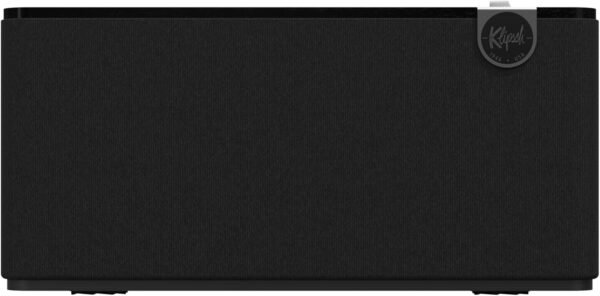
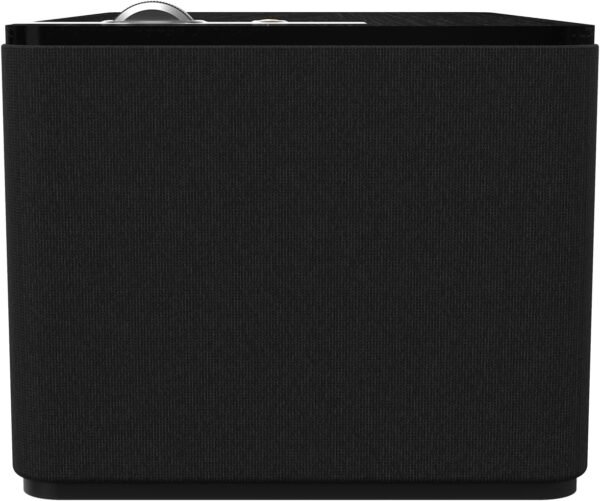
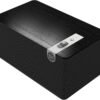
The Three Plus is a one piece tabletop speaker system rather than a portable Bluetooth speaker. It runs from mains power, weighs 10.58 pounds, measures 14 inches wide by 8.39 inches deep by 7 inches high, and is finished in real wood veneer with tactile switches and knobs. Klipsch describes it as Heritage Inspired, drawing on the design language of Paul W. Klipsch. The listing shows 147 ratings at an average of 4.3 stars since June 2023, with a country of origin of China.
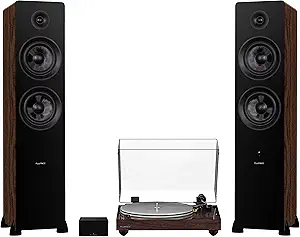
The buyer this suits is someone who wants one attractive box on a sideboard that handles both streaming and a turntable, without building a system from separates. The phono input is the feature that distinguishes it. Anyone wanting a portable speaker should look at the portable Bluetooth speakers category instead, since this has no battery. Anyone building a separates system around a turntable should compare the Fluance RT85N package.
The Driver Arrangement and Biamplification
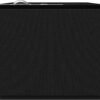
Klipsch specifies dual 2.25 inch full range drivers handling the stereo channels and a 5.25 inch high excursion woofer handling the low end, giving the 2.1 configuration. The system is biamplified, meaning separate amplifier sections drive the full range drivers and the woofer rather than one amplifier feeding a passive crossover.
Biamplification matters more than it sounds. It allows each amplifier to be matched to the drivers it feeds, and it moves the crossover to the low level signal stage where filtering is more precise and loses no power. In a compact cabinet with limited internal volume, that control over how the woofer is driven is one of the few levers available.
The physical limit still applies. A 5.25 inch woofer in a 14 by 8 inch cabinet cannot reach genuinely deep bass, and the stereo separation available from two drivers 14 inches apart is inherently narrow. Klipsch positions the product on filling larger spaces with bold sound, which is a fair claim relative to smaller tabletop speakers and not a claim about matching separate stereo speakers.
Phono Input and Turntable Use
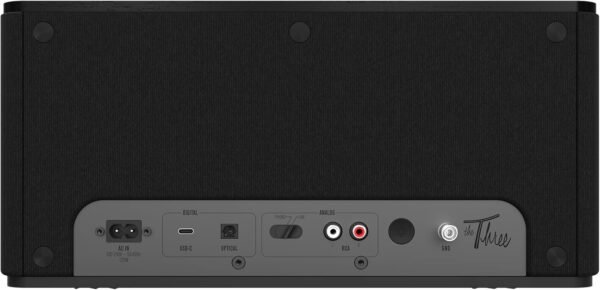
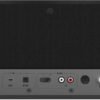
The phono and RCA inputs are the reason this product appears in a turntable context. A turntable cartridge produces a very small signal with a heavy equalization curve applied, and it needs a phono preamplifier before any normal amplifier can use it. Many turntables now include one; many do not, and buyers frequently discover this after purchase.
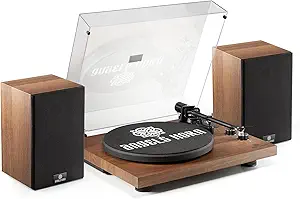
Having a phono input built into the speaker removes that problem entirely. A turntable with no internal preamplifier connects directly, and the system works. This is a genuinely useful piece of integration and it is why the product is filed here, though it should be understood that this is a speaker system with a phono input rather than a turntable. Buyers browsing the turntables category will not find a record player in this box. A separate deck such as the ANGELS HORN H00501 is what supplies that half of the system.
Connectivity, App Control and Multi Speaker Use
Bluetooth 5.3 handles wireless streaming. Here the listing contradicts itself: the marketing bullet states up to 40 feet of distance from the source, while the specification table gives the Bluetooth range as 10 meters, which is about 33 feet. Both are open space figures and neither will be achieved through walls, so the discrepancy is academic in practice.
USB-C is listed for both playback and reverse charging, so a phone can play through the speaker over a cable and draw power from it at the same time. That is an unusual and practical inclusion on a mains powered speaker.
The Klipsch Connect app provides EQ adjustment, preset saving and firmware updates. App based EQ is meaningful on a compact speaker, because room placement has a large effect on perceived bass and a tabletop speaker is usually pushed against a wall.
Broadcast Mode allows more than ten units to be linked wirelessly into one system. As with all such features the headline number is a ceiling rather than a realistic home deployment, but linking two units in different rooms is a genuine use case.
Two listing errors deserve mention. The color is written as Matter Black rather than Matte Black. A specific uses field contains a bracketed placeholder reading general use as a high quality speaker system for music playback, which is template text rather than product data. The speaker type is listed as component, which does not describe an active all in one system.
Highlights
- Built in phono input, so a turntable without a preamplifier connects directly.
- Biamplified 2.1 design with dual 2.25 inch drivers and a 5.25 inch woofer.
- Real wood veneer cabinet with physical switches and knobs.
- Bluetooth 5.3 plus USB-C playback with reverse charging for a phone.
- Klipsch Connect app for EQ adjustment, presets and firmware updates.
- Broadcast Mode for linking multiple units across rooms.
Things To Consider
This is not a portable speaker. It runs on mains power with no battery, and at 10.58 pounds it is designed to stay on a surface.
Stereo separation is limited by a 14 inch cabinet. Two drivers that close together cannot produce a wide stereo image, which is the inherent constraint of every one box system.
The listing contradicts itself on Bluetooth range, gives the color as Matter Black, and contains placeholder text in a specific uses field. The speaker type field is also wrong.
No amplifier power rating, frequency response or input list beyond phono, RCA, USB-C and Bluetooth is published. Whether an optical or 3.5 mm input exists is unstated, and the included components list mentions only the speaker itself, so cables are presumably not supplied. Buyers comparing similar one box systems should look at the Klipsch The One Plus and the Marshall Acton III.
Who Should Buy It and Who Should Not
The Three Plus fits someone who wants one good looking box that plays records and streams, who values real wood and physical controls, and who has a mains outlet where they intend to put it. The phono input, the biamplification and the app EQ together make it a more considered product than most tabletop speakers.
It is the wrong purchase for anyone who wants portability, genuine stereo imaging, or deep bass. Those buyers should build a system from a turntable, an amplifier and separate speakers, accepting the extra complexity and space in exchange.