


Description
What the Woburn III Is
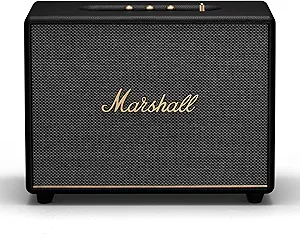
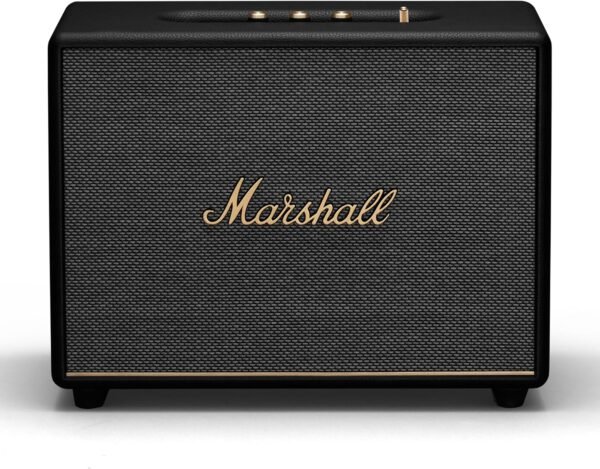
The Marshall Woburn III is the largest speaker in the Marshall home range, a mains powered stereo unit styled after the company’s guitar amplifiers. The visual language is the point as much as the audio: textured vinyl covering, the salt and pepper fret cloth, the script logo, and a brass plate on the front etched with the year 1962 in reference to the founding of the amplifier business. It is designed to sit on a sideboard as a piece of furniture, not to be carried around.
That distinction matters because of how this product is filed. It appears in the portable Bluetooth speakers category on this site, but the Woburn III has no battery and ships with a mains lead. It is a mains powered home speaker in the same class as the Klipsch The One Plus, and the smaller Marshall Acton III is the compact member of the same family. Anyone shopping for something to take outdoors should look elsewhere.
Sound Layout and Controls
Marshall describes this generation as having a re engineered, wider stereo soundstage than the previous one, which is the main audio claim made for the III. A single cabinet producing stereo has a physical limit set by how far apart the drivers can be, and the Woburn is the largest speaker in the range precisely because that width buys separation. The listing gives the cabinet as 15.75 inches wide by 7.99 deep by 12.48 high, weighing 16.4 pounds, with a 5.25 inch woofer size listed.
Control is offered two ways. Analogue knobs on the top panel handle volume, bass and treble in the manner of an amplifier control panel, which is both an aesthetic decision and a practical one, since adjusting tone by hand is faster than opening an app. The Marshall Bluetooth app provides the same adjustments plus presets. Having both is the right approach: the physical controls make the speaker usable by anyone in the room, and the app handles firmware and finer settings. Owners connecting a record player through the 3.5 mm input will find relevant options in the turntables category, though a turntable will need its own phono stage first.
Materials and Environmental Design
Marshall gives real detail on the environmental side, which is unusual enough to be worth reporting precisely. The listing states the home range takes a more sustainable approach with a PVC free build comprising 70 percent recycled plastic and using only vegan materials. Those are specific, checkable claims rather than vague language about being green, and the vegan materials point in particular replaces the leatherette that older Marshall speakers used for their covering.
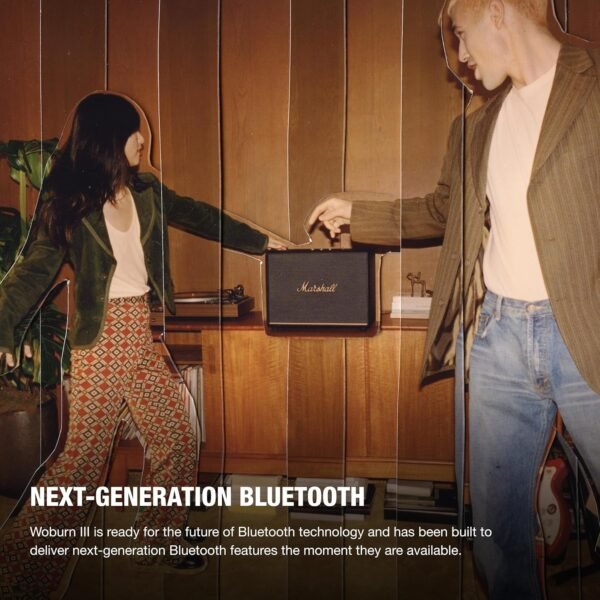
Connection is stated as Bluetooth 5.2 alongside the 3.5 mm input, and Marshall describes the generation as built to deliver next generation Bluetooth features when they become available, which is a claim about future firmware rather than present capability and should be treated accordingly. Range is listed at 10 meters. At the time this listing data was captured it showed 331 ratings at an average of 4.5 stars, and the manufacturer is given as Zound Industries, which builds the Marshall branded consumer audio range under license.
Highlights
- Largest speaker in the Marshall home range, with a wider stereo soundstage than the previous generation.
- Analogue bass, treble and volume controls on the top panel.
- Marshall Bluetooth app for additional adjustment and presets.
- Bluetooth 5.2 plus a 3.5 mm input for wired sources.
- PVC free construction using 70 percent recycled plastic and vegan materials.
- Textured vinyl covering, salt and pepper fret and brass front plate.
- Mains lead, quick start guide and safety information included.
Things To Consider
The product description attached to this listing is for the wrong product. It refers throughout to the Woburn II, gives Bluetooth 5.0 with Qualcomm aptX, and specifies two 1 inch tweeters and dual 5.25 inch woofers driven by Class D amplifiers for a total of 110 watts. The feature bullets on the same page state Bluetooth 5.2. Those two accounts of the connection standard contradict each other directly, and the driver and power figures belong to the previous generation, so they cannot be relied on for the III. A buyer who needs the actual amplifier power and driver complement of the Woburn III should get them from Marshall rather than from this page.
The specification block adds further errors. It lists the power source as battery powered and states that one lithium polymer battery is required, on a speaker that ships with a mains lead and has no battery. It gives the surround sound channel configuration as 5.2, which is the Bluetooth version entered in the wrong field. It lists multi room audio as a special feature without explaining what protocol that uses.
On genuine limitations, this is a large, heavy, mains powered speaker that occupies a permanent position and needs a socket. There is no HDMI input, so it is not a television speaker. There is no battery, so it cannot be moved outside. The listing states it is not waterproof. And a single cabinet, however wide, cannot produce the separation of two speakers placed apart, so anyone whose priority is stereo imaging should consider a pair from the bookshelf speakers category and an amplifier instead.
Who It Suits
The Woburn III suits someone who wants one substantial speaker in a living room, values the Marshall appearance as much as the sound, and will use it in a fixed position with a mains socket nearby. The physical tone controls make it approachable, the 3.5 mm input keeps older sources usable, and the material specification is more transparent than most in this market.
It is the wrong choice for outdoor use, for anyone who needs a battery, and for anyone who wants a documented amplifier specification before buying, since this listing gives figures for the previous model. Buyers who want genuine portability should look at the Bose SoundLink Revolve+ II, and those who want more output for gatherings should compare the JBL PartyBox 310.