

Description
What the Anker A1383 Is and Who It Suits
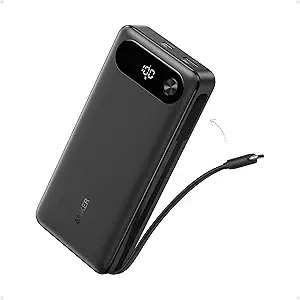
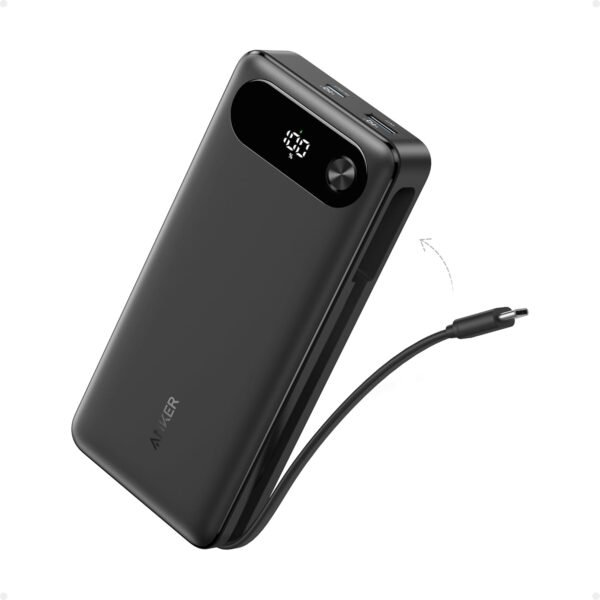
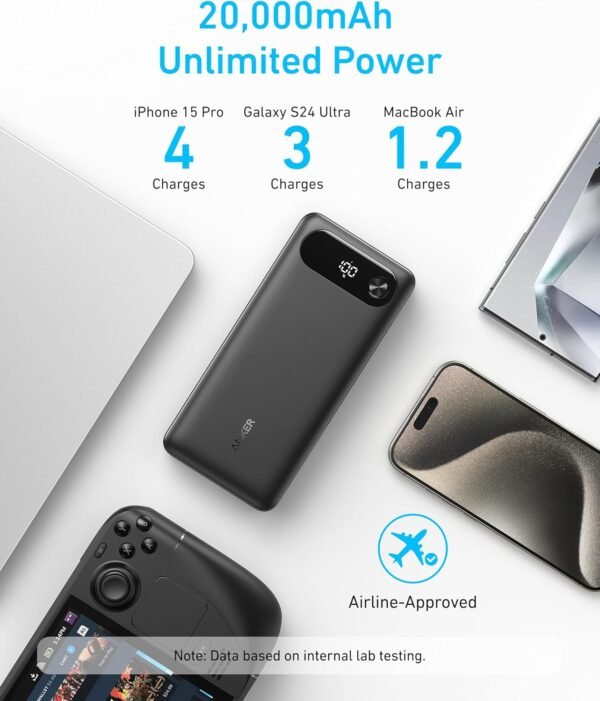
The Anker A1383 is a 20,000 mAh portable battery pack with three charging ports and a USB-C cable built into the body. Anker rates the total output at 87W, with a single connected device able to draw up to 65W. The listing gives the size as 6.22 by 1.02 by 2.91 inches and the weight as 15.2 ounces, first available in March 2024, with 3,254 ratings at an average of 4.6 stars.
It is worth stating plainly what this product is and is not. This is a phone and laptop charger, not an audio device. It appears here because portable audio gear is one of the things people carry a battery pack for, and because a speaker or a set of wireless earbuds is often the first thing to run flat on a long day out. Anyone shopping for sound should be looking at the portable Bluetooth speakers category instead. Anyone who already owns a speaker such as the Sony ULT Field 7 or a headset such as the Aftershokz OpenRun and wants to keep a phone alive alongside them is the practical audience.
Output, Ports and the 87W Rating
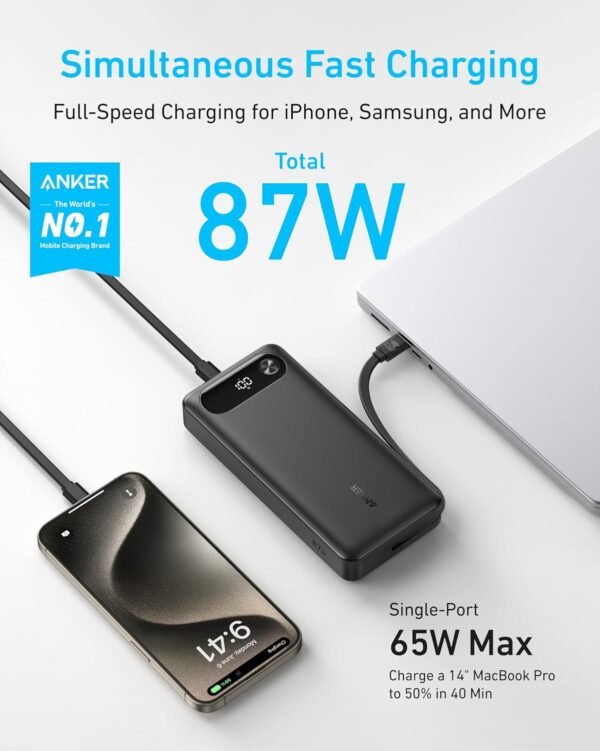
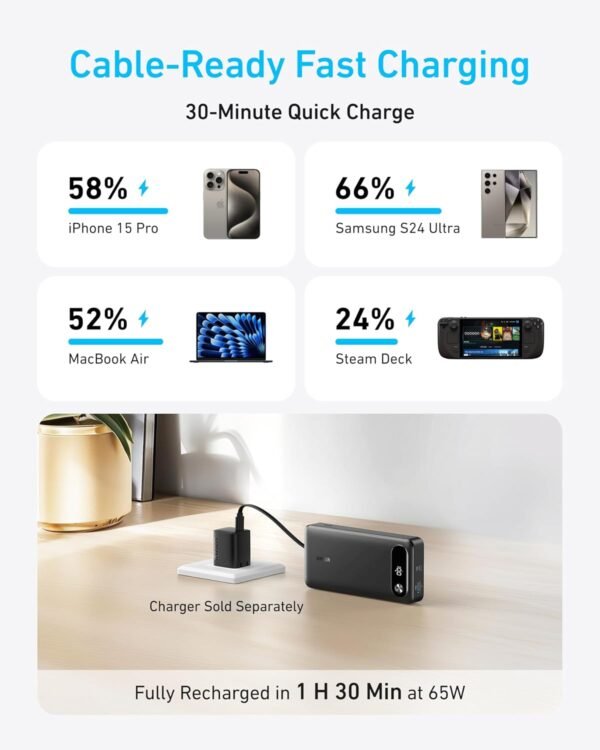
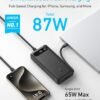
The 87W figure is a shared total, not a per port number, and Anker is clear about this. Distributed across three devices it will not deliver 87W to each. The number that matters for laptop users is the 65W single device maximum, which Anker illustrates by claiming a 14 inch MacBook Pro reaches 50 percent in under 40 minutes and a MacBook Air reaches 52 percent in 30 minutes using the built in cable.
For phones the relevant claim is that an iPhone 15 Pro reaches 58 percent in 30 minutes. All of these are manufacturer figures measured under conditions Anker does not fully describe, and real results vary with ambient temperature, the state of the device battery and whether the device is in use while charging. Treat them as an indication of class rather than a promise.
The Built In Cable
The integrated USB-C cable is the design decision that distinguishes this pack from the many otherwise similar 20,000 mAh units. It removes the most common failure point in practice, which is forgetting the cable rather than the battery. Anker rates the cable for more than 10,000 bends and designs it to stow into the body of the pack.
The tradeoff is that a built in cable is also a built in liability. If it fails, the convenience it provided is gone and the pack falls back to its loose ports. Anker does not state whether the cable is user replaceable, and nothing in the listing suggests it is. The 18 month warranty is the only stated protection.
Capacity, Recharge Time and Travel
Twenty thousand milliamp hours is a well chosen capacity point. It is enough for several full phone charges or a meaningful laptop top up, and it sits under the 100 watt hour threshold that airlines generally apply to lithium batteries in carry on baggage, which is why Anker describes the pack as approved for airline travel. Buyers should still confirm the rules with their own carrier, since airline policy is not something a product listing can settle.
Recharge time is quoted at roughly 1.5 hours with a 65W charger. That is fast for a pack of this size and matters more than it first appears, because a battery that takes six hours to refill effectively cannot be used on consecutive days without planning. The 65W charger required to hit that figure is not stated as included in the box.
At 15.2 ounces the pack is close to a pound. That is normal for the capacity and the power delivery on offer, but it is not a pocket device in any comfortable sense. It belongs in a bag, alongside whatever it is charging. Owners of USB-C powered listening gear such as the FiiO KA13 DAC dongle will find that a dongle amplifier draws from the phone battery, which is exactly the drain a pack like this is meant to offset.
Highlights
- 20,000 mAh capacity with 87W total output shared across three ports.
- 65W maximum to a single device, sufficient for mainstream USB-C laptops.
- USB-C cable integrated into the body and rated for over 10,000 bends.
- Approximately 1.5 hour recharge with a 65W charger, which is quick for the capacity.
- Sized under the common airline carry on limit for lithium batteries.
- 18 month warranty stated in the listing.
Things To Consider
The first consideration is category fit. This is a charging accessory on a site about audio, and buyers arriving here looking for sound gear are in the wrong place. It earns a mention only as a companion to portable audio.
The 87W headline invites misreading. Split across three devices the per port figure drops substantially, and Anker does not publish a breakdown of how the controller allocates power when all three ports are occupied. Anyone planning to charge a laptop and two phones at once should expect the laptop to slow down.
Charging speed claims are manufacturer measured. Percentages achieved in 30 or 40 minutes depend on the specific device, its thermal state and whether it is being used at the time. These figures are best treated as upper bounds.
The specifications list one lithium metal battery as required and included, which is almost certainly a listing data error, since packs of this type use lithium ion or lithium polymer cells. The listing also does not confirm whether the 65W charger needed for the fast recharge claim is supplied, nor whether the built in cable can be replaced if it wears out. Those are meaningful gaps for a product whose main selling point is that cable.
Who Should Buy It and Who Should Not
This pack suits a traveler who carries a USB-C laptop and a phone and wants one battery that handles both without a separate cable to lose. The recharge speed and the airline friendly capacity are the two features that justify it over cheaper packs. Someone running a portable speaker such as the JBL PartyBox 310 at an outdoor event will find it useful for keeping phones alive, though larger speakers with their own power bank output may make it redundant.
It is not for someone who only needs occasional phone top ups, where a smaller and lighter pack does the job for less weight. It is also not an audio purchase in any sense, and readers who arrived here looking for a speaker or headphones should treat it as a peripheral rather than a recommendation.