

Description
What the HIFIMAN SUSVARA Is and Who It Suits
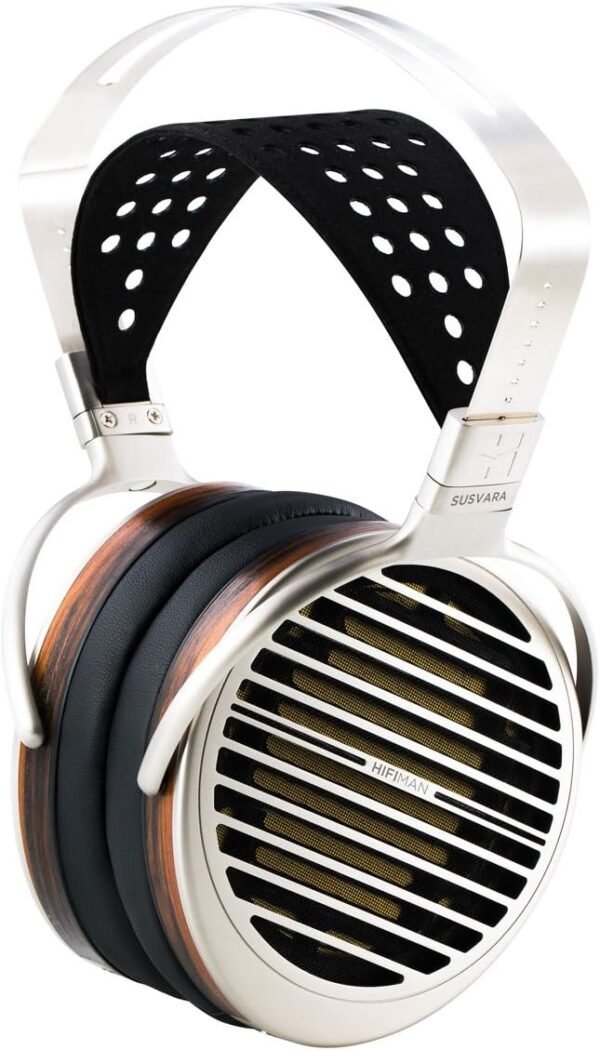
The SUSVARA is HIFIMAN’s flagship open back planar magnetic headphone, first listed in May 2017 and still positioned at the top of the company’s range. HIFIMAN specifies a frequency response of 20Hz to 20kHz, an impedance of 60 ohms, a sensitivity of 83 dB and a weight of 450g, which the listing also gives as 15.9 ounces. The driver is described as nanometer grade, with a diaphragm thinner than a millionth of a meter, paired with what HIFIMAN calls Stealth Magnets.
The audience is narrow and should be stated plainly. This is a headphone for a listener who already owns a serious desktop amplifier, listens in a quiet room, and is buying at the extreme end of the market. It is not a headphone for commuting, for office use, or for anyone plugging into a phone. Someone entering planar magnetic listening for the first time is far better served by something like the Monolith M1060, and a listener who needs isolation should be looking at closed back designs such as the Moondrop Joker instead.
The Driver and Magnet Design
HIFIMAN’s technical argument centers on two elements. The first is the Stealth Magnet structure, which the company describes as acoustically transparent, shaped to reduce the wave diffraction turbulence that occurs when sound passes back through a conventional magnet array. HIFIMAN states this reduces distortion and produces a purer result. The second is diaphragm mass: an extremely thin, low mass diaphragm can start and stop faster, which in principle yields low distortion alongside a dynamic response.
HIFIMAN also describes a Window Shade grille on the outer face of the earcup, optimized to avoid resonant frequencies while providing physical protection for the diaphragm. Open back headphones need an acoustically transparent outer face, and shaping that grille to avoid ringing is a real engineering concern rather than decoration.
These are manufacturer explanations of design intent. They describe what HIFIMAN set out to achieve, not a measured outcome, and nothing in the listing provides distortion figures or measurement data to support them.
The Amplification Requirement
The single most important number on the spec sheet is the 83 dB sensitivity. That is very low. Combined with a 60 ohm impedance, it means the SUSVARA needs substantially more voltage and current than a typical headphone to reach normal listening levels. A phone, a laptop headphone jack or a small dongle will not drive it properly, and the result of trying is thin, quiet sound rather than any indication of what the headphone can do.
A serious desktop unit such as the FiiO K9 Pro is the entry point of the conversation rather than the end of it, and many owners of this headphone pair it with speaker amplifiers. Anyone budgeting for the SUSVARA needs to budget for amplification in the same breath. Buyers can survey the options in the amplifiers category, but should treat headphone amplifier selection for an 83 dB planar as a specialist question.
Comfort, Build and Everyday Reality
HIFIMAN describes a special ergonomic design intended for extended listening. At 450g the SUSVARA is heavy in absolute terms, heavier than most closed back headphones, and weight distribution rather than raw mass is what determines comfort over hours. The listing offers no detail on the headband or pad materials beyond the ergonomic claim, so comfort is not something this page can characterize.
Being open back, the SUSVARA leaks sound in both directions. Anyone nearby will hear what is playing, and outside noise passes straight through. That is the design tradeoff open backs make in exchange for a wider soundstage, and it makes the headphone unusable in shared spaces. Wired only operation means no battery to manage but also means the listener is tethered to the amplifier.
Several attribute fields on this listing are simply wrong and are worth naming. The specification table lists a wireless communication technology of Bluetooth, a control method of touch, and a retractable cable feature. None of those apply to a passive wired headphone with no electronics. The frequency response field is also given as a bare 20000 Hz alongside the correct 20Hz to 20kHz range elsewhere in the same table.
Highlights
- Open back planar magnetic design with HIFIMAN’s Stealth Magnet structure and an ultra thin diaphragm.
- Frequency response quoted at 20Hz to 20kHz, with a 60 ohm impedance.
- Window Shade grille designed to avoid resonances while protecting the diaphragm.
- Ergonomic design intended by HIFIMAN for long listening sessions.
- Wired operation with a 3.5 mm connection listed, so there is no battery or codec to consider.
- Flagship status within the HIFIMAN range, with the company’s most advanced stated driver technology.
Things To Consider
The 83 dB sensitivity is a hard constraint, not a footnote. Without serious amplification this headphone cannot perform, and the total cost of a working setup is considerably higher than the headphone alone. Anyone unwilling to commit to that should not buy it.
Owner feedback is close to nonexistent. Seven ratings averaging 4.2 stars tells a prospective buyer nothing reliable about build quality, longevity or service. For a purchase at this level that absence matters.
The specification table contains several impossible entries, listed above, which means the listing cannot be trusted as a source of technical detail. Buyers should work from HIFIMAN’s own documentation.
Open back construction rules out any environment with other people in it, and the 450g weight is at the upper end for a headphone marketed on long session comfort. The listing also gives no information on cable length, connector type at the cup, replacement pad availability or warranty terms, all of which are meaningful for a headphone expected to last years. Finally, a product first listed in 2017 has a long history of revisions and regional variants that a single marketplace page does not distinguish between.
Who Should Buy It and Who Should Not
The SUSVARA is aimed at an experienced listener with a dedicated listening room and an amplifier chosen specifically to drive a low sensitivity planar. Someone in that position is buying a known quantity and understands the requirements. Listeners exploring the wider over-ear headphones category will find far more practical options at every other level.
It is emphatically not for a first serious headphone purchase, not for portable use, and not for anyone who intends to run it from a phone, a computer or a small dongle. Anyone in those situations should redirect the budget toward a headphone matched to their source, such as the FiiO FT3, or toward a planar in-ear design such as the SIVGA Nightingale.