Description
What the Voyager Focus 2 UC Is and Who It Suits
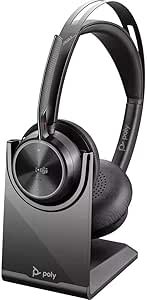
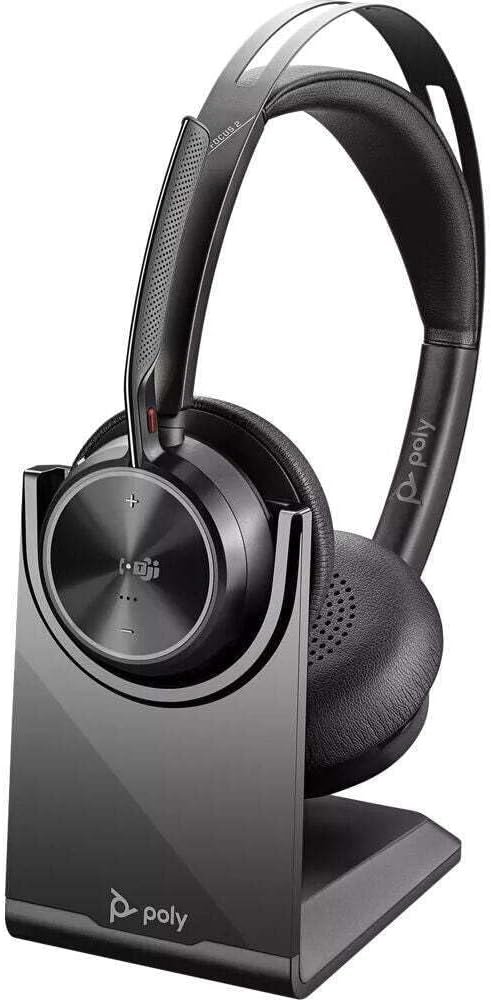
The Poly Voyager Focus 2 UC is a Bluetooth stereo headset built for office use, supplied with a charging stand and finished in black. Poly is the company formed from the merger of Plantronics and Polycom, and the Voyager line is its business headset family rather than a consumer music range. The UC suffix in the model name stands for unified communications, which is the industry term for the software platforms that carry business calls and meetings.
The buyer is someone who spends a large part of the working day on calls: a support agent, a salesperson, a recruiter, or anyone in a role where the headset is worn for hours rather than minutes. That is a different design brief from a music headphone. Microphone quality, all day comfort, mute controls and reliable connection to a computer matter more than bass extension. Readers comparing office headsets directly should look at the Jabra Evolve 65 MS and the Plantronics CS540, both of which target the same job.
Stereo, the Boom Microphone and Why Office Headsets Look Like This
Business headsets divide into mono and stereo versions, and the choice is not cosmetic. A mono headset covers one ear and leaves the other open, which suits a busy office where the wearer needs to hear colleagues. A stereo headset covers both, which suits concentration work and any situation where isolation helps. This model is a stereo headset, so it is the version for people who want to shut out a room.
The other defining feature of the category is the boom microphone. Placing a microphone on an arm close to the mouth rather than in the headband is the single biggest factor in call quality, because signal level falls sharply with distance and a close microphone needs far less gain, which means far less room noise gets amplified alongside the voice. A headset boom will outperform a laptop’s built-in microphone in almost every environment. Users who prefer a desk microphone instead can compare the Samson Meteor Mic.
The Charging Stand and Daily Workflow
The listing specifies that this version ships with a charging stand, and that detail is more significant than it sounds. A headset that lives on a stand gets charged automatically every time it is put down, which removes the single most common failure in headset ownership: reaching for the headset at the start of a call and finding it flat. A stand also gives the headset a permanent home on the desk instead of a drawer, which reduces the chance of it being damaged or lost.
The trade is desk space and portability. A stand is one more object on a crowded desk, and a headset bought as a stand version usually costs more than the same model supplied with a cable alone. For a fixed desk position the stand is worth it. For someone who moves between locations, a cable and a case are more useful. Buyers who need something that folds away instead should look at the Dell WH3022 Pro or browse the on-ear headphones section.
Connection, Compatibility and What to Verify
Business headsets connect in one of two ways, and this is the area where buyers most often order the wrong thing. Some connect over standard Bluetooth directly to a computer or phone. Others use a proprietary USB adapter that pairs with the headset and presents itself to the computer as an audio device, which is more reliable in offices with dense wireless traffic. Many models are sold in both forms with nearly identical names.
There is a second variable: certification. Headsets are certified for specific communication platforms, and a variant certified for one platform may have a dedicated button that does nothing on another. Before ordering, buyers should confirm both the connection method and the platform certification for the exact part number, using Poly’s own documentation. The listing here gives neither. Anyone building a home office setup around this can also look at the over-ear headphones category for alternatives.
Highlights
- Stereo office headset covering both ears for concentration work.
- Boom microphone positioned close to the mouth for call clarity.
- Supplied with a charging stand, so the headset charges whenever it is set down.
- Bluetooth connection to computers, phones and tablets.
- Part of Poly’s business range rather than a consumer music line.
- Black finish, listed as unisex.
Things To Consider
The most important limitation of this listing is what it does not contain. There is no specification block at all: no battery life, no talk time, no weight, no wireless range, no Bluetooth version, no microphone specification, no supported codecs and no dimensions. For an office headset, battery life and weight are the two figures that decide whether it can be worn through a working day, and neither is available here. Nothing in this review invents them. Buyers should obtain the full specification from Poly’s own documentation before purchase.
Beyond the missing data, several structural considerations apply to headsets of this class. They are optimized for voice rather than music, so the tuning generally favors clarity in the speech band over low frequency extension. The battery is not user replaceable, which sets a practical lifespan on the product measured in years of daily charging. Wireless headsets can suffer interference in offices with many competing devices, which is why the adapter based variants exist. And a boom microphone, however discreet, is visible on camera in a way some users dislike.
One further note on the product name. Poly sells several closely related models in this family with different suffixes covering the connection method and the platform certification, and the differences are easy to miss. Ordering by name alone is risky; the part number is the reliable identifier.
Who Should Buy It, and Who Should Not
This suits someone on calls for several hours a day at a fixed desk, who wants both ears covered, a proper boom microphone and a charging stand that removes the flat battery problem. In that role a dedicated business headset is a clear improvement over consumer earbuds.
It does not suit a music listener, since the whole design is voice first, and it does not suit someone who travels light, because the stand is dead weight away from a desk. Buyers in either position should look elsewhere, and those who mainly want good sound with occasional calls should consider a consumer over-ear model with a decent microphone instead.