



Description
What the Marshall Acton III Is and Who It Suits
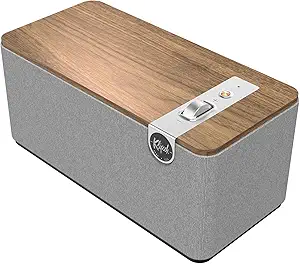
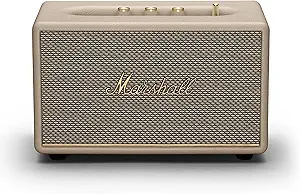
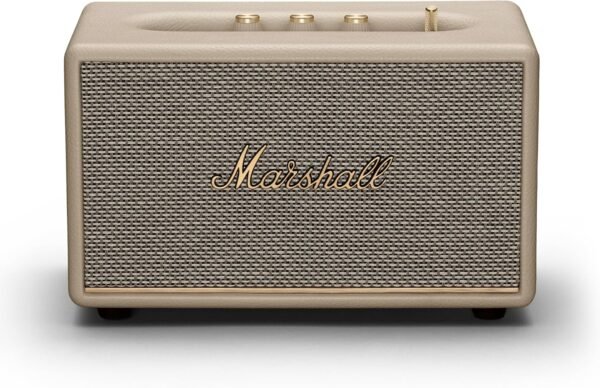
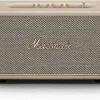
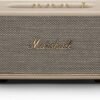
The Marshall Acton III is a mains powered Bluetooth speaker styled after the company’s guitar amplifiers. Marshall describes a wider soundstage than the previous generation, tweeters angled outward with updated waveguides, built-in Dynamic Loudness that adjusts tonal balance by volume, and Placement Compensation that corrects for nearby reflective surfaces. The listing gives a 4 inch woofer, a 0.75 inch tweeter diameter, a 2.0 channel configuration, a weight of 6 pounds, a 33 foot Bluetooth range, and multiple voltage compatibility from 100 to 240 volts. The finish here is cream and the manufacturer is listed as Zound Industries, which produces Marshall branded audio under license.
Despite sitting in the portable speakers category, this is not a portable speaker: it has no battery and runs from a wall outlet. The buyer is someone who wants one good looking speaker on a shelf, a sideboard or a kitchen counter, permanently plugged in. Buyers who want the same design language in a larger cabinet should compare the Marshall Woburn, and those weighing a different approach at similar size can read the Klipsch The One Plus.
Angled Tweeters and the Stereo Problem
Every one box stereo speaker faces the same difficulty. Stereo depends on the listener receiving different signals at each ear, and that requires the two channels to be physically separated. A cabinet ten inches wide places its left and right drivers a few inches apart, which is not enough separation to produce a convincing stereo image from a normal listening distance.
Marshall’s answer here is to angle the tweeters outward and add waveguides, which are shaped surfaces around a driver that control how sound spreads. Aiming the high frequencies away from the center widens the apparent source and reduces the sense that all the sound is coming from one small box. Marshall describes the result as sound so wide it chases the listener around the room, which is marketing language for a real engineering approach. It does not make a one box speaker into a stereo pair, but it does make it sound less like a point source. Readers who want genuine stereo separation need two cabinets, which is what the Klipsch R-51M provides.
Dynamic Loudness and Placement Compensation
Two processing features are named in Marshall’s description and both address real problems. Dynamic Loudness adjusts the tonal balance according to volume. This addresses a well documented property of human hearing: sensitivity to low and high frequencies falls faster than sensitivity to the midrange as sound gets quieter, which is why music played softly sounds thin. Compensating by lifting the extremes at low volume restores the balance the recording had.
Placement Compensation adjusts for nearby reflective surfaces. A speaker pushed against a wall or into a corner gains substantial low frequency reinforcement from the boundary, which is why the same speaker sounds boomy in a corner and thin in the open. Correcting for that in processing is genuinely useful in a product designed to sit wherever there is space. Neither feature is a substitute for good placement, but both reduce how much placement matters, and for a lifestyle speaker that is the right priority. The Bose Bluetooth speaker takes a similar approach to the same problem.
Controls, Connection and Everyday Use
Controller Type is listed as Button, and the Marshall home speakers carry physical knobs on the top panel for volume, bass and treble. That is a meaningful difference from app only control: adjusting tone with a knob is faster and does not require a phone, and it keeps working when the app is not updated. Included components are the speaker, a power cable, a quick start guide and safety information.
The listed Bluetooth range of 33 feet, given elsewhere as 10 meters, is the standard line of sight figure. Marshall’s description also states the product is ready for future Bluetooth features as they become available, which is a claim about firmware capability rather than a specification. Compatible devices are listed as laptops, MP3 players, desktops, tablets and smartphones. The wider portable Bluetooth speakers category covers the alternatives, including battery powered models for outdoor use.
Highlights
- Outward angled tweeters with waveguides to widen the apparent soundstage.
- Dynamic Loudness processing to keep tonal balance consistent at low volume.
- Placement Compensation for speakers positioned near walls or in corners.
- Physical knobs for volume, bass and treble on the top panel.
- Multiple voltage compatible from 100 to 240 volts, so it works internationally.
- Carries a 4.7 star rating across 1,248 ratings on the source listing.
Things To Consider
The category placement is the first thing to flag. This product sits under portable Bluetooth speakers, but Power Source is listed as Corded Electric and no battery appears anywhere in the specification. It is a mains powered home speaker. A buyer expecting to take it to a park or a beach will be disappointed, and this is the most consequential mismatch in the listing.
The specification block also has errors. Speaker Size is listed as 3.5 Millimeters, which is a connector size rather than a driver. Speaker Type is given as Bookshelf, which describes the shape more than the category. Subwoofer Connectivity Technology is listed as Wired on a product with no subwoofer. Product Dimensions read 10.24 inches deep by 5.91 inches wide by 6.69 inches high, and the depth and width appear to be transposed, since the cabinet is wider than it is deep in the product images.
On the product itself, the limitations are those of a single small cabinet. A 4 inch woofer sets a firm limit on bass extension regardless of processing. There is no battery, no water resistance and, according to this listing, no aux input among the included components, so Bluetooth is the connection. Stereo separation from a ten inch wide cabinet is limited whatever the tweeter angle. And the styling is a large part of the purchase, which is a legitimate reason to buy but should be recognized as such.
Who Should Buy It, and Who Should Not
This suits someone who wants one attractive speaker permanently plugged in on a shelf or a counter, who values physical tone controls, and who likes the look. The loudness and placement processing make it forgiving about where it ends up, which matters for a speaker chosen partly as furniture.
It does not suit anyone who needs portability, since there is no battery, and it does not suit a listener who wants real stereo imaging, which requires two separated cabinets. Buyers in the first group should look at a battery powered model, and those in the second should consider a pair of bookshelf speakers from the bookshelf speakers section with a small amplifier.