Description
What the Boss OD-200 Is
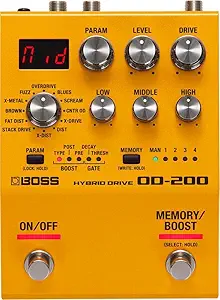
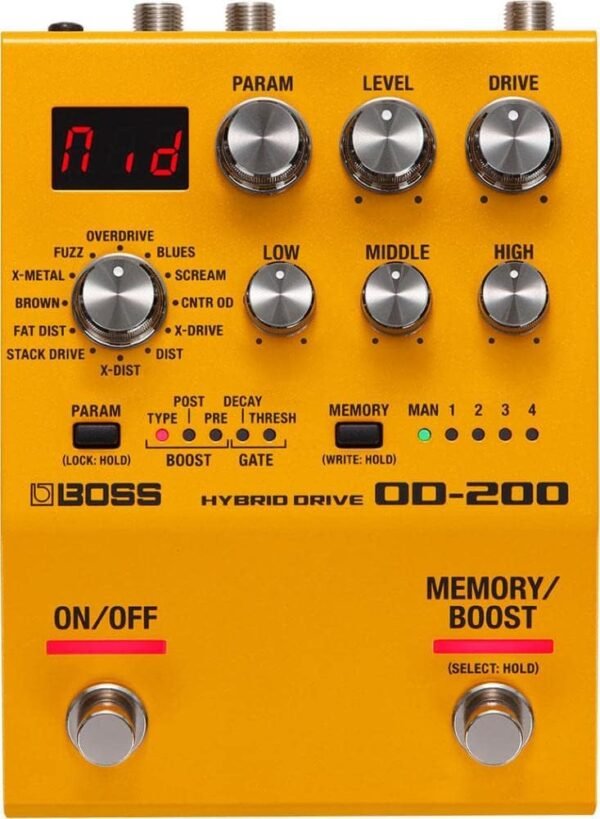
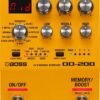
The Boss OD-200 is a compact overdrive and distortion pedal that packs twelve separate drive voicings into one enclosure, with MIDI input and output and a jack for an external expression pedal or footswitch. It belongs to the Boss 200 series, a line of pedals that sit between traditional single function stompboxes and full multi effects units: each one does a single job, but does it with the flexibility, presets and control options normally associated with a rack processor.
The word hybrid in the name refers to the mix of analog and digital circuitry. Boss uses analog gain stages where the character of the distortion is generated and digital control for the switching, tone shaping and preset recall. That approach is what allows twelve distinct voicings to exist in one box without twelve separate circuits, and it is why the pedal can be controlled over MIDI at all. The target player is someone who wants one drive pedal to cover an entire set rather than three or four separate ones, which is a very different proposition from a fixed circuit such as the Boss OC-5.
Twelve Drive Modes
Twelve modes is the headline number, and it is the reason a player would choose this over a conventional overdrive. In practice a range that wide has to cover several distinct territories: transparent low gain boost, classic mid pushed overdrive, amp like crunch, and high gain distortion. Having them selectable from one control means a guitarist can move between a blues tone and a metal tone without changing pedals or bending down to re patch anything mid set.
What the listing does not do is name the twelve modes, describe the controls, or state how many presets can be stored. That is a significant gap for a pedal whose entire value proposition rests on the breadth of those modes. Players who want to know exactly what they are buying should consult the Boss manual before ordering. Anyone comparing the one pedal approach against a full processor will find useful contrast in the floor multieffects category, where units such as the Boss GX-100 cover drive alongside modulation, delay and cabinet simulation.
MIDI and External Control
MIDI input and output on a drive pedal is genuinely uncommon, and it is the feature that separates the 200 series from almost everything else in the format. MIDI in allows a foot controller or a larger processor to recall settings on the OD-200 automatically as part of a song or patch change, so the drive tone follows the rest of the rig rather than being switched by hand. MIDI out means the pedal can pass messages along to the next device in a chain, which matters in a rig built around a central controller.
The expression pedal and footswitch input adds a second layer of control. An expression pedal can sweep a parameter in real time, while an external footswitch can be used for preset changes or for engaging a second mode without another MIDI device. Together those turn the OD-200 from a stompbox into a controllable component of a larger system. Players building a board around programmable devices should also look at the Boss IR-2 for the cabinet simulation side of the same approach.
Highlights
- Twelve drive modes in a single pedal, covering overdrive through to distortion.
- MIDI in and MIDI out, which is rare on a dedicated drive pedal.
- Expression pedal and footswitch input for external real time control.
- Hybrid analog and digital construction, with analog gain stages under digital control.
- Part of the Boss 200 series, designed to integrate with a controller based rig.
- Single purpose focus, so the entire control surface is devoted to drive.
Things To Consider
The listing itself is the weakest part of this product page. There is no product description, no dimensions, no weight, no power requirement, no current draw figure and no statement of what is in the box. For a pedal that will sit on a board with a shared power supply, current draw in milliamps is a practical necessity, and it is absent. There is also a typographical error in the feature list, which reads Overdrive slash Disttion rather than distortion, a small sign that the listing was assembled carelessly. Nothing on the page states what is in the box either, so a buyer cannot tell whether a power supply is supplied or has to be bought separately.
There is a categorization problem worth naming. This pedal is filed on this site under delay and reverb, but it is neither a delay nor a reverb; it is a drive pedal. That is a data issue rather than a product fault, and anyone browsing by category should be aware the classification does not describe the device.
On capability, a pedal with twelve modes and MIDI control has a menu system, and a menu system means a learning curve. Players who want to plug in, set three knobs and never think about it again will find a traditional single circuit overdrive faster to live with. The digital control layer also means the pedal needs a proper power supply rather than a battery, though the listing does not confirm the voltage or polarity. Anyone whose main need is a warm, simple boost may be better served by a straightforward stompbox and the money saved.
Who It Suits
The OD-200 fits a gigging guitarist who needs several distinct drive tones across a set, who already uses a MIDI controller or a larger processor, and who wants those tones to change automatically rather than by tap dancing. It also suits a player consolidating a board, since one pedal replacing three or four saves space, power outlets and patch cables.
It is a poor fit for a beginner, for a player who only ever uses one drive sound, and for anyone unwilling to read a manual. Those guitarists will get more out of a single circuit pedal, or out of a complete processor such as the Zoom G1X FOUR that covers drive alongside everything else for a similar outlay.