


Description
What the WSA-5RP Actually Is
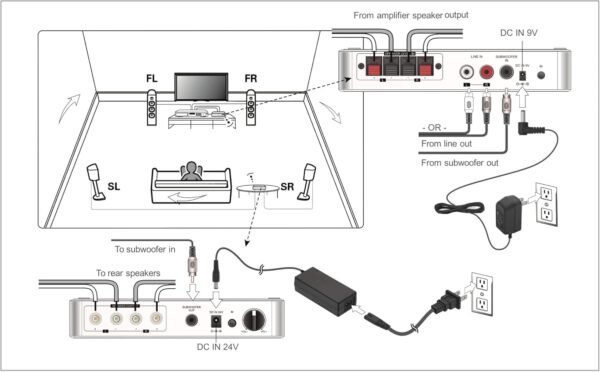
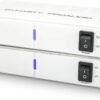
The Dynasty ProAudio WSA-5RP is a wireless audio link with an amplifier built into the receiving end. It is not a set of speakers, and the product name is easy to misread. What arrives is a transmitter that connects to an AV receiver at the front of the room and a receiver unit that sits at the back, amplifies the signal, and drives a pair of ordinary passive speakers that the buyer supplies. Understanding that is the single most important thing before purchase.
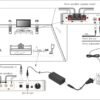
The problem it solves is the reason surround systems so often stop at 3.1: getting audio to the back of a room requires running speaker cable under a floor, around a doorway or along a skirting board, and in a rented or finished home that is often impossible. The WSA-5RP replaces that cable run with a radio link, so the rear speakers need only a mains socket rather than a cable back to the receiver. Anyone building a system this way will already own something like the Onkyo TX-RZ50 or the Pioneer Elite VSX-LX305 at the front of the chain.
The Wireless Link
Dynasty ProAudio specifies dual band operation on 5.2 GHz and 5.8 GHz, selectable by the user, with a total of 106 RF channels and automatic channel selection. The reason for that detail is interference. Home Wi-Fi networks occupy parts of the 5 GHz band, and a wireless audio link sharing that space will drop out when the network is busy. Offering two bands and a large pool of channels with automatic switching is the practical answer, and the company states the goal explicitly as avoiding interference with a 5G network.
The stated audio specification is 24 bit at 48 kHz, uncompressed, which the company describes as near lossless. That is a meaningful claim: many wireless audio links compress the signal to fit available bandwidth, and compression at the rear channels of a surround system introduces artifacts on exactly the effects the rear channels exist to carry. Transmission range is given as up to 100 feet, or 30 meters, line of sight. Real world range through walls will be shorter, and the line of sight qualifier is doing real work in that figure.
Amplifier and Connections
The receiver unit contains a Class D amplifier rated at 2 x 25 W RMS into 8 ohms or 2 x 50 W RMS into 4 ohms. Those are honest, specific figures with the load stated, which is more than many listings provide. Twenty five watts per channel is adequate for rear surround duty, where the channels carry effects and ambience rather than the main content, though it would be marginal for main speakers.
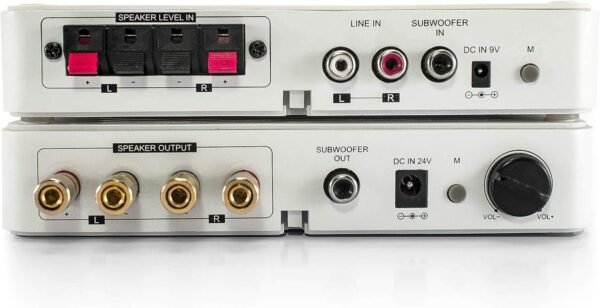
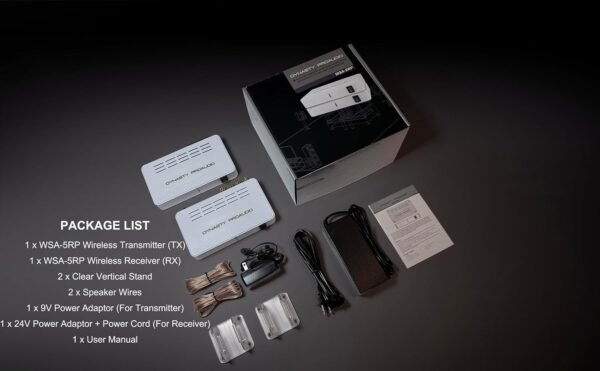
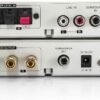
Input options cover both routes into the system. A speaker line level input accepts the output of an amplifier directly, which is how it connects to a receiver that has no rear pre outs, and a stereo RCA input accepts a line level signal from a receiver or preamp that does. There is also a mono subwoofer input and output, allowing a powered subwoofer to be placed at the back of the room on the same link. The transmitter and receiver are both listed as included. Buyers still need to choose the speakers themselves, and the bookshelf speakers category is the usual starting point.
Highlights
- Removes the need to run speaker cable to the back of a room.
- Class D amplifier built into the receiver at 2 x 25 W into 8 ohms.
- Dual band 5.2 and 5.8 GHz operation with 106 channels and automatic selection.
- Uncompressed 24 bit 48 kHz transmission rather than a compressed link.
- Both speaker level and stereo RCA inputs for different receiver types.
- Separate mono subwoofer input and output for a rear placed subwoofer.
- Stated range of up to 100 feet line of sight.
Things To Consider
The specification block describes this as a speaker, which it is not. It gives the speaker type as surround sound, subwoofer and bookshelf, lists a dynamic driver as the audio driver type and gives a speaker size of 1 inch. There are no drivers in this product. It also lists a Bluetooth range of 1E plus 2 feet, scientific notation for 100 feet, on a device that uses a proprietary radio link rather than Bluetooth, and gives the surround sound channel configuration as 5.2, which is the frequency band in gigahertz entered into the wrong field. The control method is listed as App with no app named anywhere in the description.
Practically, the buyer still has to supply passive rear speakers, speaker cable from the receiver unit to those speakers, and a mains socket at the back of the room. The link removes the long cable run but does not remove the need for power, so placement is still constrained by where sockets are. Anyone whose rear wall has no outlet gains less from this than the marketing implies.
There is also latency to consider. Any wireless link introduces delay, and rear channels arriving late relative to the front channels degrades the effect that surround sound exists to create. The listing does not state the latency figure or whether the receiver compensates for it, and a buyer should ask before purchasing. Finally, 25 watts per channel into 8 ohms sets a ceiling on how loud the rears can go, which is fine for effects but limits the use of this kit to drive main or height channels. Those wanting a wireless solution for a subwoofer specifically should compare the Klipsch WA-2 wireless subwoofer kit.
Who It Suits
The WSA-5RP suits someone who already owns an AV receiver and a pair of passive speakers, who cannot run cable to the back of the room, and who wants genuine discrete rear channels rather than the virtualized approximation a sound bar offers. The dual band design and the uncompressed transmission are the right engineering answers to the two problems that sink cheaper wireless kits.
It is the wrong purchase for anyone expecting speakers in the box, for anyone without a receiver, and for anyone whose rear wall has no power outlet. Buyers who want a complete solution rather than a component should compare the packaged systems in the sound bars category, several of which include wireless rear speakers as part of the bundle.