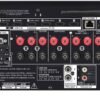
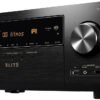
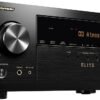
Description
What the Pioneer Elite VSX-LX305 Is and Who It Suits
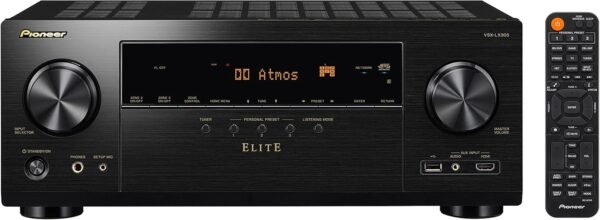
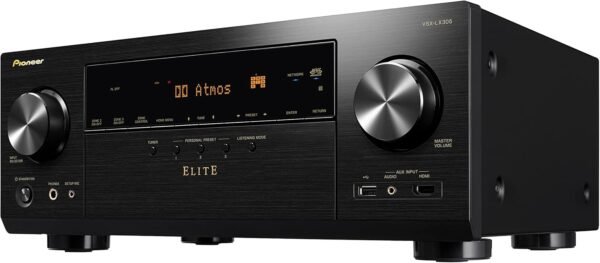
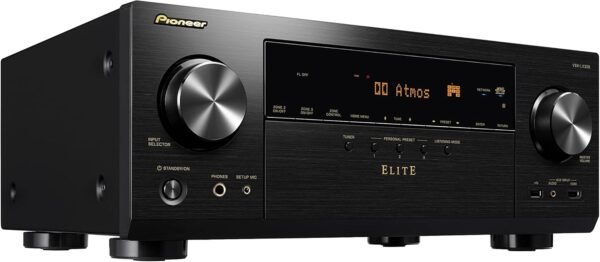
The VSX-LX305 is a 9.2 channel network AV receiver from Pioneer’s Elite line, positioned as the hub of a home theater rather than a stereo amplifier with extras bolted on. Pioneer rates it at 100 watts of continuous power per channel and builds it around HDMI 2.1 with 8K passthrough, Dirac Live room correction and the full set of current surround formats. The spec sheet lists dimensions of 14 by 17 by 6 inches and a weight of 22.9 pounds, and the listing shows 222 ratings at an average of 4.2 stars.
The buyer this suits is someone building a real multi speaker room: front three, surrounds, and either height channels or a second zone, with one or two subwoofers. Nine amplified channels give room to run a 5.1.4 layout or a 7.1.2 layout with headroom left over. Someone who only wants to improve television sound is overbuying here and should look at a soundbar such as the Klipsch Flexus CORE 100 instead. Someone pairing this with speakers can start with a matched center such as the Klipsch R-52C and fill in from there.
Room Correction: Dirac Live Plus MCACC
The headline feature is that Dirac Live ships included rather than as a paid upgrade. Pioneer states that the license requires no additional purchase, which is worth flagging because several competing receivers gate Dirac behind a separate fee. Dirac corrects across the full frequency band using measurements taken from multiple listening positions, and it is generally regarded as a more capable approach than the simpler EQ systems bundled with entry level receivers.
Pioneer also retains its own MCACC auto room tuning, which measures up to nine listening positions and works to suppress standing waves between walls, ceiling and floor. MCACC includes Auto Phase Control Plus, which Pioneer describes as analyzing phase difference in real time and compensating for the gap between the LFE channel and the main signals. Having two correction systems on one unit is unusual, and the listing does not explain how a buyer should choose between them, which is a genuine gap in the documentation.
Video, Gaming and Streaming
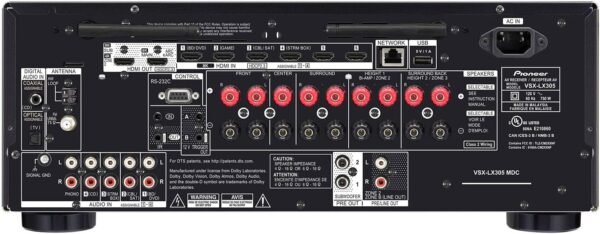
Video handling is current generation. Pioneer specifies HDMI 2.1 with uncompressed 8K and 4K transfer at 40 Gbps, along with two HDMI outputs. For gaming the receiver supports 4K at 120Hz HDR passthrough, Variable Refresh Rate, Auto Low Latency Mode and Quick Frame Transport. That combination is the practical requirement for a current console feeding a display through the receiver rather than around it.
On the streaming side the listing names Sonos compatibility, Chromecast built in, AirPlay 2 and DTS Play-Fi, with support for Spotify, Amazon Music, Pandora, TIDAL, Deezer and TuneIn. eARC handles high bitrate audio from television apps, which covers Dolby Atmos, DTS:X, Dolby TrueHD and DTS-HD Master Audio without needing a separate optical run. Pioneer also lists IMAX Enhanced certification and Dolby Atmos Height Virtualization, the latter simulating height effects when no ceiling speakers are installed.
Power, Bass Management and Physical Fit
The 100 watt per channel rating is stated as continuous power, which is a more meaningful figure than the peak numbers common on cheaper equipment. In a nine channel receiver, however, that rating is normally measured with only two channels driven, so buyers running a full nine channel layout at high volume should not expect 900 watts of simultaneous output. This is standard practice across the category rather than a Pioneer specific issue, but it is worth understanding before matching speakers.
The two subwoofer outputs are more than a convenience. Two subwoofers placed asymmetrically smooth low frequency response across a room far more effectively than one, and Dirac is well suited to integrating them. A pairing with something like the Klipsch RP-1400SW or a smaller sealed unit gives the receiver something to work with.
Physically, the listing gives 14 by 17 by 6 inches and 22.9 pounds. AV receivers run warm and need clearance above and behind them, so a closed cabinet without ventilation is a poor home for this unit. One oddity in the listing: the specifications state that two AA batteries are required, which refers to the remote control rather than the receiver, though the listing does not make that distinction clear.
Highlights
- Dirac Live room correction included with no separate license purchase required.
- Nine amplified channels rated at 100 watts continuous each, supporting 5.1.4 or 7.1.2 layouts.
- HDMI 2.1 at 40 Gbps with 8K passthrough, dual HDMI outputs and full gaming feature support.
- Two subwoofer outputs for smoother in room bass response.
- Dolby Atmos, DTS:X, Dolby TrueHD and DTS-HD Master Audio over eARC.
- Broad streaming support including AirPlay 2, Chromecast built in, DTS Play-Fi and Sonos compatibility.
Things To Consider
The average rating of 4.2 across 222 reviews is respectable but not spotless, and the review count is modest for a product first listed in May 2021. That is a small sample to draw conclusions from compared with mass market audio gear.
Running two overlapping room correction systems is a documentation problem. Dirac and MCACC solve the same class of issue by different methods, and nothing in the listing tells a buyer which to run or whether running both is sensible. Expect to spend time in forums or the manual working that out.
The 8K support is forward looking rather than immediately useful. Very little consumer content exists at 8K, so that specification should be treated as future proofing, not a present day benefit. The gaming features at 4K and 120Hz are the part that pays off now.
Setup effort is real. A nine channel receiver with two subwoofer outputs, multi position measurement and multiple streaming protocols is not a plug it in and forget it purchase. Buyers who want simplicity will find the configuration burden significant. Cabinet depth and heat clearance also need checking before purchase given the 22.9 pound, 17 inch deep chassis.
Who Should Buy It and Who Should Not
This receiver fits someone assembling a dedicated home theater who wants serious room correction without paying extra for it, and who has or plans a speaker count that justifies nine channels. Anyone shopping the wider receivers category with a current game console and a 4K 120Hz display will find the HDMI 2.1 implementation directly relevant. Pairing with efficient tower speakers such as the Dayton Audio Classic T65 keeps the amplifier well inside its comfort zone.
It is the wrong purchase for a two channel listener, for someone with no space for surround speakers, or for a buyer who wants the audio problem solved in one box with minimal configuration. Those needs are better met by a soundbar system or a simple stereo amplifier.