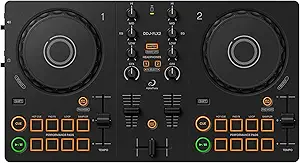
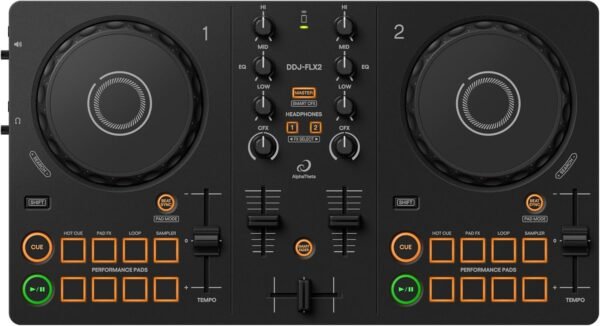
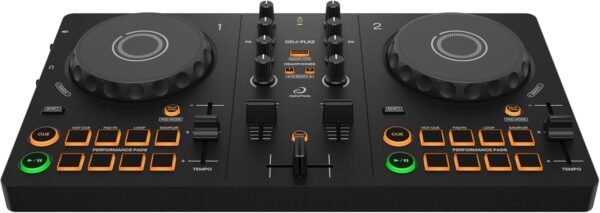
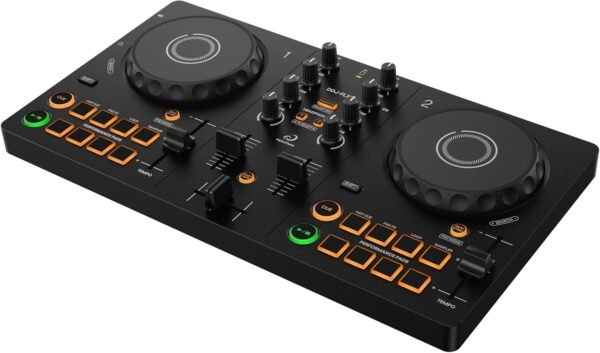

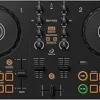
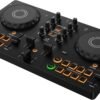
Description
What the Pioneer DJ DDJ-FLX2 Is and Who It Suits
The DDJ-FLX2 is a compact two channel DJ controller from AlphaTheta, the company that now produces the Pioneer DJ range. It measures 15.09 by 8.19 inches at 1.9 inches high and weighs 2.65 pounds, connects over USB, and works with smartphones, tablets and computers. The listing shows 116 ratings at an average of 4.3 stars since October 2024, with a country of origin of Malaysia, and it sits at number one in Amazon’s DJ controller category.
The buyer this suits is someone learning to DJ, or an experienced DJ who wants something small enough to travel with. Two channels means two decks, which is the minimum for mixing and the standard for learning. Anyone building a permanent setup with multiple sources will outgrow it. The controller feeds an external system, so it pairs with powered speakers such as the Behringer Eurolive B210D or a portable system such as the JBL PartyBox 310.
Smart CFX and Smart Fader
The two named features on this controller both address the same problem: the gap between wanting to mix and being able to. Smart CFX applies effects with a single control rather than requiring the user to select, configure and time them individually. Smart Fader handles the transition between tracks, managing the elements that a beginner usually gets wrong, such as bass frequencies clashing when two tracks overlap.
The honest framing is that these features do part of the work. That is precisely their purpose, and for someone learning it removes the frustration of early attempts sounding bad. It also means a player relying on them is not developing the manual skills that transfer to professional equipment. Both statements are true at once, and buyers should choose knowing which they want.
The listing does not state which effects Smart CFX covers, how Smart Fader behaves, or whether either can be disabled for manual operation. Those are meaningful details for anyone intending to progress beyond assisted mixing.
Phone and Tablet Support
Compatibility with smartphones and tablets rather than only computers is the more consequential feature. A controller that works from a phone removes the laptop from the equation entirely, which changes what the product is: a small controller and a phone fit in a bag in a way that a controller and a laptop do not.
The listing also states compatibility with multiple DJ applications and streaming services. Streaming service integration matters because it removes the need to build and maintain a local music library, though it introduces a dependency on a connection and on a subscription. The listing names no specific applications or services, which is a real gap: DJ software compatibility is rarely universal, and the answer determines whether the controller fits a particular workflow.
Outputs, Power and Physical Format
One bullet states that music plays directly from the DDJ-FLX2 through speakers, with headphone monitoring alongside. That describes a built in audio interface with separate master and headphone outputs, which is what allows a DJ to cue the next track in headphones while the current one plays to the room. It is the single most important function on any DJ controller and its absence would disqualify a product from the category.
What the listing does not state is the connector type on those outputs. Whether the master output is RCA, 3.5 mm or quarter inch determines what cable is needed to reach a speaker or a mixer, and whether the headphone output is 3.5 mm or quarter inch determines whether an adapter is required. Neither appears anywhere in the product data.
The power source is listed as corded electric with a USB connector. On controllers of this size, USB bus power from the connected device is common, though a phone may not supply enough current, in which case a separate supply is needed. The listing does not clarify which arrangement applies, and that is a practical question for anyone planning to run it from a phone.
At 2.65 pounds this is genuinely portable, and the 1.9 inch height means it fits in a backpack. The mounting type is listed as tabletop. Two of the five bullets say essentially the same thing about application and streaming compatibility, which suggests the listing was assembled from a short marketing sheet rather than a full specification.
Highlights
- Two channel layout, the standard configuration for learning to mix.
- Works from a smartphone or tablet as well as a computer.
- Smart CFX and Smart Fader reduce the skill barrier for early transitions and effects.
- Built in audio interface with master output and separate headphone monitoring.
- Light at 2.65 pounds and slim at 1.9 inches, so it travels easily.
- Number one ranking in its Amazon category, indicating strong sales.
Things To Consider
The output connector types are not stated. Whether the master output is RCA or quarter inch determines what cables are needed to connect to speakers, and that is basic information a listing should provide.
No DJ software or streaming service is named. Compatibility in this category is specific rather than universal, and buyers should confirm their intended application is supported before purchase.
Whether the controller runs on USB bus power from a phone, or needs a separate supply, is unclear. That matters directly for the mobile use the product is marketed on.
The assisted features are not described in enough detail to know whether they can be turned off, which matters for anyone learning manual technique. Two channels is also a hard limit; a DJ who wants four decks needs a different controller. Buyers should compare options across the DJ controllers category and consider the amplification side in the PA systems category, where the Mackie SRM150 and the PRORECK Club 4000 take different approaches.
Who Should Buy It and Who Should Not
The DDJ-FLX2 fits someone learning to DJ who wants low friction, phone compatibility and a controller small enough to carry to a friend’s house. The assisted mixing features do exactly what beginners need, and the category ranking suggests the product delivers on that brief.
It is the wrong controller for a working DJ who needs four decks, standalone operation without a phone or laptop, or a documented output specification before buying. Those buyers should look at larger controllers or at standalone units.