Description
What the Mackie SRM150 Is and Who It Suits
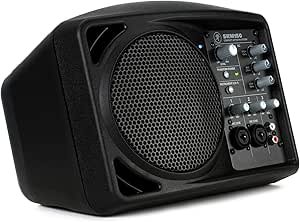
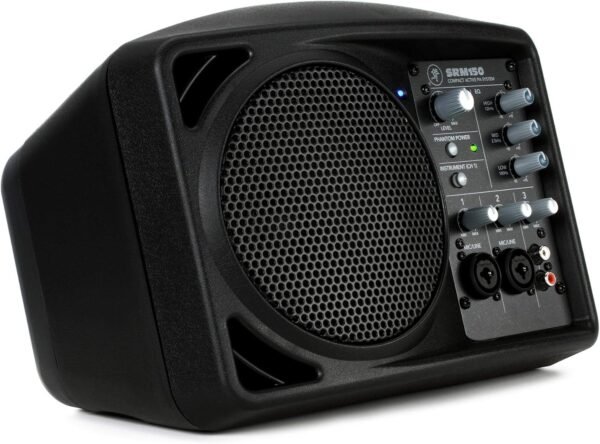
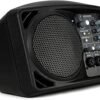
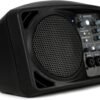
The Mackie SRM150 is a compact active PA speaker with a mixer built into it. Mackie describes it as suitable for uses from audio visual work through to live music performance, with a built-in mixer and high output for its size. The listing gives a 5.25 inch woofer, an active amplification type, 150 watts, a weight of 7.6 pounds, dimensions of 6.8 x 11.2 x 8 inches, corded electric power, a top carry handle, an integral aluminum heat sink and a mic stand integration system. It first became available in July 2004 and is listed as not discontinued, a twenty year production run.
Active means the amplification is inside the cabinet, so no separate power amplifier is needed. Combined with the onboard mixer, that makes this a complete system in one box for a solo performer, a presenter or a small venue. Buyers looking at larger powered speakers should compare the Behringer B210D and the ProReck Club 4000.
The Built-In Mixer and Why It Matters
A mixer inside the speaker is the feature that separates this from an ordinary powered box. It means multiple sources can be connected and balanced without carrying a separate mixer, cables between the two, and a table to put it all on. For a singer with a guitar, a presenter with a microphone and a laptop, or a busker with a backing track, that is the difference between a rig that fits in one hand and one that needs a trip to the car.
The listing does not state how many channels the mixer has or what connections they accept, and those are the two things a buyer needs to know. A mixer with one microphone channel and one line input covers a very different set of situations from one with two microphone channels. Mackie’s own documentation is the reference. Users who need more inputs than a small onboard mixer provides should look at a separate mixing desk feeding a larger speaker such as the PreSonus CDL12P.
Mic Stand Mounting and Physical Design
The mic stand integration system is a more thoughtful design decision than it sounds. Standard PA speakers mount on a speaker pole, which is a heavy tripod with a 35 mm socket. A speaker light enough to sit on a microphone stand instead removes an entire item from the load, and a microphone stand is something almost every performer already owns.
At 7.6 pounds the SRM150 is genuinely light enough for that to work safely, which is the constraint that makes the feature possible. The top carry handle addresses the other half of portability. Mackie also names an integral aluminum heat sink among the included components, which is how a small sealed enclosure containing an amplifier disposes of heat without a fan, and a fanless design is a real advantage in a quiet room or a recording situation. Performers assembling a small rig will also need a microphone, and the PylePro PDMIC78 covers a suitable stage dynamic.
Output, Coverage and Realistic Expectations
The 150 watt rating and the 5.25 inch woofer set the boundaries. This is a speaker for a coffee shop, a classroom, a boardroom, a small function room or a street corner. It is not a speaker for a bar with a drum kit, and no amount of amplifier power changes what a 5.25 inch cone can move. The listing does not state whether the 150 watt figure is continuous or peak, nor how it divides between the woofer and any high frequency driver.
Signal to noise ratio is listed as 7E+1 dB, scientific notation for 70 dB, which is adequate for speech and backing tracks. The listing shows a 4.0 star rating across 162 ratings, a moderate score on a reasonable sample for a product this old. Compatible devices are listed as keyboard and headphone, which is a partial description at best. Readers comparing across the PA systems category will find both smaller and much larger options.
Highlights
- Built-in mixer, so no separate mixing desk is needed for a simple setup.
- Active design with amplification inside the cabinet.
- Mic stand integration, which removes the need for a speaker pole and tripod.
- Light at 7.6 pounds with a top carry handle.
- Integral aluminum heat sink, indicating a fanless design.
- Listed as not discontinued after a production run beginning in 2004.
Things To Consider
Several specification entries do not belong to this product. Control Method is listed as App, Wireless Communication Technology as Bluetooth and Connectivity Protocol as Bluetooth, on a wired PA speaker first sold in 2004. There is no app and no Bluetooth here. Series Number is listed as 663961028379, which is a UPC rather than a series. Five different UPC values appear, which for a twenty year production run usually indicates multiple packaging revisions rather than a problem. Surround Sound Channel Configuration reads 1.0, which is technically true of a mono PA speaker but is a home theater field.
More significantly, the listing omits the specifications a buyer needs. There is no mixer channel count, no input connector list, no maximum sound pressure level, no frequency response, no coverage angle and no statement of whether the 150 watt figure is continuous or peak. For a product whose main selling point is its onboard mixer, the absence of a channel count is a substantial gap.
On the product itself, the age is worth weighing. A design from 2004 predates the class D amplifier and digital processing improvements that have transformed small powered speakers since, and a modern competitor of the same size may offer more output and less weight. The 4.0 star rating is also lower than the strongest products in this catalog carry. And a 5.25 inch woofer will not produce low bass, so music with a strong low end will sound thin at volume.
Who Should Buy It, and Who Should Not
This suits a solo performer, presenter or teacher who needs a complete self contained system that mounts on a microphone stand and carries in one hand. The onboard mixer and the stand mounting together make it a genuinely one trip rig for small rooms.
It does not suit a band, a loud venue, or anyone who needs more inputs than a small onboard mixer offers. Those users should look at a larger powered speaker with a separate mixing desk, and can start from the PA systems category.