

Description
What the ATH-M30x Is
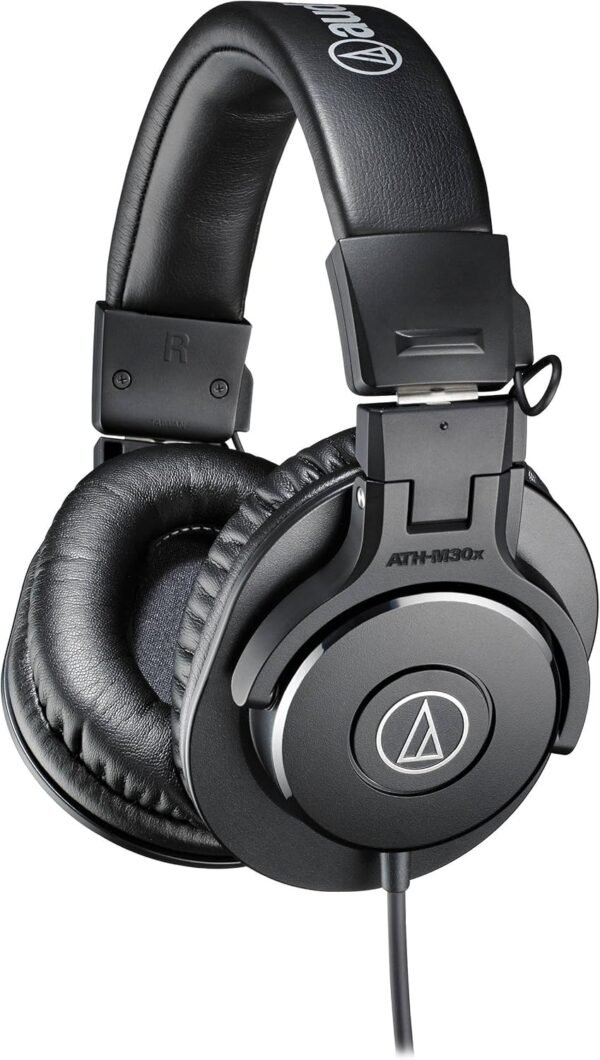
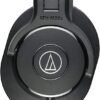
The Audio-Technica ATH-M30x is a wired, closed back studio monitoring headphone and the entry point into the M-Series, a range that has become close to a default in home and project studios. Audio-Technica describes it as designed primarily for studio tracking and mixing, with features added for portability that also make it usable for field recording. That is a fair summary of what it is: a working tool rather than a consumer listening product, with the isolation and the flat mounting hardware that implies.
The M30x sits below the M40x and M50x in the same family, and the differences between them come down to driver size, tuning and cable arrangement. What all three share is the circumaural closed back design and the emphasis on hearing what is actually on a recording rather than a flattered version of it. Anyone comparing studio options should also look at the Sennheiser HD 280 Pro, which occupies almost exactly the same role, and at the wireless AIAIAI TMA-2 Studio Wireless+ for a very different take on the same brief.
Drivers and Voicing
Audio-Technica specifies 40 mm drivers using rare earth magnets and copper clad aluminum wire voice coils. Rare earth magnets allow a stronger magnetic field in a smaller assembly, which improves driver control, and copper clad aluminum voice coils are lighter than solid copper, which reduces the mass the magnet has to move. Both are standard engineering choices at this level rather than exotic ones, but they are the reason a 40 mm driver in a headphone at this price can hold together at higher levels.
The voicing is described as tuned for enhanced detail with mid range definition, and that emphasis is the M30x’s defining characteristic within the family. A mid forward tuning suits tracking work, where the job is to hear a vocal or a guitar clearly against a backing, more than it suits bass heavy listening. The stated frequency range is 20 Hz to 20,000 Hz. Impedance and sensitivity are not published on this listing, which is a gap, though a headphone of this class is designed to run from an interface headphone output rather than needing anything from the headphone amplifiers category.
Isolation, Build and Portability
The earcups are circumaural, meaning they contour around the ear rather than pressing on it, and Audio-Technica states they seal tightly for isolation in loud environments with minimal bleed. That last point matters more than it sounds. Bleed is sound escaping the headphone and being picked up by a microphone during recording, and it is the reason closed back headphones are the only sensible choice for tracking. Noise control is listed as sound isolation, which is passive rather than active: there is no cancellation circuitry, just the seal of the cup.
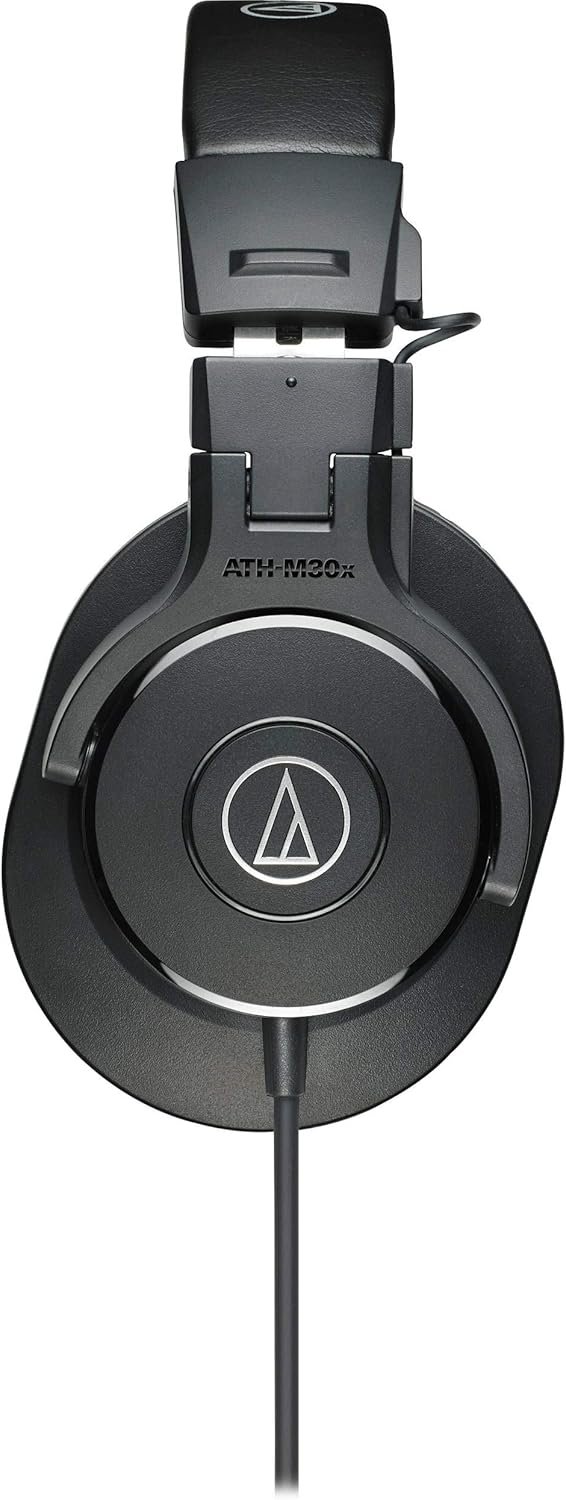
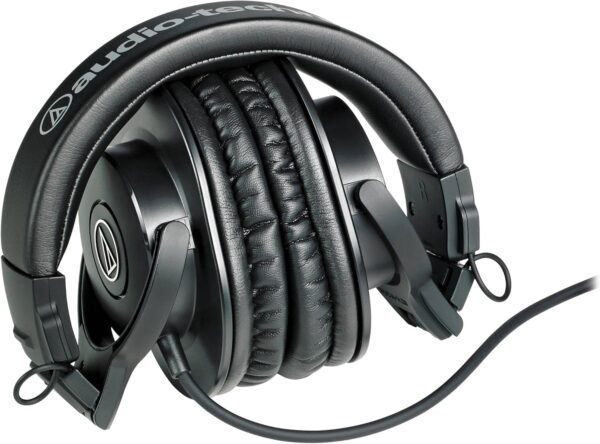
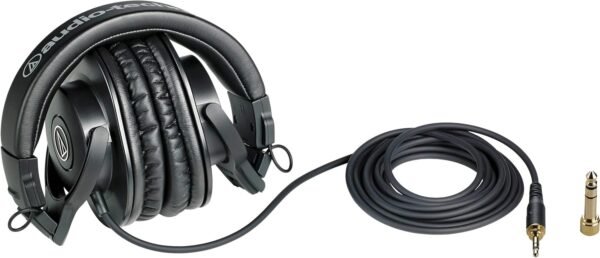
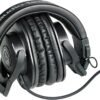
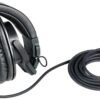
The headphone collapses for storage and uses a single side cable exit, which keeps the cable out of the way when only one ear is being monitored. A protective case and a screw on adapter are listed in the box, the adapter converting the 3.5 mm plug to the quarter inch socket found on interfaces and mixers. Weight is given as 7.7 ounces, and the material is listed as aluminum. At the time this listing data was captured it showed 11,984 ratings at an average of 4.6 stars and ranked 183rd in over ear headphones.
Highlights
- 40 mm drivers with rare earth magnets and copper clad aluminum voice coils.
- Tuned for detail and mid range definition rather than a bass lifted consumer curve.
- Closed circumaural cups for passive isolation and low bleed during tracking.
- Collapsible for storage with a single side cable exit.
- Protective case and screw on quarter inch adapter included.
- Wired only, so nothing to charge and no pairing to manage.
- Very large review base, indicating a long established and widely used product.
Things To Consider
Several attribute fields on this listing describe a product that does not exist. It states that one AAAA battery is required, on a passive headphone with no electronics. It gives the control method as touch, when there are no controls at all. It lists four USB 2 ports. And it describes the cable as detachable while the feature list describes a single side cable exit without confirming a socket, which are not the same thing; within the M-Series, detachable cables are a feature of the higher models. A buyer who specifically needs a replaceable cable should confirm that with Audio-Technica rather than relying on this page.
The manufacturer copy also leans hard on superlatives and on the opinions of unnamed reviewers and engineers, which is advertising rather than specification and should be read as such. More useful is what the copy implies about fit: a tight seal is what delivers isolation, and a tight seal means clamping force, which is the usual complaint about monitoring headphones worn for several hours.
On limitations, a closed back tuned for mid range detail is not the most enjoyable headphone for casual listening, and it is not intended to be. There is no active noise cancellation, so aircraft and train noise are only reduced by the physical seal. There is no microphone and no inline remote, so it cannot be used for calls as supplied. And the voicing that makes it useful for tracking is exactly what makes it a modest choice for a listener who wants a warm, bass forward sound. Those buyers are better served elsewhere in the over ear headphones category, and anyone wanting an open back presentation for mixing should compare the Monolith M1060.
Who It Suits
The M30x suits someone setting up a first home studio, a podcaster who needs isolation while recording, or a musician tracking to a click who needs the headphone to leak as little as possible into the microphone. It also suits anyone who simply wants a durable wired headphone with a case, no battery and a long history of availability for spare parts.
It is a weaker choice for critical mixing, where an open back is generally preferred, and for anyone who wants noise cancellation, wireless operation or a microphone for calls. Buyers whose priority is a professional wired reference with fuller published specifications should compare the Focal Listen Professional before deciding.