
Description
What the Douk Audio P1 Is and Who It Suits
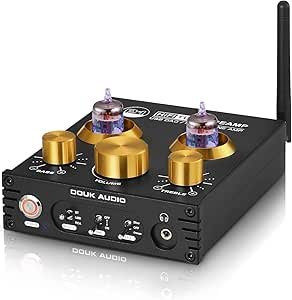
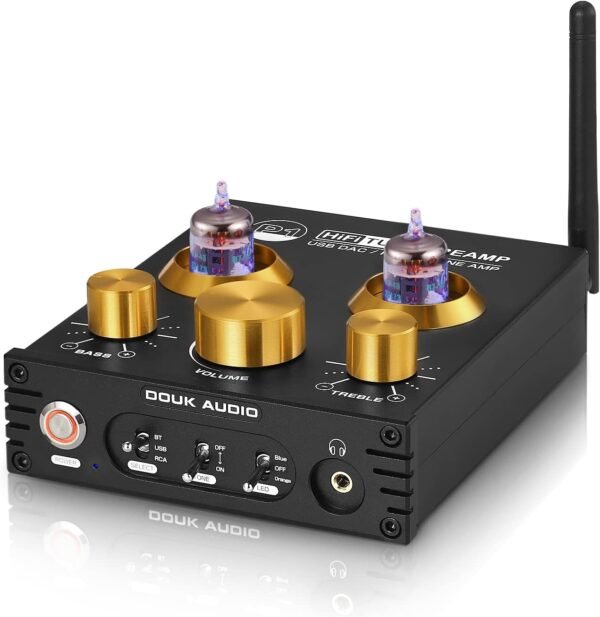
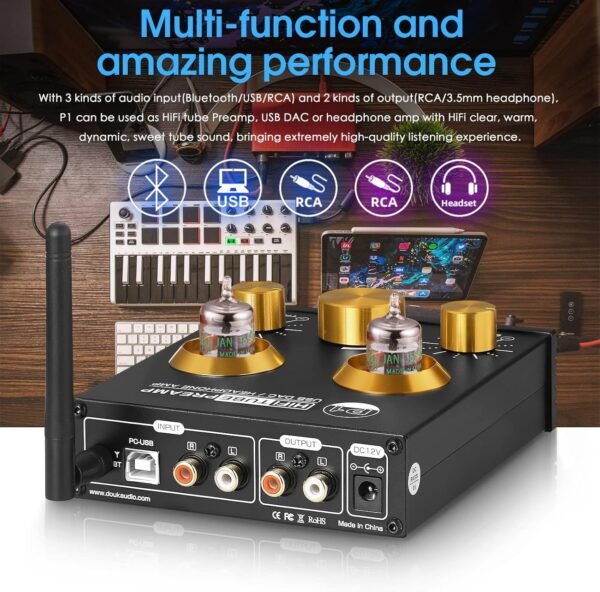
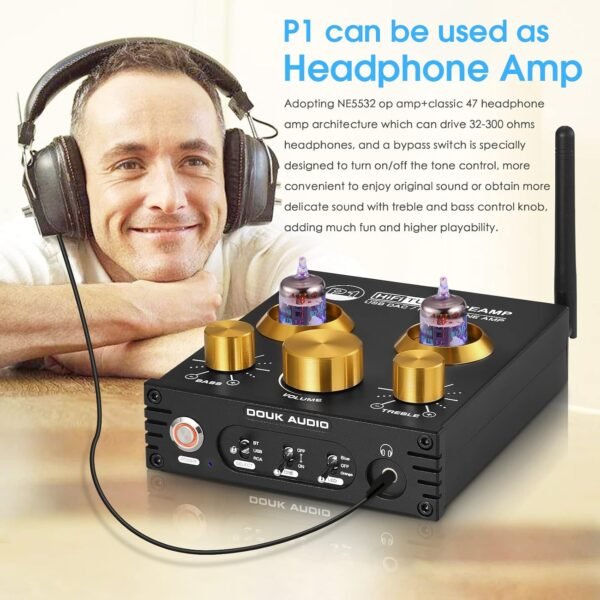
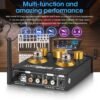
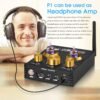
The Douk Audio P1 is a compact vacuum tube preamplifier that also functions as a Bluetooth receiver and a USB digital to analog converter. That combination is the point of the product: three components that would traditionally be three boxes, collapsed into one small chassis. Douk Audio operates at the affordable end of the tube equipment market, building compact hi-fi components rather than large traditional amplifiers.
The buyer is someone with a desktop system or a small hi-fi who wants a tube stage in the signal path without the space, heat and cost of a full tube amplifier. In practice a unit like this sits between the sources and a power amplifier or a pair of active speakers, handling input selection, volume and digital conversion. Readers building a system around it should look at the FiiO K9 Pro for a headphone focused alternative and the FiiO K11 for a smaller desktop option.
What a Preamplifier Actually Does
The word preamplifier causes confusion because it describes a component whose job is easy to state and easy to misunderstand. A preamplifier does three things: it selects between input sources, it controls volume, and it buffers the signal so the source is not loaded down by whatever comes next. It provides little or no power amplification in the sense a speaker needs; that job belongs to the power amplifier after it.
In a modern system, this matters when the sources are digital and the amplification is separate. A phone connects over Bluetooth, a computer connects over USB, an older source connects over analog inputs, and the preamplifier turns all of that into one line level output at a controllable volume. Without one, a power amplifier has no volume control and no way to switch inputs. The Arylic B50 covers an integrated approach where preamplifier and power amplifier live in one box.
The Tube Stage and What It Contributes
Vacuum tubes in a preamplifier of this type usually operate as a buffer or gain stage rather than as the main amplification. The reason people seek them out is that tube circuits produce a different distortion profile from transistor circuits, favoring low order harmonics that many listeners describe as warm or full. Whether that constitutes accuracy is a matter of long standing disagreement, and the honest position is that a tube stage colors the sound in a way some listeners prefer and others do not.
The practical consequences of tubes are less debatable. They generate heat and need ventilation. They wear out over time and need periodic replacement, which is normally a simple operation on a small preamplifier and is one of the attractions of tube equipment, since a change of tube changes the character of the unit. They can also be microphonic, meaning physical vibration reaching the tube becomes audible, which is a reason not to put the unit on top of a speaker. Listeners pairing this with passive speakers will need a power amplifier, and the amplifiers selection covers the options.
Bluetooth Reception and USB Conversion
The other two functions in the box are digital. A USB digital to analog converter takes the digital audio stream from a computer and converts it to analog, bypassing the computer’s own internal sound circuitry, which in most machines is compromised by proximity to noisy digital components. That is a genuine and audible improvement in most cases, and it is the single most cost effective upgrade available to anyone listening from a laptop.
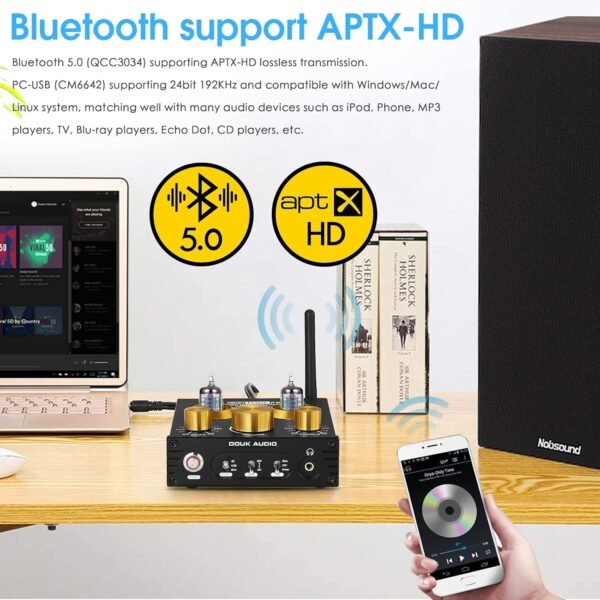
The Bluetooth receiver does the same job for a phone. Reception quality depends on the codec supported at both ends rather than on the Bluetooth version number, and the codecs matter here: basic SBC is the universal fallback, while aptX, aptX HD and LDAC carry more data and preserve more of the original. Buyers who care about wireless quality should confirm which codecs this unit supports. Speakers suited to a system like this appear in the bookshelf speakers, including the Klipsch R-51M.
Highlights
- Combines a tube preamplifier, a USB converter and a Bluetooth receiver in one chassis.
- Tube stage provides the coloration many listeners specifically want.
- Tubes are typically user replaceable, which allows the character to be changed.
- USB conversion bypasses a computer’s own noisy internal audio circuitry.
- Bluetooth reception adds phone playback to a system that has none.
- Compact chassis suited to a desk rather than a full sized equipment rack.
Things To Consider
The retail listing for this product publishes no specification block at all. There is no tube type, no output level or impedance, no supported sample rates for the USB input, no Bluetooth version or codec list, no input and output connector list, no dimensions and no weight. For a preamplifier, output level and impedance determine whether it will drive a given power amplifier properly, and the codec list determines the Bluetooth quality. None of it is available here. Nothing in this review invents any of it, and buyers should obtain the full specification from Douk Audio before purchase.
There is also no customer rating and no ratings count on this listing, so no aggregate buyer feedback is available from this data either.
On the product category itself, several practical points apply. Tubes take time to reach operating temperature, so a tube preamplifier is not a device to switch on and use immediately. They consume power continuously and generate heat, which matters in a confined shelf. Tube life is finite and replacement is an ongoing cost, though usually a small one. A unit combining three functions also concentrates three potential failure points in one box: if the Bluetooth section fails, the preamplifier goes with it. And a preamplifier alone makes no sound, so a power amplifier and speakers, or a pair of active speakers, are required alongside it.
Who Should Buy It, and Who Should Not
This suits a listener who wants to add a tube stage, a USB converter and Bluetooth to a desktop or small hi-fi system in one purchase, and who has verified the connections and output specification independently. For anyone driving a separate power amplifier from a computer and a phone, that combination genuinely does replace three boxes.
It does not suit a buyer who needs the specification before deciding, because this listing provides none, and it does not suit someone looking for a complete system, since a power amplifier and speakers are still required. Those buyers should consider an integrated amplifier with digital inputs instead.