Description
What the Dayton Audio Classic T65 Is and Who It Suits
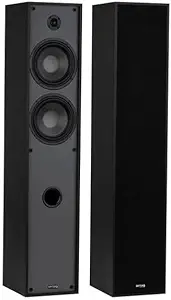
The Classic T65 is a full size floorstanding tower speaker sold as a pair in black. Dayton Audio builds it as a bass reflex design standing 39.4 inches tall, 7.25 inches wide and 7.8 inches deep, with two 6.5 inch polypropylene bass drivers and a 1 inch silk dome tweeter per cabinet. Power handling is stated at 150W, and the speakers ship with gold plated binding posts and speaker wire. The listing shows 53 ratings at an average of 4.4 stars since May 2024, with a country of origin of China.
The buyer this suits is someone furnishing a living room or a media room who wants full range stereo or the front left and right of a home theater without paying premium prices. Towers of this type deliver more bass and more output than standmounts because the cabinet is larger, and they need no stands. Anyone short of floor space should look at the bookshelf speakers category instead, where the Klipsch R-50M covers similar ground in a smaller footprint.
Driver Layout and Cabinet Design
Two 6.5 inch bass drivers per cabinet is the layout that defines this speaker. Doubling the woofer count roughly doubles the cone area, which means more output for the same excursion and less strain at high volume. It is a more effective route to bass output than fitting one larger driver, because two smaller cones are lighter and can move faster.
Dayton Audio pairs these with a bass reflex cabinet, meaning a port allows air movement inside the enclosure to reinforce low frequencies. Ports are what let a modestly sized tower reach lower than a sealed cabinet of the same volume, at the cost of a steeper rolloff below the tuning frequency and greater sensitivity to placement near walls.
The 1 inch silk dome tweeter is the conventional choice for a speaker aiming at a smooth rather than aggressive presentation. Dayton Audio describes it as reproducing accurate treble without being harsh, which is the standard argument for soft dome tweeters over metal domes. The company also states that real crossovers distribute the signal between woofers and tweeter, which sounds obvious but is worth noting because very cheap speakers sometimes use a single capacitor rather than a proper crossover network.
Height and Tweeter Placement
Dayton Audio makes a specific claim about the 39 inch height: that it places the tweeter at ear level. This is a real design consideration rather than marketing. Treble is highly directional, and a tweeter significantly above or below seated ear height changes the tonal balance a listener hears. Getting a tweeter to roughly 36 to 40 inches above the floor is exactly why tower speakers exist in this shape, and it is a genuine advantage over bookshelf speakers placed on furniture of the wrong height.
Power Handling, Connections and Amplifier Matching
The stated 150W power handling describes what the speaker can absorb, not what it needs. In practice a receiver delivering 50 to 100 watts per channel will drive these comfortably in a domestic room. A multichannel receiver such as the Onkyo TX-RZ50 or the Pioneer Elite VSX-LX305 is the natural partner, particularly if the towers are the front pair in a surround system.
Gold plated binding posts are the correct connector for speakers at this level. They accept banana plugs, spade connectors or bare wire, and gold plating resists corrosion at the contact point. This is a small quality of life detail rather than an audible upgrade, but binding posts are considerably more secure than the spring clips found on budget speakers.
The listing does not state the impedance or the sensitivity, which is a genuine gap. Impedance determines whether an amplifier can drive the speakers safely, and sensitivity determines how loud they play for a given input. Both are standard published specifications and neither appears here. Buyers should obtain them from Dayton Audio before pairing with a low power amplifier.
Several attribute fields are wrong in ways worth naming. The connectivity protocol is listed as Ethernet, which is impossible for a passive speaker with no electronics. The power source and controller type are given as corded electric and the control method as touch, none of which apply. The subwoofer connectivity technology field appears although these are not subwoofers. The number of items is listed as one while the product title and the 47.9 pound weight both indicate a pair.
Highlights
- Two 6.5 inch bass drivers per cabinet for greater output than a single woofer design.
- Bass reflex cabinet with the internal volume that a 39 inch tower allows.
- 1 inch silk dome tweeter placed at approximately seated ear height.
- Stated 150W power handling, comfortably above what most home receivers deliver.
- Gold plated binding posts accepting banana plugs, spades or bare wire.
- Sold as a pair with speaker wire included, and no stands required.
Things To Consider
Impedance and sensitivity are not published in this listing. Those are the two numbers that determine amplifier compatibility, and buying without them means guessing.
The 53 rating sample is small for a product launched in May 2024, and 4.4 stars is respectable rather than outstanding. There is not yet a long term reliability record.
Ported towers are sensitive to placement. Pushed against a rear wall the port output reinforces bass to the point of boominess, so these need space behind them, which is the practical cost of choosing a floorstander over a compact speaker.
The attribute table contains several impossible entries, including Ethernet connectivity and a touch control method on a passive speaker. It also does not state crossover frequency, frequency response, or cabinet material. Buyers planning a full surround system should note that the listing does not identify a matching center channel, so a partner such as the Klipsch R-52C would be a mixed brand pairing rather than a designed match. A subwoofer such as the Klipsch R-12SW would still be needed for the lowest octave in a home theater.
Who Should Buy It and Who Should Not
The Classic T65 fits a buyer who wants full size tower speakers for stereo music or as the front pair of a home theater, who has floor space and a conventional amplifier, and who values cone area and cabinet volume over brand prestige. The dual woofer layout and the correctly positioned tweeter are the two design decisions that matter most here. Shoppers can compare across the floorstanding speakers category and plan low frequency support in the subwoofers category.
It is the wrong speaker for a small room, for anyone who cannot leave space behind the cabinets, or for a buyer who needs published impedance and sensitivity figures before matching an amplifier. Anyone wanting a single box solution for television sound should be shopping soundbars instead.