Description
What the R-52C Is
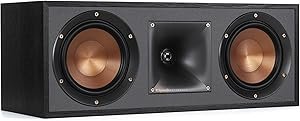
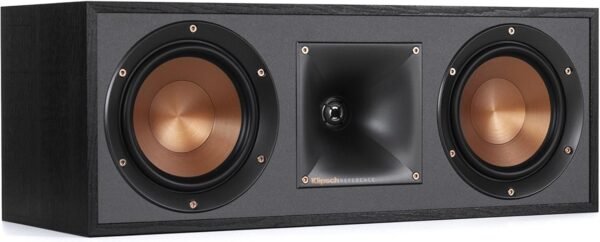
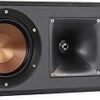
The Klipsch R-52C is a passive center channel speaker for home theater, built as a two way design with dual 5.25 inch woofers arranged either side of a horn loaded tweeter. A center channel is the speaker that carries the majority of dialogue in a film soundtrack, which makes it arguably the most important speaker in a surround system and the one where clarity matters more than anything else. It sits in the Klipsch Reference line and at the time this data was captured it was ranked first in the center channel speakers subcategory with 2,945 ratings at an average of 4.8 stars.
Passive is the key word. This speaker has no amplifier and no power connection; it is driven by the center channel output of an AV receiver over speaker cable. Anyone buying one needs a receiver such as the Onkyo TX-RZ50 or the Pioneer Elite VSX-LX305 to drive it, and it is normally bought alongside matching left and right speakers from the same family so that sound panning across the front stage keeps a consistent tonal character.
Drivers, Horn Loading and Sensitivity
The tweeter is a 1 inch aluminum unit using what Klipsch calls Linear Travel Suspension with a Kapton suspension, mated to a 90 by 90 square Tractrix horn. Horn loading is the defining Klipsch design choice and it does two things: it increases efficiency, because the horn couples the small driver to the air more effectively, and it controls dispersion, directing sound into a defined pattern rather than spraying it everywhere. A 90 by 90 pattern means 90 degrees horizontally and 90 degrees vertically, which for a center channel keeps more energy pointed at the seating area and less at the ceiling and floor where it would arrive as reflections.
The efficiency shows in the numbers. Sensitivity is stated as 95 dB at 2.83 volts measured at one meter, which is high; most conventional speakers sit closer to 87 or 88 dB. In practical terms a speaker like this reaches a given loudness with substantially less amplifier power than a less efficient design, which is why Klipsch speakers have a reputation for sounding lively on modest receivers. Power handling is stated at 400 watts, though that is a maximum rather than a requirement. The woofers are 5.25 inch spun copper IMG units, IMG standing for injection molded graphite, a stiff and light cone material.
Frequency Response and System Integration
Klipsch publishes the response as 89 Hz to 21 kHz within plus or minus 3 dB, and that first number is the one to plan around. A low frequency limit of 89 Hz means this speaker does not reproduce bass; anything below roughly 90 Hz has to be handled by a subwoofer. That is normal and correct for a center channel of this size, but it does mean the R-52C is not a standalone solution. A receiver should be set to cross the center channel over at around 100 Hz and route everything below that to the subwoofer.
The published tolerance of plus or minus 3 dB is itself worth noting, because many speaker listings quote a frequency range with no tolerance at all, which makes the figure meaningless. Klipsch giving both is a sign the specification is real. Buyers assembling a full front stage should look at the matching Klipsch R-51M bookshelf speakers, and will need something from the subwoofers category to cover the bottom two octaves.
Highlights
- Two way design with dual 5.25 inch spun copper IMG woofers.
- 1 inch aluminum LTS tweeter with Kapton suspension on a 90 by 90 square Tractrix horn.
- High stated sensitivity of 95 dB, so it goes loud without demanding amplifier power.
- Published response of 89 Hz to 21 kHz with a plus or minus 3 dB tolerance.
- 400 watts stated power handling.
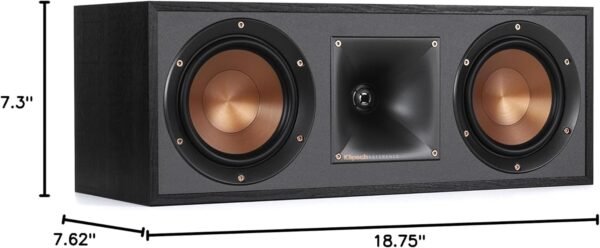
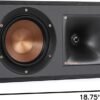
- Horizontal cabinet at 18.75 inches wide by 7.62 deep by 7.3 high, weighing 13.5 pounds.
- Removable grille supplied.
Things To Consider
The attribute table on this listing describes an active wireless speaker, which this is not. It lists the power source as corded electric and the controller type as corded electric, on a passive speaker with no power inlet. It gives a Bluetooth range of 10 meters and lists Bluetooth as the connectivity protocol, and states the subwoofer connectivity technology as wireless. It also quotes a signal to noise ratio of 75 dB, a figure that has no meaning for a passive loudspeaker since it has no electronics to generate noise. And the mounting type is given as floor standing, when a center channel sits on a shelf or under a television. A buyer who took those fields at face value would expect a completely different product.
On genuine limitations, the 89 Hz low frequency limit means a subwoofer is not optional. Horn loaded tweeters are also a matter of taste: the controlled dispersion and high efficiency come with a presentation some listeners find forward in the upper midrange, particularly at higher volumes, and it is worth listening before committing if that is a concern.
Physically, at 18.75 inches wide this is a large center channel and it needs a shelf deep enough for its 7.62 inch depth plus clearance behind for the speaker terminals. It should be positioned as close to ear height as possible, since a center channel placed low and angled up will sound different from the left and right speakers. And it should be bought as part of a matched set where possible; mixing a Klipsch horn loaded center with conventional dome tweeter left and right speakers produces an audible change in character as sound pans across the screen. Alternatives with a more conventional design include the Polk Audio TL1 and the Definitive Technology ProCenter 1000.
Who It Suits
The R-52C suits someone building or upgrading a home theater around an AV receiver, who already owns or intends to buy matching Klipsch Reference speakers and a subwoofer, and who wants dialogue reproduced by a dedicated horn loaded design rather than shared between stereo speakers. The high sensitivity makes it a sensible partner for a mid range receiver rather than requiring a large amplifier.
It is the wrong purchase for anyone without a receiver, anyone without space for an 18.75 inch cabinet, and anyone who does not intend to add a subwoofer. Buyers in that position should look at the sound bars category, where the amplification, the center channel and often the subwoofer arrive as one package.