
Description
What a Drum Microphone Kit Is For
A drum kit is the hardest instrument in a band to record, because it is not one instrument. It is five or six separate sound sources spread across several feet, each with a different frequency range, a different attack and a different volume, all playing at once. A kick drum produces most of its energy below 100 Hz. A snare sits in the midrange with a sharp transient. Cymbals extend past 15 kHz. No single microphone handles all of that well, which is why drum microphone kits exist.
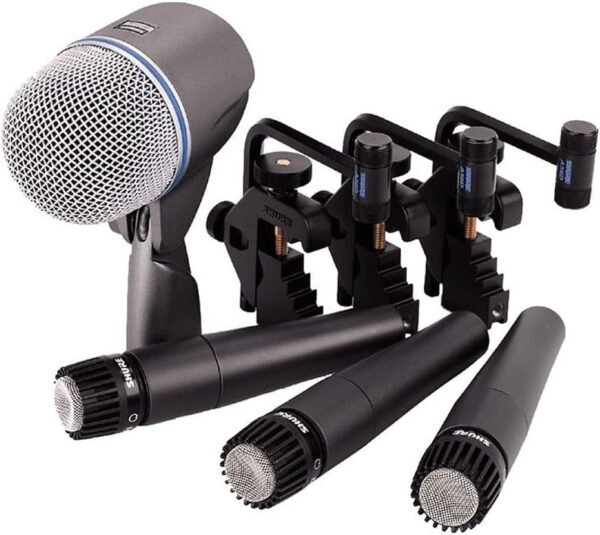
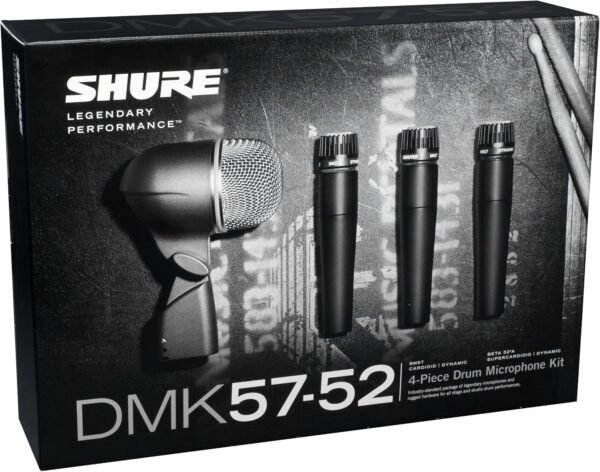
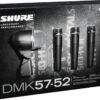
The Shure DMK57-52 packages the microphones and the mounting hardware to cover a kit in one purchase. Its model designation names the two microphones it combines, the 57 and the 52, and the product information confirms the Beta 52A among them. Buying a kit rather than assembling one individually saves money and, more importantly, removes the guesswork about which mounts fit which microphones. Drummers should also look at the Shure A56D drum mount, which is the rim clamp used for this kind of work.
The Beta 52A and Kick Drum Capture
The Beta 52A is a dynamic microphone built specifically for kick drums and other high sound pressure low frequency sources. Three things separate a kick drum microphone from a general purpose one. It has a frequency response tailored with a low end lift and a presence peak, so the drum sounds full and the beater click cuts through without heavy equalization afterward. It handles extremely high sound pressure levels, since the inside of a kick drum is one of the loudest places a microphone is ever put. And it uses a supercardioid pattern to reject the rest of the kit.
The other microphones in the kit are the SM57 family, which is the most widely used instrument microphone in existence. On a drum kit an SM57 goes on the snare and the toms, where its midrange presence and its ability to take a very loud transient without complaint have made it the default for fifty years. Anyone adding overhead microphones to capture cymbals and the kit as a whole will need a condenser, and the AKG P120 is one option in the multipurpose microphones category.
Mounting and Practical Use
The listing describes a mounting system that allows placement on drum rims, stands or cymbal mounts. That flexibility is the difference between a kit that can be set up quickly and one that fights the drummer. Rim clamps put the microphone in a fixed position relative to the drum, so it stays correct even if the kit is moved, and they remove the stands that would otherwise surround the player. Stand mounting remains necessary for overheads and often for the kick drum.
Construction is described as road ready and durable for touring conditions, which for dynamic microphones is a reasonable expectation rather than a claim: dynamic capsules have no active electronics and no fragile diaphragm assembly, which is exactly why they dominate live use. They also need no phantom power, so any mixer with microphone inputs will work. Drummers recording electronically instead should compare the Yamaha EAD10.
Highlights
- Complete drum kit microphone package rather than individually chosen pieces.
- Beta 52A included for kick drum and other high SPL low frequency sources.
- SM57 family microphones for snare and toms, an industry standard for decades.
- Mounting hardware supplied for rims, stands and cymbal mounts.
- Dynamic microphones throughout, so no phantom power is required.
- Road ready construction suitable for live use as well as studio work.
- Microphones and mounts matched to each other, removing compatibility guesswork.
- Works with any mixer or interface that has standard microphone inputs.
Things To Consider
This listing carries no specification data at all: no attribute table, no manufacturer description and no feature bullets. That means the exact contents are undocumented on this page. The number of microphones supplied, the number of mounts, whether a case is included, whether cables are included and the individual microphone specifications are all absent. For a kit purchase, where the value depends entirely on what is in the box, that is the single most important information and it is missing. A buyer should consult the Shure documentation before ordering.
The kit also does not cover a full drum recording setup on its own. Overhead microphones are needed to capture cymbals and the overall kit sound, and those are almost always condensers rather than dynamics, so they are a separate purchase. Depending on the kit size, additional tom microphones may be required. Microphone cables are needed for every channel, and each microphone needs an input on a mixer or interface, so a four microphone kit implies a four input interface at minimum.
On practical grounds, close miking a drum kit produces bleed: every microphone hears every drum to some degree, and managing that is a skill rather than an equipment problem. Rim mounted microphones are also exposed to stick strikes, particularly on the snare, so careful angling matters. And a full kit setup takes time, which is why many drummers recording at home use a simpler two or three microphone approach instead. Those looking at the mounting hardware separately will find it in the instrument category, and vocalists needing a microphone for the same sessions should compare the Shure MV7X.
Who It Suits
The DMK57-52 suits a drummer or engineer who needs to mic a kit properly for live performance or recording, who wants microphones that will still be useful in fifteen years, and who would rather buy a matched package than research each component. The SM57 and Beta 52A are both long standing industry defaults, and buying them together with the correct mounts removes a great deal of friction.
It is not a complete drum recording solution on its own, since overheads, cables and interface inputs are all extra, and it is the wrong purchase for someone who only needs one microphone for a snare or a practice recording. Those buyers should look at individual microphones and mounts instead.
