
Description
What the Shure MV7X Is and Who It Suits
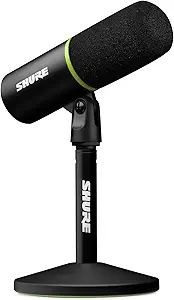
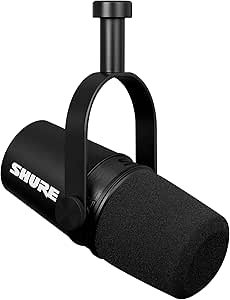
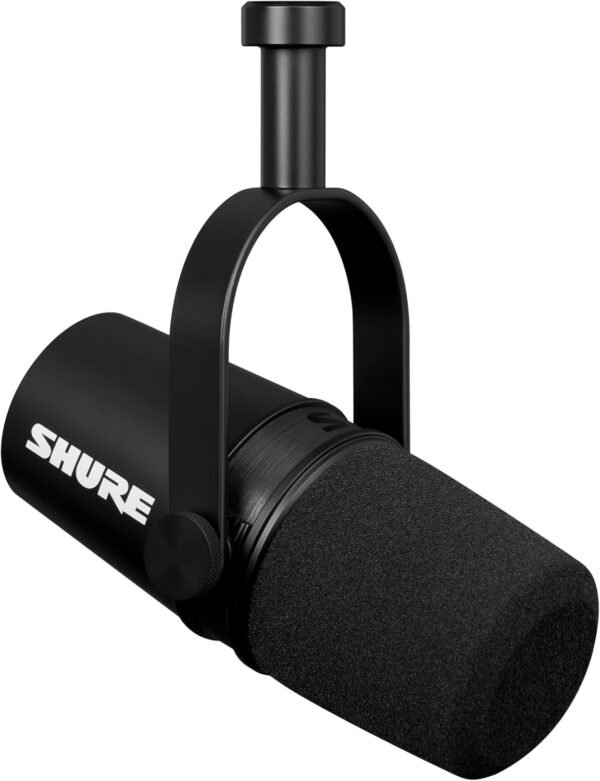
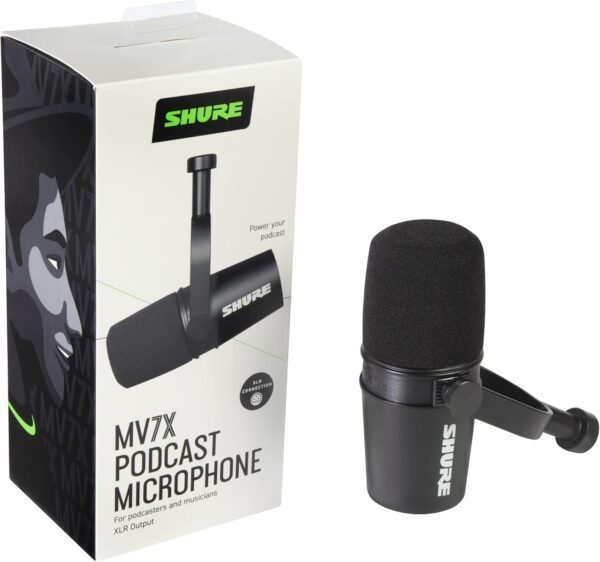
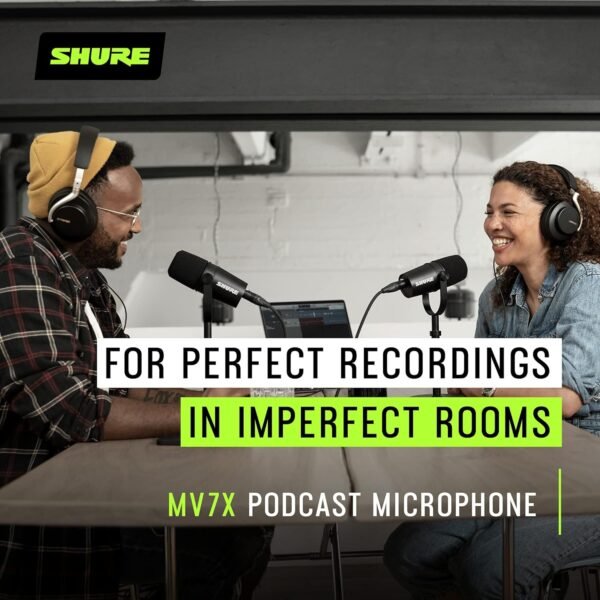
The MV7X is an XLR only dynamic microphone designed for podcasting and vocal recording. Shure built it on the form factor of the SM7B, the broadcast microphone that has become the visual shorthand for a podcast studio, but at a substantially lower cost and without the USB output found on the closely related MV7. The listing gives the frequency range as 50 Hz to 16,000 Hz, the weight as 1.12 pounds, the material as metal, and shows 3,305 ratings at an average of 4.7 stars since September 2021.
The buyer this suits is a podcaster, voiceover artist or streamer who already owns an audio interface or mixer and wants a microphone that sounds controlled in a room that has not been acoustically treated. The XLR only design is deliberate: it targets people with existing equipment rather than people plugging into a laptop. Anyone who needs a USB connection should look at the Shure MV6 or the MAONO PD200X instead.
Voice Isolation and the Dynamic Cartridge
Shure’s Voice Isolation Technology is a combination rather than a single feature: a dynamic cartridge, a cardioid pickup pattern and an internal shock mount working together. Each part addresses a different problem.
The dynamic cartridge is less sensitive than a condenser, which sounds like a drawback but is the point. Lower sensitivity means the microphone picks up less of the room, less of the computer fan and less of the traffic outside. In an untreated bedroom or office, that is worth more than the extra detail a condenser would capture, because most of the extra detail would be reflections.
The cardioid pattern rejects sound arriving from the sides and rear, focusing on what is directly in front. The internal shock mount isolates the cartridge from vibration transmitted through the stand, which matters on a desk where typing and knocks travel through the surface. Shure states the combination brings the voice forward and rejects background noise, and describes the result as usable in rooms that are not acoustically ideal.
The 50 Hz to 16 kHz Range
The frequency range is narrower than the 20 Hz to 20 kHz figure quoted for most condensers, and that is intentional rather than a shortcoming. Human speech occupies roughly 80 Hz to 8 kHz, with sibilance and air extending higher. Rolling off below 50 Hz removes rumble, air conditioning and structural vibration. Limiting the top end at 16 kHz removes hiss and high frequency room noise that add nothing to a spoken word recording.
For music recording that restriction would matter. For podcasting, where intelligibility and a clean noise floor are the objectives, a tailored range is an advantage. Buyers recording acoustic instruments or singing across a wide range should choose a condenser such as the Audio-Technica AT2035 instead.
Connection, Mounting and Practical Setup
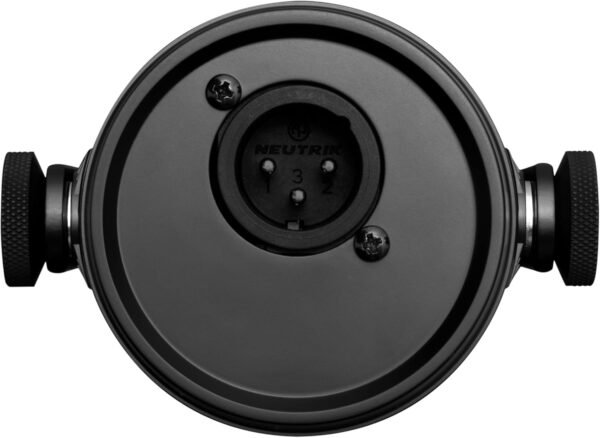
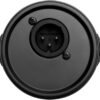
XLR only means an audio interface or mixer is mandatory. Shure states that the microphone connects to professional interfaces without needing an in-line preamplifier for additional gain, which is a meaningful claim: the SM7B is notorious for requiring a booster because of its low output, and Shure is positioning the MV7X as avoiding that requirement.
Because it is a dynamic microphone, no phantom power is needed. The specification table lists the power source as corded electric, which is incorrect; the microphone draws no power at all and connects only by XLR cable. Note that the cable is not listed as included.
Mounting uses an adjustable yoke with a 5/8 inch thread, the standard size for microphone stands in the United States, and a thread adapter is supplied for stands using the European 3/8 inch size. The yoke design allows the microphone to be angled without moving the stand, which suits a desk arm such as the RODE PSA1+. At 1.12 pounds the microphone is heavy enough that a lightweight desk stand will not hold position.
Two listing errors are worth flagging. The specification table lists a RAM size of 512 GB, which is meaningless for a passive microphone and is clearly stray data. The form factor is listed as large diaphragm, a term normally reserved for condenser microphones; the MV7X is a dynamic. One of the marketing bullets also refers to a 5/8 inch to 3.8 inch adapter, an obvious typo for 3/8 inch, which a later bullet states correctly.
Highlights
- Dynamic cartridge with a cardioid pattern and internal shock mount for untreated rooms.
- SM7B derived form factor at a considerably lower cost.
- Frequency range tailored to speech rather than a full 20 Hz to 20 kHz sweep.
- No phantom power required, and no in-line preamplifier needed according to Shure.
- All metal construction with an adjustable yoke and both 5/8 inch and 3/8 inch thread compatibility.
- Two year warranty stated in the listing, alongside 3,305 ratings at 4.7 stars.
Things To Consider
There is no USB output. An audio interface or mixer is required, and buyers without one need to budget for it. The related MV7 adds USB, and anyone unsure which they need should resolve that before ordering.
The restricted 50 Hz to 16 kHz range is well matched to voice and poorly matched to music. This is not a general purpose recording microphone.
An XLR cable is not listed among the box contents, and neither is a stand. The microphone body alone is not a working setup.
The specification table contains a 512 GB RAM entry and describes a dynamic microphone as a large diaphragm model, so it should not be relied on. The listing also does not state the maximum sound pressure level or the output impedance. Buyers wanting a broader recording tool should compare the multipurpose microphones category rather than staying within dynamics.
Who Should Buy It and Who Should Not
The MV7X is a strong choice for a podcaster or voiceover recordist working in an ordinary room with an existing interface, who wants broadcast style sound without the gain requirements of an SM7B. The tailored frequency response and the isolation package are aimed precisely at that job. Buyers can compare it with other options in the vocal microphones category.
It is the wrong microphone for recording music across the full frequency range, for anyone without an interface, or for a buyer who wants to plug directly into a computer. Those needs are met by USB models or by condensers with full bandwidth capture.