Description
What the FiiO K9 Pro Is and Who It Suits
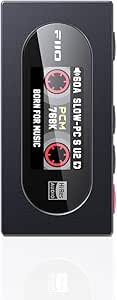
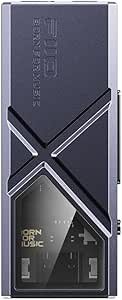
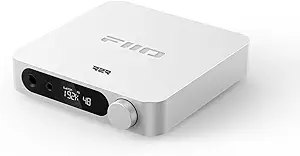
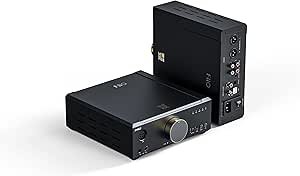
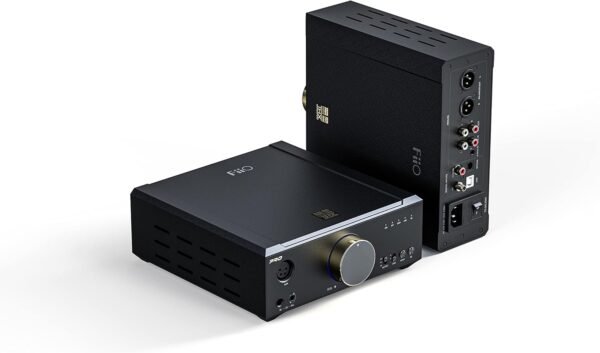
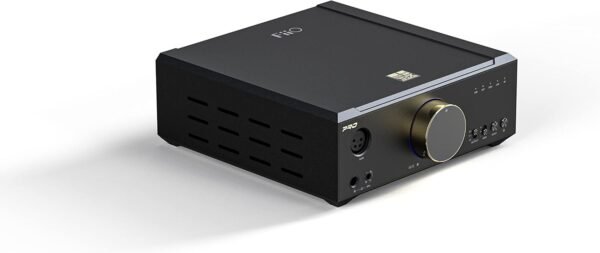
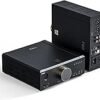
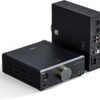
The FiiO K9 Pro is a desktop headphone amplifier combined with a digital to analog converter and a Bluetooth receiver. FiiO’s listing title names support for 384 kHz sampling, DSD256, MQA, LDAC, aptX Adaptive and aptX HD, and identifies this variant as the K9 Pro ESS. The specification sheet gives two channels, an output power of 2,100 milliwatts, stainless steel construction, mains operation at 115 volts, tabletop mounting and FCC compliance. It first became available in April 2022.
This is the box that sits between a computer and a pair of demanding headphones. The buyer is someone who has bought a headphone that a phone or a laptop cannot drive properly, or who wants to bypass a computer’s internal audio entirely. Readers looking at smaller options in the same family should compare the FiiO K11 and the FiiO KA15, both of which do a similar job at lower power in a smaller package.
Output Power and Driving Difficult Headphones
The 2,100 milliwatt figure is the specification that justifies a desktop unit over a portable one. Two point one watts into a headphone is a great deal of power, and it is aimed at high impedance and low sensitivity designs that a portable device cannot bring to a usable volume. Planar magnetic headphones in particular are often power hungry, and a portable dongle simply runs out.
The important caveat is that power figures for headphone amplifiers are quoted into a specific impedance, and the listing does not state which one. An amplifier delivering 2,100 milliwatts into 32 ohms is a very different proposition from one delivering it into 300 ohms, and matching to a specific headphone requires knowing both. FiiO’s own specification sheet gives the figures at each load. Owners of demanding full size headphones such as the HiFiMan Susvara will want that detail before deciding.
Digital Formats, MQA and the Codec List
The format list in the title is unusually complete and worth unpacking. A 384 kHz sampling rate covers any high resolution file a buyer is likely to encounter. DSD256 refers to the direct stream digital format used by some high resolution downloads and SACD rips, which uses a fundamentally different encoding from conventional PCM audio and requires specific hardware support. MQA is a proprietary format used by some streaming services, and support for it is a service specific feature rather than a general quality improvement.
The Bluetooth codec list is more practically relevant for most owners. LDAC, aptX Adaptive and aptX HD all carry substantially more data than the basic SBC codec that every Bluetooth device supports, and the benefit is only realized when the sending device supports the same codec. LDAC is common on Android phones, aptX variants on Android and Windows, and neither is available on Apple devices, which use AAC. Buyers should check what their own source supports rather than assume the receiver’s list is the whole story. Headphones suited to a unit like this appear across the over-ear headphones selection.
Build, Power and Desktop Integration
Material is listed as Stainless Steel, and the shipping weight of 9.22 pounds indicates a substantial chassis, almost certainly with a linear power supply rather than a switching one. That matters for a headphone amplifier: a linear supply is heavier and produces less high frequency electrical noise, which is why it remains preferred in audio equipment despite the weight and cost.
Voltage is listed as 115 volts, which identifies this as the North American version. Buyers outside 115 volt regions need the matching variant, and this is not something an adapter solves for a mains powered device with a linear supply. The tabletop mounting type and the chassis size mean this occupies real desk space rather than sitting beside a laptop. Readers who need portability should look at the smaller units in the amplifiers category instead.
Highlights
- 2,100 milliwatt output, enough for demanding full size headphones.
- Support listed for 384 kHz PCM, DSD256 and MQA.
- LDAC, aptX Adaptive and aptX HD Bluetooth codecs listed.
- Stainless steel chassis with substantial weight, indicating a linear power supply.
- Two channel design with tabletop mounting.
- Listed as meeting FCC requirements at 115 volts.
Things To Consider
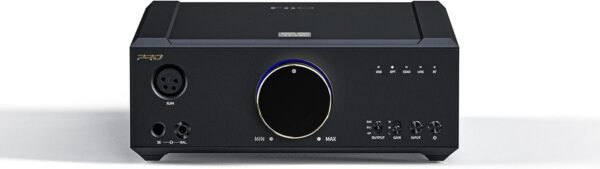
The listing publishes an output power figure without stating the load impedance it was measured into, which makes the number difficult to use for headphone matching. It also omits the output impedance of the amplifier itself, which matters because a high output impedance interacts with a headphone’s own impedance curve and can change the frequency response audibly, particularly with multi driver in-ear monitors. Signal to noise ratio, total harmonic distortion and the available output connections are all absent as well. FiiO publishes these figures, and buyers should work from the manufacturer’s sheet rather than this listing.
Package Dimensions of 14.17 x 13.46 x 6.18 inches and the 9.22 pound weight describe the shipping carton rather than the unit itself, so the actual desk footprint needs confirming separately.
The review evidence is modest. The listing shows 4.0 stars across 103 ratings, which is a smaller sample and a lower score than the strongest products in this catalog carry. It is not a warning, but it does suggest reading recent buyer feedback before committing. On the product itself, this is a mains powered desktop device with no battery, so it is not portable in any practical sense despite the word appearing in the listing title. The 115 volt rating restricts it to matching regions. And the format support is only useful to the extent a buyer’s actual library and streaming service use those formats.
Who Should Buy It, and Who Should Not
This suits an owner of demanding full size headphones who listens at a desk and wants one device to handle a computer, a phone over Bluetooth and any high resolution files they own. The power output and the codec list are the two features that justify the desktop format.
It does not suit anyone who needs portability, anyone outside a 115 volt supply region, or anyone whose headphones are easy to drive, since a much smaller and cheaper unit will reach the same volume. Those buyers should look at a portable dongle instead.