

Description
What the FiiO KA15 Is and Who It Suits
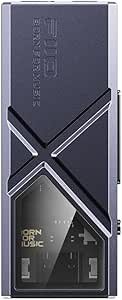
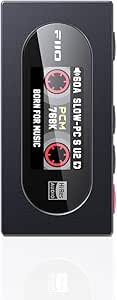
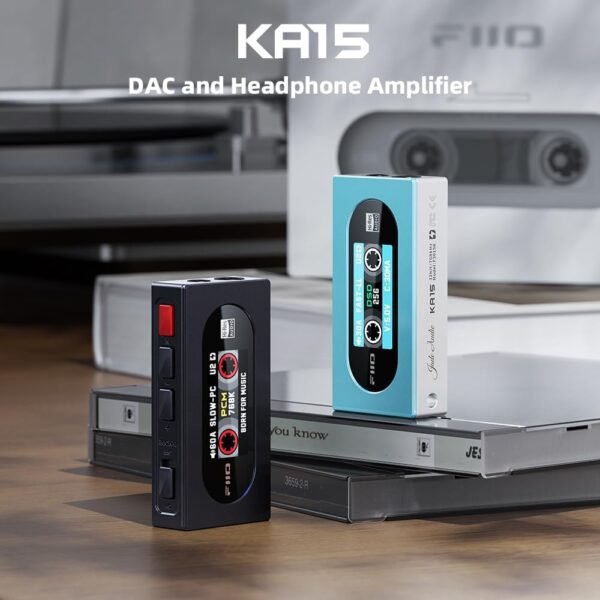
The KA15 is a USB dongle DAC and headphone amplifier, part of FiiO’s 5 series of audio dongles. It plugs into a phone, tablet or computer and takes over both digital to analog conversion and headphone amplification from the host device. The listing gives the dimensions as 2.05 by 0.98 by 0.43 inches, the compatible devices as cellphones, tablets, laptops and desktops, and a frequency range of 20Hz to 20,000Hz. It was listed in September 2024 with 83 ratings at an average of 4.6 stars.
The buyer this suits is someone using wired headphones with a phone or laptop that either has no headphone jack at all or has one that cannot drive their headphones properly. A dongle solves both problems at once without the desk space a unit like the FiiO K11 requires. Owners of demanding in-ear monitors such as the SIVGA Nightingale are a natural audience.
The Converter and Amplification Chain
FiiO specifies dual CS43198 DAC chips paired with dual SGM8262 operational amplifiers. Using two converters rather than one allows a fully differential design where each channel gets its own converter, which is the normal approach when a balanced output is offered. The op-amps handle the current delivery to the headphones.
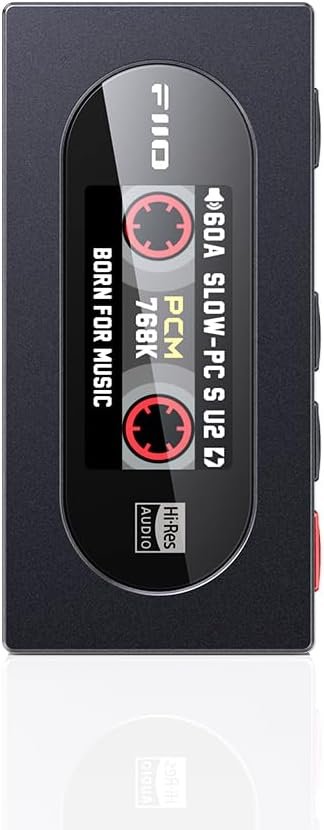
Decoding support is stated at up to 768kHz and 32 bit, along with DSD256, and the unit carries Hi-Res Audio certification. Those numbers exceed the resolution of essentially all commercially available music, which is normal for this class of device; they indicate that the converter is not the limiting factor rather than describing content anyone will play.
Desktop Mode is the feature FiiO emphasizes most. Activating it raises balanced output to 560mW per channel, which the company states is a 207 percent increase over the earlier KA5. Output power is the specification that determines whether a dongle can drive full sized headphones rather than only earbuds, and 560mW is substantial for a device of this size. FiiO states the headroom covers both low and high impedance headphones.
Parametric EQ and App Control
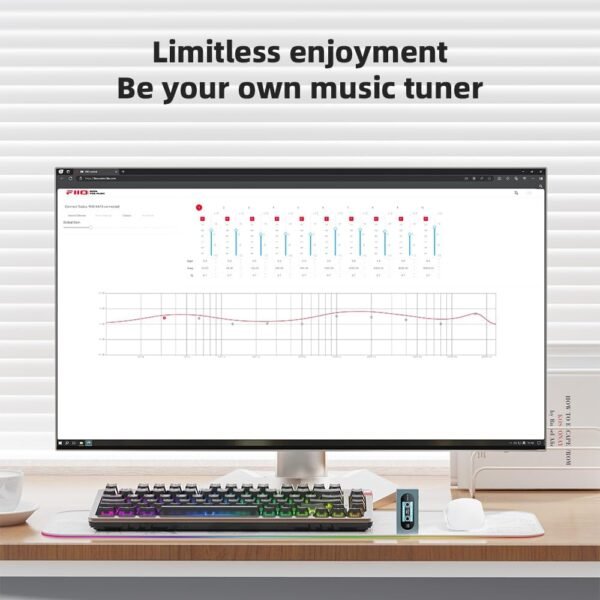
The ten band parametric EQ is more capable than the fixed presets most portable devices offer. Parametric EQ allows the center frequency, gain and bandwidth of each band to be set independently, which is what makes it possible to correct a specific dip or peak in a headphone’s response rather than applying a broad tone control. FiiO describes it as high precision and lossless, running on the device’s own DSP rather than on the phone.
Curves can be exported, imported, shared and saved, and FiiO points to both officially recommended tunings and community shared ones. That ecosystem matters more than the feature itself: a ten band EQ is only useful to someone who knows what to do with it, and shared curves lower that barrier considerably.
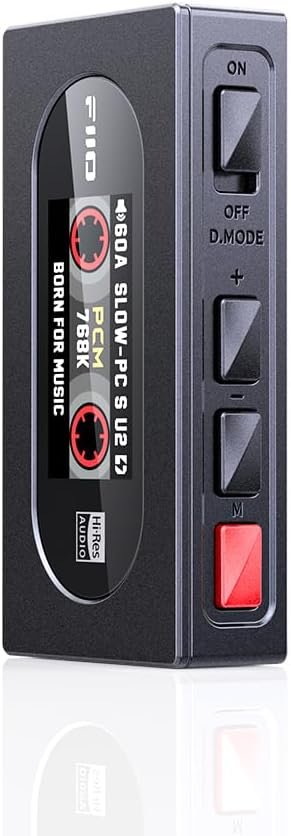
Control runs through the FiiO Control app or a web interface, covering EQ, channel balance, USB audio class mode, volume, button behaviour, screen brightness, sleep timing and theme. FiiO states explicitly that app control of the KA15 is supported only on the Android version of the app, which is a meaningful limitation for iPhone users and is stated in a footnote rather than prominently.
Screen, Power Management and Build
The 0.96 inch IPS color screen is unusual on a dongle, and FiiO claims a first in this category. It displays settings menus in Chinese or English and runs a retro interface with a simulated spinning tape animation, matching the tape recorder styling of the housing. A screen removes the guesswork from devices that otherwise communicate state through LED colors.
Power management is the practical concern with any dongle, because the device draws from the host phone’s battery. FiiO addresses this with real time voltage and current monitoring that adjusts consumption to the playback state, and an ultra low power sleep mode that engages when playback stops, so a sleep timer ending overnight does not leave the phone drained by morning. That is a genuinely well considered feature.
Several attribute fields describe a completely different product. The audio driver type is listed as dynamic driver and the earpiece shape as over ear, on a device with no drivers and no earpieces. The control method and controller type both say remote, when control is by buttons and app. The noise control field says none, which is meaningless here. The listing states one nonstandard battery is required, when the device is powered entirely by the host over USB. The headphones jack is listed only as 3.5 mm, although the bullets describe balanced output power, which implies a balanced connector as well; the listing does not state its size. The weight of 3.59 ounces describes the packaged product rather than the dongle.
Highlights
- Dual CS43198 converters with dual SGM8262 op-amps in a fully differential arrangement.
- Desktop Mode raising balanced output to 560mW per channel.
- Decoding to 768kHz/32bit and DSD256 with Hi-Res Audio certification.
- Ten band lossless parametric EQ with importable and shareable curves.
- 0.96 inch IPS color screen with menu navigation rather than LED status codes.
- Real time power monitoring and a low power sleep mode to protect phone battery life.
Things To Consider
App control is Android only. iPhone users lose access to EQ, channel balance and configuration through the app, which removes a substantial part of what the device offers.
The dongle draws power from the connected phone whenever it is in use, and Desktop Mode by definition draws more. The power management features mitigate this but do not eliminate it.
The listing does not state the connector type on the host side, the balanced output connector size, or whether adapters are included. Those are basic compatibility questions.
The attribute table describes the product as a headphone with drivers, an earpiece shape and a battery, none of which exist. Eighty three ratings is also a modest sample for a product first listed in September 2024. Anyone wanting a simpler dongle should compare the FiiO KA13, and anyone with desk space and demanding headphones should look at the FiiO K9 Pro instead. The wider amplifiers category covers both approaches.
Who Should Buy It and Who Should Not
The KA15 fits an Android user with wired headphones who wants desktop class output power in a pocket device, and who will actually use the parametric EQ and the screen. The power figures, the converter pairing and the battery aware design are all serious engineering rather than specification padding. Listeners can browse suitable wired options across the earbud headphones category.
It is a weaker choice for an iPhone user, since the app control that unlocks the EQ and configuration is Android only. It is also unnecessary for anyone using wireless headphones, where the amplification already sits inside the headphone, and for listeners whose headphones are efficient enough that a phone output already drives them well.