
Description
What the Rockville RCS80-1 Is and Who It Suits
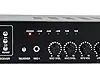
The RCS80-1 is a commercial installation amplifier rather than a home audio product, and the distinction matters. Rockville rates it at 60 watts and fits it with 70V and 100V constant voltage speaker outputs alongside conventional low impedance taps for 4, 8 and 16 ohm speakers. That output arrangement is what defines the category: constant voltage distribution lets many speakers run from one amplifier over long cable runs, which is how sound is delivered in a restaurant, a retail floor, a small office or a waiting room.
The buyer this suits is a business owner or an installer covering a space with background music and announcements. Anyone building a home listening system should look elsewhere, since constant voltage distribution trades fidelity for coverage and cable efficiency. The natural speaker partner is a ceiling model such as the Polk Audio RC60i, and a business needing louder foreground sound in one room would be better served by a powered cabinet such as the Behringer Eurolive B210D.
Outputs, Power and Installation Flexibility
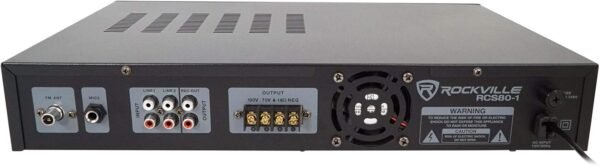
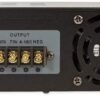
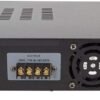
Rockville lists a red positive terminal for 100V speakers, a separate red positive terminal for 70V speakers, an 8 ohm red positive terminal, and a shared negative terminal. In practice an installer picks one distribution scheme and wires the whole zone to match. The 70V and 100V systems use step down transformers at each speaker, with a tap setting that determines how much of the amplifier’s power that speaker draws, which is how a single 60 watt amplifier can feed a dozen ceiling speakers at low level.
Sixty watts is a modest figure and sets a real limit. Distributed across many speakers it delivers background level sound, not foreground volume. For a cafe, a boutique or a small office that is the correct amount of power. For a busy bar or a large open retail space it is not, and a larger amplifier such as the Behringer KM750 would be the more appropriate starting point, albeit without the constant voltage outputs.
Inputs and Source Options
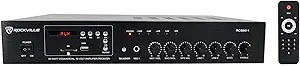
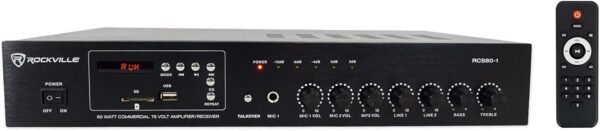
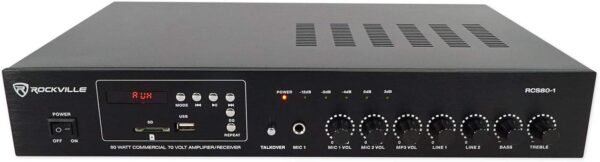
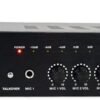
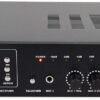
Source flexibility is the strongest part of this unit. Rockville lists two sets of RCA aux inputs, two quarter inch microphone inputs, USB, SD card and FM radio, plus Bluetooth 5.0. Each of the microphone and line sources has its own volume control, with shared bass and treble adjustment and a five segment signal level indicator.
The separate microphone volume controls are the detail that makes this a working commercial amplifier rather than a stereo receiver with extra jacks. A restaurant or a small venue needs to speak over the music without touching the music level, and independent gain per source is what allows that. The USB, SD and FM options mean the system can run without any connected device at all, which matters for a business that does not want a phone tied up behind the counter.
Bluetooth 5.0 handles casual streaming from a phone or tablet. Rockville describes the signal as stable with long range capability; range in a commercial building with walls and metalwork will be considerably shorter than any open space figure.
Physical Format, Cooling and Listing Contradictions
Rockville describes the chassis as a lightweight rack mount design at 19 inches wide, with a built in cooling system to keep components cool during continuous operation. A 19 inch width is the standard rack unit dimension, so this can live in an equipment rack alongside other gear. Continuous duty cooling is important in commercial use, where an amplifier may run open to close every day.
The specification table, however, disagrees with the marketing copy in several places. The mounting type is listed as surface mount rather than rack mount. The number of channels is given as four, which does not match a single zone 60 watt amplifier with one set of distribution outputs. The voltage field lists 100 volts, 120 volts and 70 volts together, mixing the mains supply voltage with the speaker line voltages, and a separate maximum supply voltage field reads 1.2E+2 Volts, which is 120 volts written in scientific notation. The package dimensions are given as 18.75 by 12.5 by 6.5 inches, slightly under the stated 19 inch chassis width, which suggests those are shipping figures rather than the unit itself.
None of these errors change what the amplifier does, but they mean the specification table should not be used for planning a rack layout or an electrical install. Work from Rockville’s manual instead. The listing gives the weight as 13 pounds, the country of origin as China, and shows 112 ratings at an average of 4.2 stars since March 2019.
Highlights
- 70V and 100V constant voltage outputs plus 4, 8 and 16 ohm taps in one unit.
- Two microphone inputs with independent volume controls for announcements over music.
- Bluetooth 5.0, USB, SD card, FM radio and two RCA aux inputs.
- RCA record output for capture or for chaining to another amplifier or processor.
- Five segment level metering with bass and treble adjustment.
- Built in cooling designed for continuous commercial operation.
Things To Consider
Sixty watts is the binding constraint. Constant voltage systems divide power among speakers, so a large installation will run out of headroom quickly. Anyone planning more than a handful of ceiling speakers should calculate total tap wattage before buying rather than after.
This is a mono amplifier for a distributed system. There is no stereo imaging in a 70V install by design, and buyers expecting a stereo listening experience have misunderstood the product category.
The specification table contains multiple contradictions, described above, including a channel count and a mounting type that do not match the product description. Treat it as unreliable.
The listing does not state the microphone input impedance, whether phantom power is available, or the frequency response of the amplifier. Phantom power in particular matters: without it, only dynamic microphones will work, which rules out most condenser models. A rugged dynamic handheld such as the PylePro PDMIC78 is the safe assumption for an amplifier with no stated phantom power.
Who Should Buy It and Who Should Not
The RCS80-1 fits a small business that needs music and paging across several ceiling or wall speakers from one inexpensive box, with a range of source options and no dependence on a phone. The 70V and 100V outputs, the dual microphone channels and the built in media playback cover that brief directly. Buyers comparing options can look through the wider amplifiers category, and should plan the speaker side alongside it in the ceiling and in-wall speakers category.
It is the wrong amplifier for a home stereo, for anything requiring high volume, or for an installation large enough to need more than 60 watts of total tap power. It is also unsuitable for anyone needing condenser microphones without confirming phantom power support first.