Description
What the Behringer KM750 Is and Who It Suits
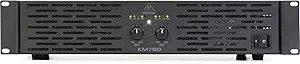
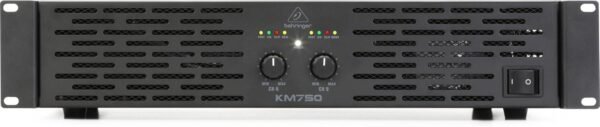
The Behringer KM750 is a two channel professional power amplifier. Behringer describes it as a 750 watt stereo power amplifier with ATR, which the company expands as Accelerated Transient Response. It is a dedicated power stage, which means it takes a line level signal from a mixer or a processor and drives passive loudspeakers. It is not an integrated amplifier, it has no streaming, and it has no tone controls. That single job is the whole point of the product category.
The audience is anyone running passive speakers who needs more headroom than a powered box provides. That covers small live sound rigs, houses of worship, school halls, rehearsal rooms and fixed installations where the amplifier lives in a rack and rarely moves. Behringer lists the product under Musical Instruments, Live Sound and Stage, and Power Amplifiers, which is a fair description of the intended market. Anyone building a portable rig from active cabinets instead can skip this category and look at self powered options such as the Behringer B210D powered speaker.
Power Rating, Channels and What ATR Means
The listing gives Number of Channels as 2 and Output Power as 7.5E+2 Watts, which is scientific notation for 750 watts. Wattage is separately listed as 750 watts. Behringer does not state in this listing how that figure divides across the two channels or at which impedance it is measured, and those two variables change the number substantially. Amplifier power ratings are only comparable when the load impedance and the measurement standard are stated, so buyers matching this to a specific cabinet should check Behringer’s own manual for the per channel figures at 4 and 8 ohms rather than working from the headline number.
ATR, or Accelerated Transient Response, is Behringer’s name for circuitry intended to improve how quickly the amplifier responds to sudden peaks in the signal. Transients are the sharp leading edges of sounds such as a snare hit or a slapped bass string, and an amplifier that smears them makes a system sound soft. The claim is Behringer’s, made in its own product description, and there are no published measurements in the listing data to place alongside it. It is reported here as a stated design goal rather than a demonstrated result.
Chassis, Weight and Rack Integration
Physical dimensions are listed at 21.2 x 16.85 x 6.95 inches with a weight of 18.74 pounds. That footprint and depth are consistent with a rack mountable chassis, although the listing gives Mounting Type as Tabletop, which is one of several places where the imported data does not match the product class. A 6.95 inch height corresponds roughly to a four rack unit face, and the depth means a shallow rack case will not close behind it. Anyone planning a portable rack should measure before buying, because depth is where most amplifier rack plans fail.
The color is listed as Black and the power source as Corded Electric. Specification Met is given as FCC. Two different UPC values appear in the listing, 748252164544 and 642892767083, along with two Global Trade Identification Numbers. That usually indicates the same model sold through more than one distribution channel or a repackaged revision, and it is worth mentioning because it can complicate a warranty claim. Buyers pairing this with passive cabinets can see the kind of loudspeakers it is meant to drive in the PreSonus CDL12P and the ProReck Club 4000.
Where It Fits in a Live Rig
A separate power amplifier makes sense when the speaker cabinets are passive, when the amplifier needs to sit in a rack away from the stage, or when one amplifier needs to drive several zones through a distribution system. It stops making sense when the whole rig is built from active boxes with amplification already inside, which is the more common approach for small mobile setups today. The Mackie SRM150 illustrates that alternative for a compact PA, and the Behringer B210D shows how a powered cabinet handles the same job in a single enclosure.
Behringer positions the KM750 at the value end of the professional market, and the listing shows a customer rating of 4.4 stars across 144 ratings along with a sales rank of number 93 in Power Amplifiers. Those figures describe demand and buyer sentiment on the retail listing, not measured performance. Readers assembling a full front of house chain will also want to look at signal sources and processing, and the Tone Hammer bass preamp covers a preamp stage of the kind that feeds an amplifier like this one.
Highlights
- Two channel design rated by Behringer at 750 watts with ATR transient circuitry.
- Corded electric operation with FCC listed under Specification Met.
- Chassis listed at 21.2 x 16.85 x 6.95 inches, sized for a standard equipment rack.
- 18.74 pound weight is manageable for a one person load in and out.
- Listed as not discontinued by the manufacturer, first available in August 2016.
- Carries a 4.4 star customer rating across 144 ratings on the source listing.
Things To Consider
The listing does not state per channel power at a given impedance, does not state the cooling arrangement, and does not state whether the amplifier supports bridged mono operation. Those are the three questions that decide whether an amplifier suits a particular speaker load, and none of them can be answered from the imported data. The Mounting Type entry of Tabletop conflicts with the chassis dimensions, which describe a rack unit. Buyers should treat the manufacturer manual as the authority here rather than the retail specification block.
Fan noise is the standard trade for this class of amplifier and the listing says nothing about it, so anyone installing this in a quiet room, a recording space or a small chapel should assume it is audible until proven otherwise. The product first became available in August 2016, so it is a long running design rather than a current generation release. That means mature production and plenty of units in circulation, but also an older feature set than newer class D competitors with onboard digital signal processing.
Who Should Buy It, and Who Should Not
This suits a buyer who already owns passive cabinets and needs a rack amplifier to drive them, or who is building a fixed install where the amplifier is out of sight and out of earshot. It also suits a rehearsal room or a school hall where robustness matters more than a refined feature list.
It does not suit home listening, where fan noise and a lack of input switching make it awkward, and it does not suit anyone whose speakers already contain their own amplification. Buyers in that position should look at active alternatives instead, and can start with the PA systems category to see what a self powered rig looks like.