


Description
What the CCA C12 Is and Who It Suits
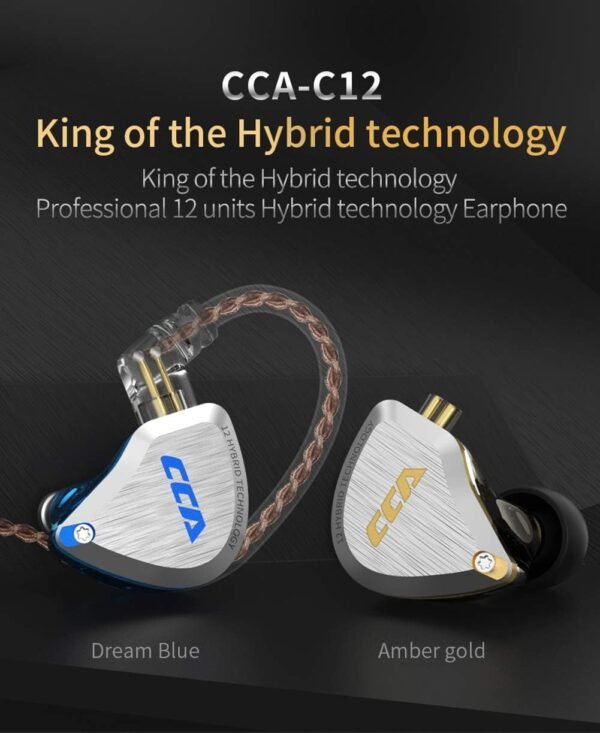
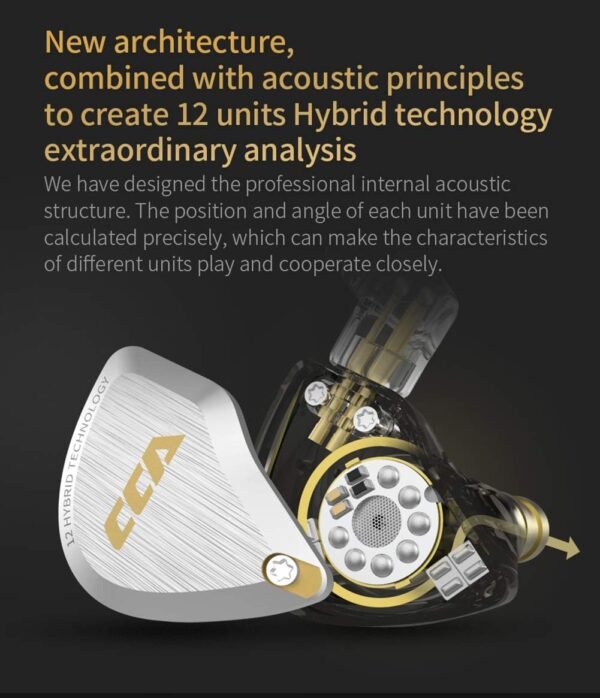
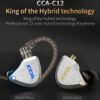
The CCA C12 is a wired in-ear monitor built around a hybrid driver array. CCA publishes an unusually complete specification for a retail listing: one dynamic driver plus five balanced armature drivers per side, a 3.5 mm plug, a 0.75 mm two pin detachable cable of roughly 125 cm, an impedance of 24 ohms, a sensitivity of 112 dB per milliwatt, and a frequency range of 7 Hz to 40 kHz. The box contains the earphones, three pairs of eartips in small, medium and large, the detachable cable, a manual and a one year warranty. This particular version is listed without a microphone, in the Dream Blue finish.
In-ear monitors of this type came out of stage use, where a performer needs to hear a personal mix while standing in front of a loud PA. The same design has been adopted by listeners who want isolation and detail from a small package. The buyer here is someone exploring the enthusiast end of wired audio without a large budget. Readers comparing directly should look at the Linsoul KZ ZS10 Pro, which uses a similar hybrid approach, and the Etymotic ER3XR for a very different single driver philosophy.
Hybrid Drivers: What Five Armatures Plus One Dynamic Actually Does
The two driver types work differently and have complementary strengths. A dynamic driver moves a cone or dome with a voice coil in a magnetic field, and it excels at low frequencies because it can move a relatively large volume of air. A balanced armature is a tiny sealed mechanism originally developed for hearing aids, and it is fast and efficient across the midrange and treble but poor at moving enough air for deep bass.
A hybrid puts the dynamic driver on bass duty and hands the rest of the range to the armatures, with a crossover network dividing the signal. Done well, this gets the low frequency authority of a dynamic with the speed and detail of armatures. The engineering difficulty is the crossover: each driver has its own response and phase behavior, and blending six drivers per side into a coherent whole is harder than tuning one. Driver count is a marketing number rather than a quality measure, and a well tuned single driver design will outperform a poorly integrated six driver one every time. The Moondrop Chu II DSP represents that alternative single driver approach.
Impedance, Sensitivity and What Drives Them
The published figures here are genuinely useful. An impedance of 24 ohms and a sensitivity of 112 dB per milliwatt describe a very easy load: these will play loudly from a phone, a laptop or the cheapest dongle. That is characteristic of multi armature designs, which are efficient by nature.
High sensitivity has a downside that buyers rarely hear about. A very efficient in-ear reveals noise in the source, so a hissy amplifier that sounds fine with full size headphones can be audibly noisy with these. It also means the usable volume range on a device may be compressed into the first few steps of the control. A clean source matters more than a powerful one for earphones like these, and the FiiO KA13 dongle covers a compact option built for that job. The wider amplifiers category has more.
The Detachable Cable and Long Term Ownership
The 0.75 mm two pin detachable connector is one of two common standards in this segment, and its presence is a practical benefit rather than a luxury. Cables are the part that fails on any wired earphone, usually at the point where the cable meets the plug or the earpiece. A detachable cable means that failure costs a cable rather than the whole product, and it also opens the door to replacing the stock cable with a different length, a microphone equipped version, or a balanced termination.
Three pairs of eartips in the box addresses the other variable that decides whether an in-ear works: the seal. Without a proper seal, an in-ear loses most of its bass and most of its isolation at once, and the correct tip size is rarely the one people assume. CCA also lists a one year warranty from the date of purchase. Listeners who want a sealed alternative with a different tuning philosophy can look at the Sivga Nightingale.
Highlights
- Six drivers per side: one dynamic for bass plus five balanced armatures.
- Published impedance of 24 ohms and sensitivity of 112 dB per milliwatt.
- Detachable 0.75 mm two pin cable, so a cable failure is a cheap repair.
- Three pairs of eartips included for fitting the seal correctly.
- Metal construction listed under material.
- Carries a 4.5 star rating across 1,322 ratings on the source listing.
Things To Consider
Several specification fields contradict the product description. Recommended Uses For Product is listed as Calling, and Control Type is given as Media Control, on a version that CCA’s own title explicitly states is sold without a microphone and therefore has no controls at all. Compatible Devices is listed only as Cellphones. Frequency Response is recorded as a single value of 40000 Hz, which is the upper bound of the range published elsewhere. Item Weight of 2.29 ounces and package dimensions of 3.82 x 2.87 x 1.22 inches describe the retail package.
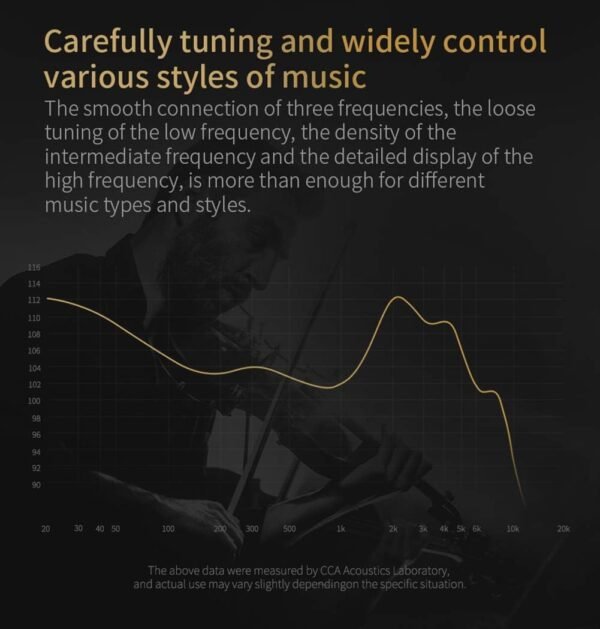
The frequency range claim also needs context. A stated 7 Hz to 40 kHz carries no tolerance figure, and no headphone is flat across that span. Numbers of this kind describe the limits at which some output is measurable rather than anything about how the earphone sounds, and they should not influence a purchase.
Practical limitations are those of the category. Sealed in-ears block outside sound, which is a safety consideration for walking or cycling. Fit takes experimentation and the supplied tips may not suit every ear, so buyers should be prepared to try aftermarket tips. There is no microphone on this version, so calls are not supported unless a different cable is purchased. Multi driver in-ears can also be physically larger in the ear than single driver models, which affects comfort for smaller ears. And CCA does not publish crossover detail or an independently measured response, so the tuning has to be judged from user feedback rather than data.
Who Should Buy It, and Who Should Not
These suit a listener starting to explore wired in-ear monitors who wants a detachable cable, an easy to drive load and a hybrid driver arrangement, and who is willing to spend a little time getting the eartip seal right. The large body of buyer feedback behind the score is reassuring at this level.
They do not suit anyone who needs a microphone for calls, since this version does not have one, and they do not suit a listener who wants awareness of their surroundings. Buyers who need calls should look at the version with a microphone or at a wireless model with a built-in one.