
Description
What the Moondrop CHU II DSP Is and Who It Suits
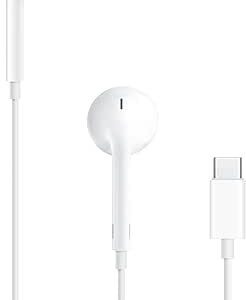
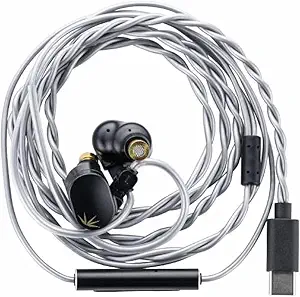
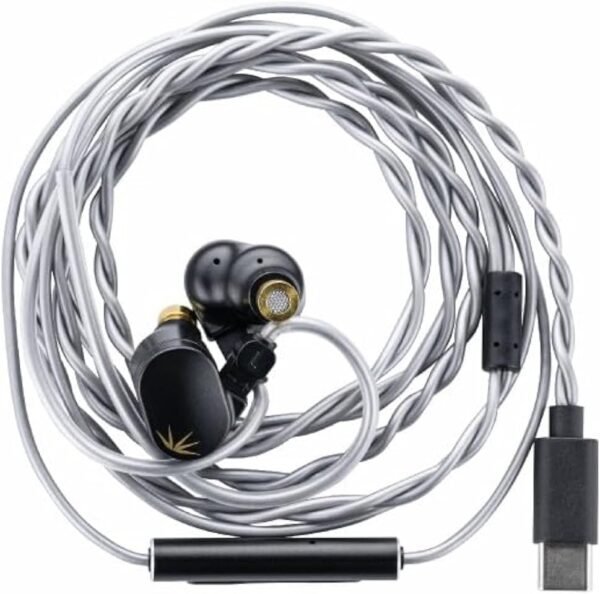
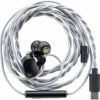
The CHU II DSP is a wired in-ear monitor with an unusual connection: instead of a 3.5 mm analog plug, the cable terminates in USB-C and carries its own digital signal processing and conversion. The listing specifies a single dynamic driver of 10 millimeters, aluminum housings, a detachable cable, a frequency range of 15Hz to 38kHz and compatibility with devices having a USB-C port. It ships with a leather case, small, medium and large ear tips, a manual, a certificate and a wearing card, and was listed in January 2024.
The buyer this suits is someone using a phone or laptop with no headphone jack who wants wired sound quality without carrying a separate dongle. The DSP version puts the conversion inside the cable, so the earphone works directly from a USB-C port. Anyone whose device has a 3.5 mm jack, or who owns a separate dongle DAC such as the FiiO KA13, should buy an analog terminated earphone instead and keep the flexibility.
The USB-C DSP Approach
Putting a DAC and DSP into the cable solves a specific modern problem. Phones without headphone jacks force a choice between wireless, a dongle, or an earphone with a built in converter. The third option is the tidiest: one cable, no extra hardware to lose, and no Bluetooth codec in the signal path.
The tradeoff is loss of universality. An earphone terminated in USB-C cannot plug into a 3.5 mm jack on an aircraft entertainment system, a portable player, a desktop amplifier or a mixing desk. It also cannot use a different DAC, because the conversion is fixed in the cable. Whether that matters depends entirely on how the buyer listens.
Because the cable is detachable, an analog cable could in principle replace it, and Moondrop sells the CHU II in a standard analog version. Buyers should confirm connector compatibility before assuming a swap is possible, since detachable connector standards vary between models.
The Single Dynamic Driver
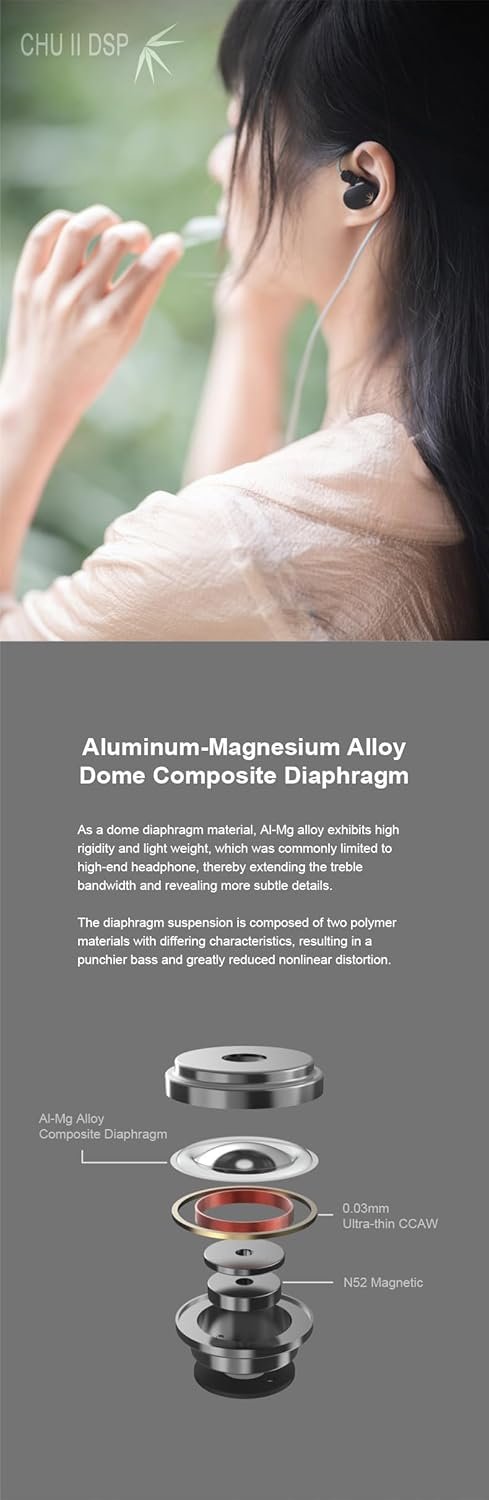
A 10 millimeter dynamic driver is the conventional approach for an in-ear monitor at this level, and there is a good argument for it. A single driver has no crossover, so there is no phase interaction between drivers and no crossover point where two different transducers hand over. Multi driver designs such as the KZ ZS10 Pro and the CCA C12 trade that coherence for greater specialization across the frequency range.
The stated 15Hz to 38kHz range extends well beyond the audible band at both ends. As with all such figures, the numbers indicate that the driver is not artificially limited rather than describing anything a listener will hear. The specification table gives the frequency response in a separate field as 3.8E+4 Hz, which is 38,000 Hz written in scientific notation and duplicates the upper bound.
Build, Fit and Accessories
Aluminum housings are a step up from the resin and plastic used at the very bottom of this category, and they hold up better to being carried loose in a pocket. The earpiece shape is described as rounded tips, and three ear tip sizes are supplied, which is the minimum expectation for any sealed in-ear design and is met here.
The detachable cable is the most important durability feature. Cable failure at the strain point is how almost every wired earphone eventually dies, and a detachable design converts that from a write off into a replacement. The accessory list is generous for the price point: a leather case, a wearing card explaining orientation, a certificate and a manual.
Noise handling is passive only. The seal between the ear tip and the canal blocks outside sound, and there is no active cancellation. That is normal for a wired in-ear monitor and is not a shortcoming, though buyers coming from wireless earbuds with ANC should understand the difference.
Several attribute fields do not fit the product. The control type and control method are both listed as touch, on a passive earphone whose only electronics sit in the cable and which has no touch surface. The wireless communication technology field reads nonsupport, which appears to be an untranslated way of saying wired. A theme field contains an escaped fragment reading audio equipment or headphones, which is stray data. The driver size is given as 1E+1 millimeters, which is 10 mm in scientific notation. The item weight of 3.87 ounces and the package dimensions of 3.94 by 3.54 by 1.93 inches describe the retail box.
What the listing does not state is more consequential: there is no impedance figure, no sensitivity rating, no output power for the built in DSP, no information on whether EQ or tuning options are available through an app, and no customer rating data in the product record.
Highlights
- USB-C termination with conversion in the cable, so no separate dongle is needed.
- Single 10 mm dynamic driver with no crossover in the signal path.
- Aluminum housings rather than resin or plastic.
- Detachable cable, making cable failure a repair rather than a replacement.
- Leather case and three ear tip sizes included.
- Stated range of 15Hz to 38kHz, indicating an unrestricted driver.
Things To Consider
USB-C only means these will not connect to a 3.5 mm jack. Aircraft entertainment systems, older phones, portable players and desktop amplifiers are all out of reach without an adapter that may not exist for a digital connection.
The conversion quality is fixed in the cable and completely undocumented. No output power, no DAC chip and no supported sample rate appears in the listing, so there is no way to assess it.
There is no customer rating data in the product record, so no owner feedback signal is available, and no impedance or sensitivity figure is published.
The attribute table lists touch controls on a passive earphone and contains an untranslated field and a stray theme entry. Buyers wanting an analog connection with a similar single driver approach should compare the Etymotic ER3XR, and anyone wanting planar drivers in an in-ear should look at the SIVGA Nightingale. The wider earbud headphones category covers both.
Who Should Buy It and Who Should Not
The CHU II DSP fits someone whose phone or laptop has USB-C and no headphone jack, who wants wired listening without a dongle, and who values a detachable cable and metal housings at a modest price. The single driver design and the accessory set are both sensible for the category.
It is the wrong purchase for anyone who needs to plug into a 3.5 mm jack, for a listener who already owns a good dongle DAC and would rather choose their own conversion, or for someone using a device with a Lightning port. Those buyers should choose the analog version of the same earphone or an equivalent.