Description
What the Klipsch R-12SW Is and Who It Suits
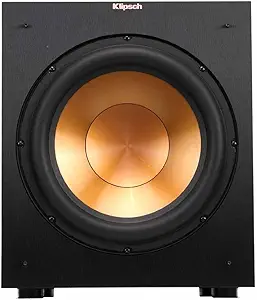
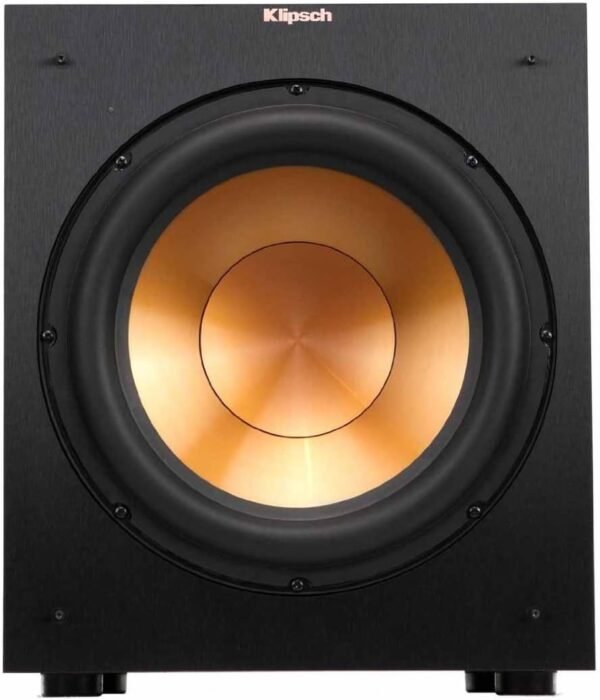
The Klipsch R-12SW is a front firing powered subwoofer built around a 12 inch copper spun woofer. Klipsch states 400 watts of power, a frequency response of 29 Hz to 120 Hz, an integrated low pass crossover with phase control, and both LFE and line level inputs for installation flexibility. The cabinet is MDF finished in brushed black vinyl, listed at 14 inches wide by 18.5 inches deep by 16 inches high. It first became available in August 2014 and carries a 4.7 star rating across 5,593 ratings, one of the largest samples in this catalog.
A 12 inch driver is the size at which a subwoofer stops being a supplement and starts being the foundation of a system. This is the model for a living room home theater or a music system where the main speakers cannot carry the bottom octaves. Buyers with less space should compare the Klipsch R-8SW, which uses an 8 inch driver in a much smaller cabinet, while those pairing it with speakers can look at the Klipsch R-51M bookshelf speakers.
Front Firing, Driver Size and Frequency Response
The published response of 29 Hz to 120 Hz is the most useful figure in this listing, and it is a genuinely low number. Most film soundtrack effects and the fundamental notes of an electric bass or a pipe organ live above 29 Hz, so a subwoofer that reaches that far covers nearly everything a home system will encounter. It should be noted that no tolerance figure accompanies the range, which is standard practice in consumer listings and means the number describes usable output rather than a flat response.
Front firing means the driver faces into the room rather than at the floor. That gives a more direct path to the listener and makes the subwoofer less sensitive to what it is standing on, where a down firing design depends on the floor surface. It also makes the cabinet deeper, which is why this one is 18.5 inches from front to back. Klipsch’s copper spun cone finish is a visual signature across the range, and the driver material choice is where the company balances cone stiffness against mass. The Klipsch RP-1400SW uses the same design language in a smaller cabinet.
Crossover, Phase and Setting It Up
Klipsch lists an integrated low pass crossover and phase control, and describes them as allowing the sound to be optimized for the listening environment. Those two controls do more for the result than the driver size does, and they are the ones most often left at their factory positions.
The crossover sets the upper limit of what the subwoofer plays, and it needs to hand over to the main speakers cleanly. Set too high, the subwoofer becomes locatable and voices sound thick; set too low, there is a gap in the response. When the receiver is doing the crossover through its LFE output, the subwoofer’s own control should normally be set to its maximum so it does not filter twice. Phase adjusts the timing relationship with the main speakers, and the correct setting is simply the one that produces the most bass at the listening seat. Owners integrating this into a Klipsch system will find the matching center in the Klipsch R-52C.
Inputs, Placement and Room Behavior
Both LFE and line level inputs are provided, which Klipsch links to compatibility with old and new receivers. An LFE input takes the dedicated subwoofer output from a modern receiver that has already applied its own crossover. Line level inputs take a stereo signal from an older amplifier with no subwoofer output, in which case the subwoofer’s internal crossover does the work. Choosing the wrong one is the most common setup mistake with any subwoofer.
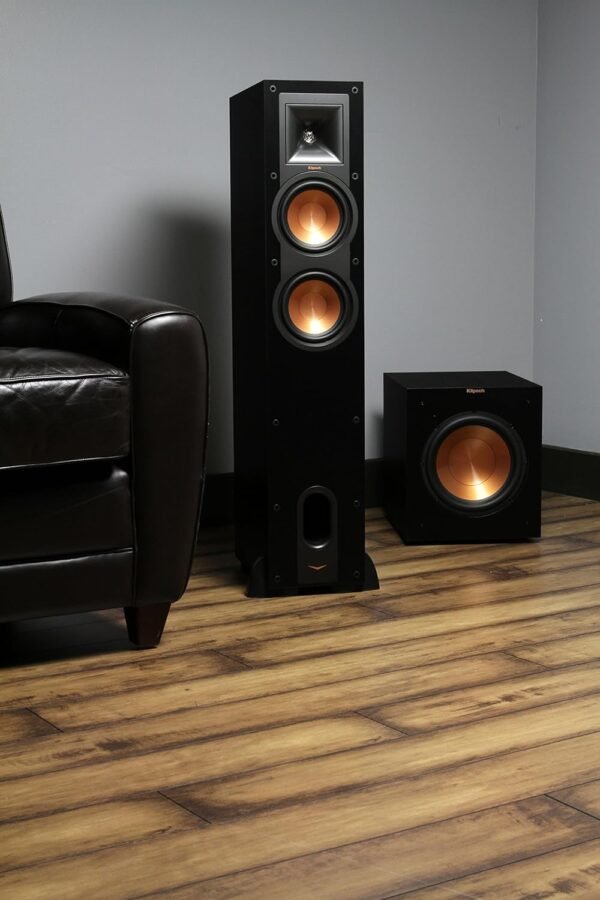
Placement matters more than any specification. Low frequencies form standing waves in a room, which means the same subwoofer will sound powerful in one position and thin in another with nothing changed but its location. Moving it along a wall and listening from the main seat costs nothing and improves the result more than any setting. For owners who want the subwoofer somewhere a cable cannot easily reach, the Klipsch WA-2 wireless kit addresses that on compatible models. Alternatives at other sizes appear across the subwoofers category.
Highlights
- 12 inch copper spun woofer in a front firing MDF cabinet.
- Klipsch states 400 watts of digital power.
- Published frequency response of 29 Hz to 120 Hz.
- Low pass crossover and phase control for blending with the main speakers.
- Both LFE and line level inputs for modern and older receivers.
- 4.7 stars across 5,593 ratings on the source listing, a very large sample.
Things To Consider
The specification block for this product is among the worst in this catalog and should be disregarded entirely in favor of the manufacturer’s description. Item Weight is listed as 0.01 ounces, which for a 12 inch MDF subwoofer is off by roughly five orders of magnitude. Power Source is listed as Battery Powered on a mains connected powered subwoofer. Special Feature includes Built In Microphone, which this product does not have. Control Method is given as Remote, and there is no remote. Maximum Range reads 20 Meters, which is a wireless figure on a wired product. Vehicle Service Type is listed as Car. Surround Sound Channel Configuration reads 5.1 for a single subwoofer. None of this describes the product.
The 400 watt figure also needs care, because the listing does not state whether it is continuous or peak. Klipsch describes it as digital power, which suggests a class D amplifier, but comparing this number against another manufacturer’s continuous rating would be misleading. Klipsch’s own specification sheet is the place to resolve it.
Physically, this is a large box. At 18.5 inches deep it takes real floor space, and a 12 inch subwoofer in a small room can be too much of a good thing, exciting room modes that make bass boomy rather than deep. Apartment dwellers should also consider that low frequencies transmit through building structure far more readily than midrange does. The connection is wired only, and the design dates from 2014, though its continued strong sales rank suggests it remains competitive.
Who Should Buy It, and Who Should Not
This suits a medium to large room where a subwoofer needs to carry film effects and musical bass properly, and where there is floor space for a cabinet of this size. The published response figure, the dual inputs and the crossover and phase controls make it straightforward to integrate.
It does not suit a small room, an apartment with sensitive neighbors, or a setup where the subwoofer must be discreet. Buyers in that position should step down to an 8 or 10 inch model and accept less extension in exchange for a cabinet that fits.