Description
What the Klipsch RP-1400SW Is and Who It Suits
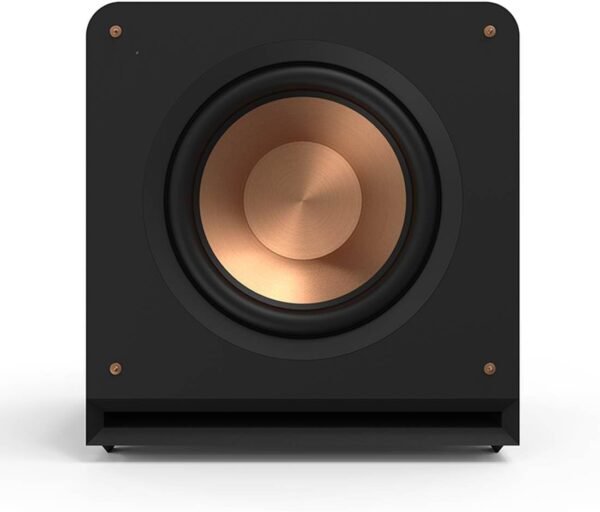
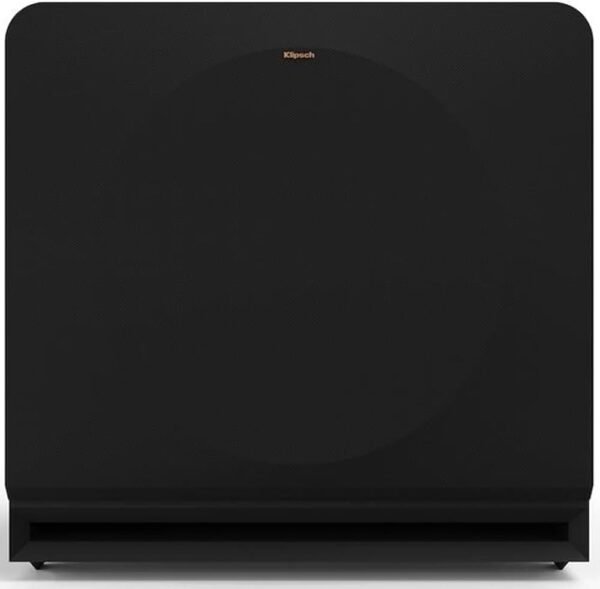
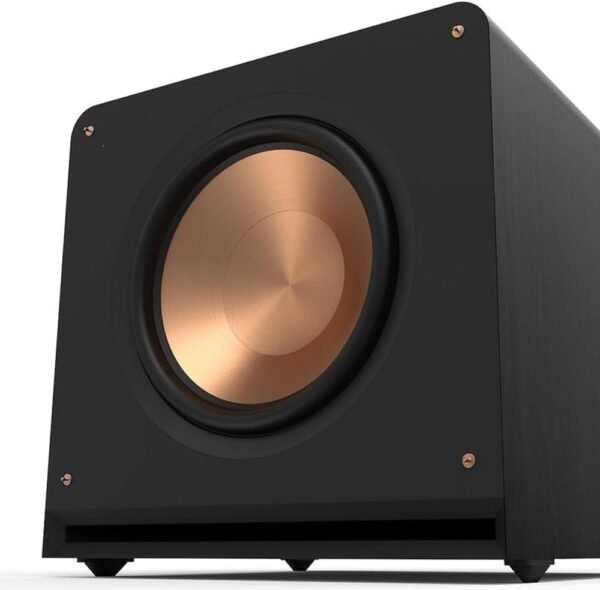
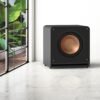
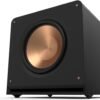
The RP-1400SW is the largest subwoofer in Klipsch’s Reference Premiere range, built around a 14 inch high excursion Cerametallic woofer with a Class D amplifier rated in the listing at 500W RMS. The cabinet measures 25.67 inches deep by 20 inches wide by 21.34 inches high and weighs 85 pounds, finished in a scratch resistant ebony vinyl with rounded corners, rubber feet, steel grille posts and a woven cloth grille. It was listed in January 2023 and shows 28 ratings at an average of 4.0 stars.
The buyer this suits is someone building a serious home theater in a medium to large room, with the floor space and the structural tolerance for a subwoofer this size. This is not a subwoofer for an apartment or a small living room. Anyone in that position should look at the far more manageable Klipsch R-8SW or the mid sized Klipsch R-12SW.
The 14 Inch Driver and the Amplifier
Driver diameter is the most fundamental specification on a subwoofer, because low frequency output depends on how much air the cone can move. A 14 inch driver has roughly 36 percent more cone area than a 12 inch and more than twice that of a 10 inch, which translates directly into more output at low frequencies for the same excursion.
Klipsch describes the woofer material as Cerametallic, a ceramic coated aluminum used across its range, chosen for stiffness at low mass. A stiffer cone resists flexing at high excursion, which is where distortion appears in subwoofer drivers. High excursion means the cone travels further than a conventional driver, extending output at the lowest frequencies.
The amplifier is Class D with what Klipsch describes as an analog preamp design. Class D output stages are efficient, which matters because a 500W amplifier of an older class would need substantial heatsinking and would run hot. Retaining an analog preamplifier stage means the signal is not digitized before amplification, which Klipsch presents as preserving the original signal path.
The 500W RMS figure appears only in a special feature field rather than as a formal specification. RMS is the meaningful measure for continuous power, as opposed to peak figures, so it is a more useful number than most subwoofer ratings, though the listing does not state the measurement conditions.
Front Firing and the Aerofoil Port
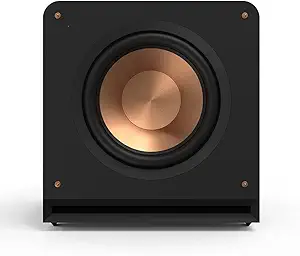
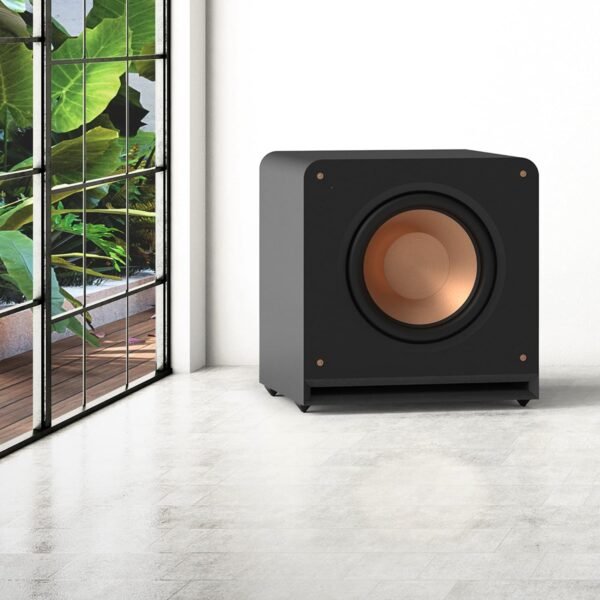
Klipsch makes a placement argument built on two design decisions. The driver fires forward rather than downward, and the port is a slot on the front face rather than a tube at the rear. Both mean the subwoofer does not need clearance behind it or beneath it, so it can sit against a wall or inside a cabinet opening without the port being obstructed.
Port turbulence is a real problem on high output subwoofers. Air moving fast through a port generates audible chuffing that is unrelated to the music, and the Aerofoil geometry Klipsch describes is a shaping approach to reduce it. The practical benefit is cleaner output at high levels rather than a change in tonal character.
The claim that this allows placement anywhere should still be read with care. Room acoustics affect subwoofer placement more than any other component, and a corner placement will produce very different bass from a mid wall position regardless of how the cabinet is ported. Room correction from a receiver such as the Pioneer Elite VSX-LX305 is the practical tool for managing that.
Connections, Size and Listing Problems
The connectivity protocol field lists wired RCA, LFE and WA-2 wireless. The WA-2 reference is important: it means the subwoofer accepts Klipsch’s wireless kit, which is sold separately as the Klipsch WA-2, not included here. Buyers wanting a wireless connection should budget for it.
Eighty five pounds is the practical constraint. This is a two person lift, it needs a floor that will not transmit its output into a neighboring property, and at 25.67 inches deep it protrudes considerably from a wall. The ebony vinyl finish is described as scratch resistant and covering the entire cabinet, with rounded corners and shock absorbing feet.
Several specification fields are simply wrong. The wireless communication technology is listed as optical, which is not a wireless technology and is not how this subwoofer connects. A vehicle service type field reads car, which is absurd on an 85 pound home theater subwoofer. The control method is listed as remote although no remote appears in the included components, which list only the subwoofer. The controller type reads corded electric, a surround sound channel configuration of 5.1 is listed on a single subwoofer, and processor count and circuit count fields appear that mean nothing here.
Klipsch’s own description also makes an unverifiable superiority claim about the product relative to everything else available, which should be read as marketing rather than assessment.
Highlights
- 14 inch high excursion Cerametallic driver, the largest in the Reference Premiere range.
- 500W RMS Class D amplifier with an analog preamplifier stage.
- Front firing driver and front slot port, so no rear or floor clearance is required.
- Aerofoil port geometry aimed at reducing turbulence noise at high output.
- Scratch resistant full cabinet finish with rounded corners and shock absorbing feet.
- Compatible with the Klipsch WA-2 wireless kit for cable free connection.
Things To Consider
Eighty five pounds and a 25.67 inch depth make this a major piece of furniture. Measure the space and consider the floor before ordering.
Twenty eight ratings at 4.0 stars is a small sample and a moderate average for a flagship product. There is not much owner data to draw on.
The WA-2 wireless kit is not included, so a wired RCA or LFE run from the receiver is required unless it is purchased separately.
The specification table contains a vehicle service type of car, an optical wireless technology and a remote control method on a product with none of those. No frequency response, crossover range or phase control detail is published. In a shared building, a subwoofer of this output is a neighbor relations issue as much as an audio one. Buyers should compare across the subwoofers category before committing.
Who Should Buy It and Who Should Not
The RP-1400SW fits a dedicated home theater in a detached house with a large room, matched to full range speakers and a receiver with room correction. The driver size, the RMS rating and the front firing port design are all serious engineering aimed at high output. Pairing with a matched center channel such as the Klipsch R-52C keeps the tonal character consistent.
It is the wrong subwoofer for an apartment, a small room, or any situation where 85 pounds and 25 inches of depth are a problem. It is also unnecessary for music only listening, where a smaller sealed subwoofer usually integrates better with stereo speakers.