Description
What the FIFINE AM8T Is and Who It Suits
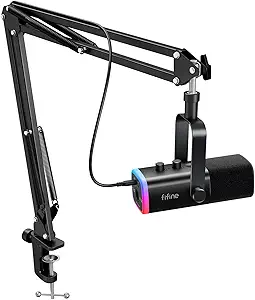
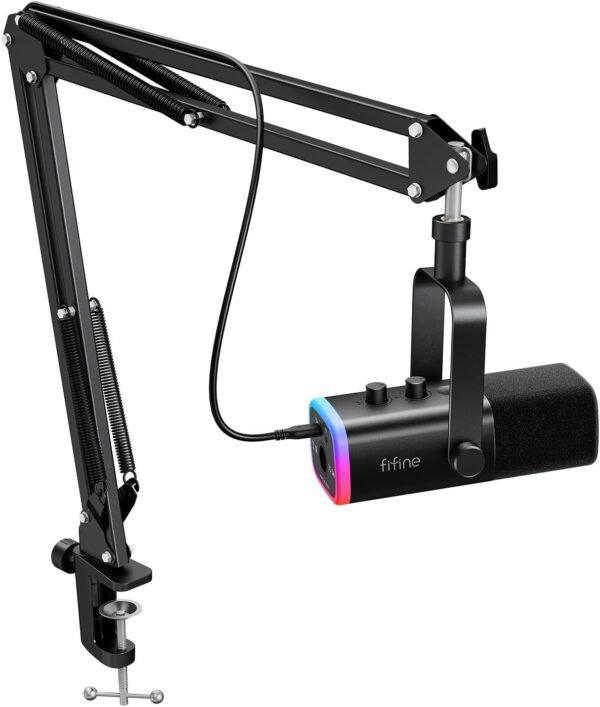
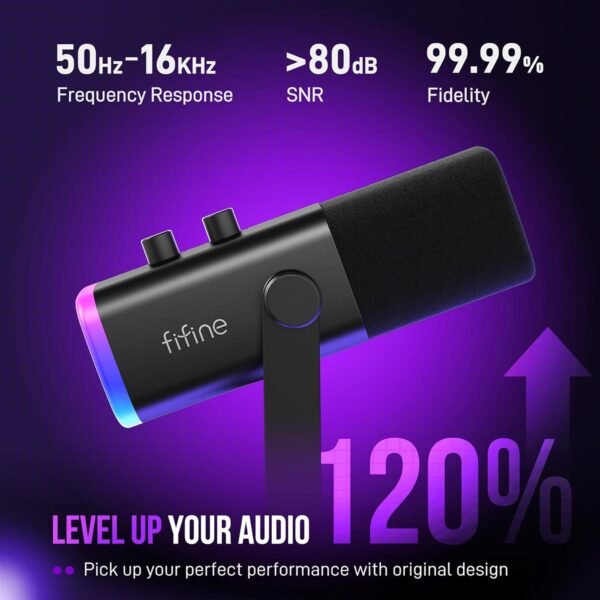
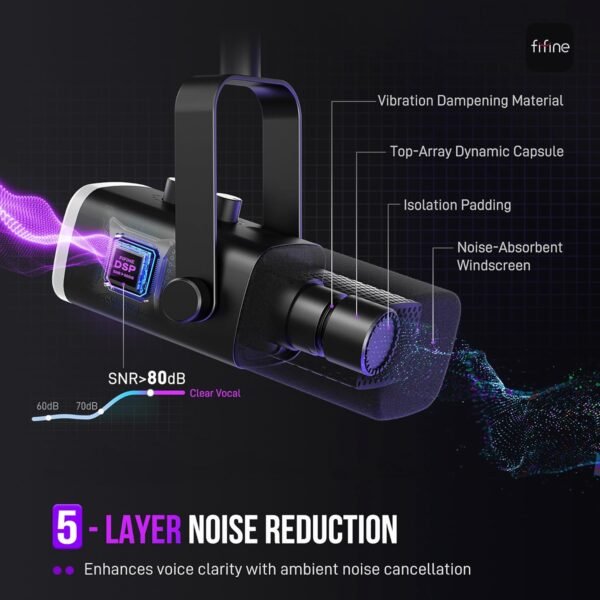
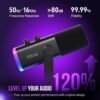
The FIFINE AM8T is a dynamic microphone sold as a kit rather than as a bare microphone. The listing gives Microphone Form Factor as Microphone Kit, a frequency range of 50 Hz to 16 kHz, a signal to noise ratio of 80 dB, a single channel, corded electric power, and construction in ABS plastic and metal. Package dimensions of 16.42 x 7.2 x 3.46 inches and a weight of 2.55 pounds reflect the kit contents rather than the microphone alone. It first became available in July 2023 and holds the number one position in Vocal Dynamic Microphones on the source listing.
FIFINE builds its business on delivering the visible features of a streaming setup at a fraction of the cost of professional equipment, and the AM8T fits that pattern. The buyer is a streamer, a podcaster or a gamer setting up a desk for voice. Readers comparing similar kits should look at the MAONO PD200X, which competes directly, and the Shure MV7X for a more studio oriented alternative.
Why a Dynamic Microphone for Streaming
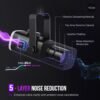
The choice of a dynamic microphone rather than a condenser is the most important decision embedded in this product, and it is the right one for most home setups. A condenser microphone is more sensitive and captures more detail, which is why studios use them in treated rooms. In an untreated bedroom with a mechanical keyboard, a computer fan and a window onto a street, that sensitivity becomes a liability: the microphone captures the room as faithfully as it captures the voice.
A dynamic microphone is less sensitive and typically has a tighter pickup pattern, which means the speaker has to be close to it but everything else in the room is substantially quieter in the recording. That is why broadcast studios have used dynamic microphones for voice for decades. The listed frequency range of 50 Hz to 16 kHz reflects this too: it is narrower than a condenser’s, and voice does not need more than that. Readers who want to compare the condenser approach can read about the Audio-Technica AT2035.
The Kit Contents and the Boom Arm
Selling this as a kit is the other significant decision. A microphone on a desk stand picks up every keystroke and every knock through the desk surface, because vibration travels through solid material far more efficiently than through air. A boom arm lifts the microphone off the desk, positions it close to the mouth without occupying desk space, and, when it includes a shock mount, isolates the capsule from mechanical vibration.
Buying an arm separately typically costs a meaningful fraction of the microphone’s price, so including one changes the value calculation considerably. The package weight of 2.55 pounds and the long 16.42 inch box are consistent with an arm being included. Buyers who want to see what a heavier duty studio arm looks like should read the Rode PSA1 studio arm, which is built to hold larger microphones. The wider vocal microphone category covers the microphone options across the site.
Connection and Setup
The Hardware Platform field lists PC, desktop, laptop, mixer, sound card and audio interface. The presence of mixers and audio interfaces in that list points to an XLR connection rather than USB, since a USB microphone connects to a computer directly and has no reason to mention a mixer. That distinction matters a great deal in practice: an XLR microphone needs a separate interface or mixer to work at all, which is an additional purchase, while a USB microphone plugs straight into a computer.
Buyers should confirm the connection type for the exact model before ordering, because FIFINE sells closely named variants with different connections and the retail listing does not state it plainly. If the microphone is XLR, a dynamic microphone with modest output may also benefit from an interface with generous gain, since dynamics produce a lower signal level than condensers and a noisy preamp becomes audible when turned up. Streamers building the rest of a chain can compare the Shure MV6.
Highlights
- Dynamic capsule, which rejects room noise far better than a condenser in an untreated space.
- Sold as a complete kit rather than as a bare microphone.
- Frequency range of 50 Hz to 16 kHz, matched to the voice band.
- Signal to noise ratio listed at 80 dB.
- ABS plastic and metal construction.
- Holds the number one position in its listed microphone category on the source data.
Things To Consider
The specification block contradicts itself. Frequency Range is given as 50 Hz to 16 kHz, and Maximum Frequency and Minimum Frequency separately confirm 16 kHz and 50 Hz. But a further field, Frequency Response, reads 20 KHz, which does not match and appears to be an unrelated number placed in the wrong field. Noise Level is listed as 80 dB, which is the same figure as the signal to noise ratio: a genuine noise level of 80 dB would make the microphone unusable, so this is the signal to noise figure duplicated into the wrong field rather than a real measurement.
The listing also omits several things a buyer needs. There is no polar pattern, which for a dynamic microphone is normally cardioid but should be confirmed. There is no sensitivity figure, no impedance, no maximum sound pressure level and no explicit statement of the connection type. There is no itemized list of what the kit actually contains, so whether a shock mount, a pop filter or a cable is included cannot be established from this data.
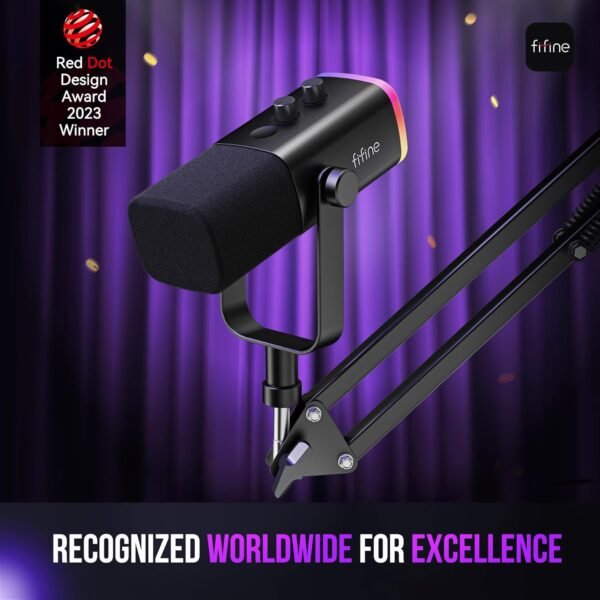
On the product itself, the usual caveats apply to microphones in this bracket. A narrower frequency range suits speech and suits singing less well. Dynamic microphones require close placement, typically a few inches, and sound thin at any distance. And an RGB lit microphone on a boom arm is a visual element as much as an audio one, which is fine for streaming and irrelevant for anything else.
Who Should Buy It, and Who Should Not
This suits a streamer or podcaster setting up a first proper voice chain who wants the microphone and the arm together, and who understands that a dynamic capsule in an untreated room is the practical choice rather than a compromise.
It does not suit anyone recording acoustic instruments or singing, where a condenser’s extended response is genuinely needed, and it does not suit a buyer who cannot confirm the connection type and add an interface if one is required. Those readers should look at a USB model where the connection is unambiguous.