Description
What the Audio-Technica AT2035 Is and Who It Suits
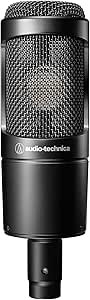
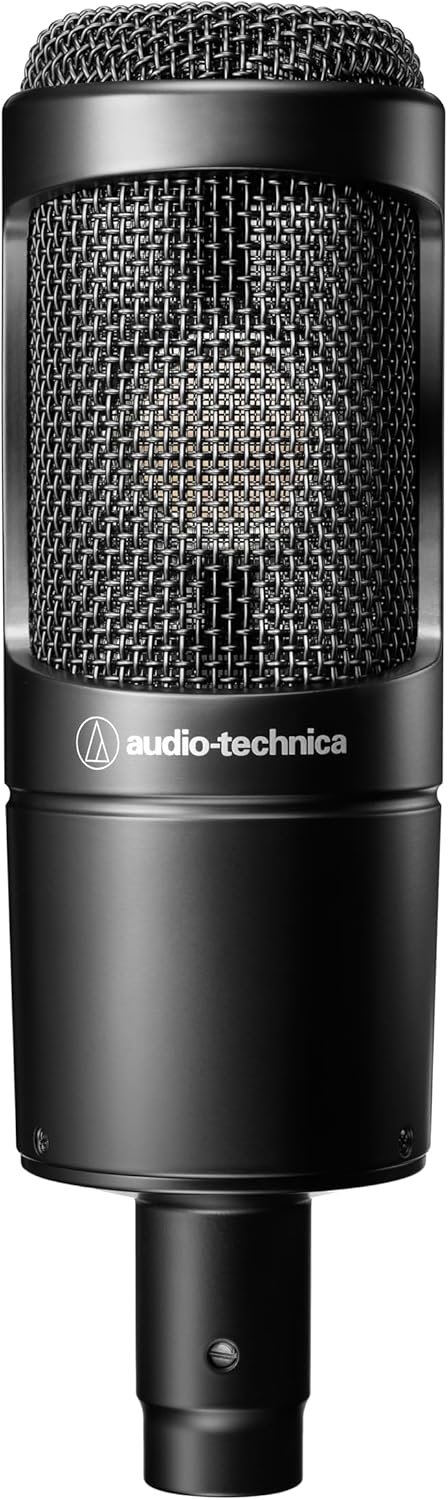
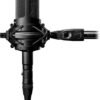
The AT2035 is a side address large diaphragm cardioid condenser microphone, designed by Audio-Technica for home, project and professional studio recording as well as live performance. The listing specifies a large diaphragm form factor, a single channel, a weight of 14.1 ounces and a country of origin of Taiwan. It has been listed since October 2009 and carries 2,898 ratings at an average of 4.7 stars, which is by a wide margin the strongest feedback record of any microphone covered here.
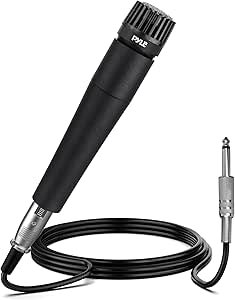
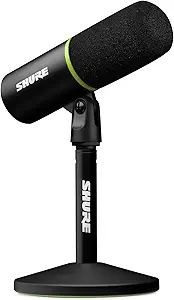
The buyer this suits is someone recording vocals, acoustic instruments, voiceover or podcasts in a room they can control at least partly. It is a standard first serious studio microphone and a common permanent fixture in project studios. Anyone who needs a microphone for a loud stage or for handheld vocal use should choose a dynamic model such as the PylePro PDMIC78 instead, and anyone wanting a USB microphone that plugs straight into a computer should look at the Shure MV7X family.
The Cardioid Pattern and the Large Diaphragm
Cardioid means the microphone is most sensitive to sound arriving from the front and progressively less sensitive toward the sides and rear. Audio-Technica describes this as improving isolation of the desired source, which is the practical benefit: in an untreated room, a cardioid microphone hears less of the walls behind it than an omnidirectional one would.
Side address means the microphone is spoken into from the side of the body rather than the end, which is the conventional layout for studio condensers and is why they are mounted vertically in a shock mount. The large diaphragm is the other defining characteristic. Audio-Technica states it delivers smooth, natural sound with low noise, and in general large diaphragm designs produce a fuller low end and a lower self noise figure than small diaphragm alternatives, at the cost of some accuracy at high frequencies and off axis.
The listing gives an audio sensitivity of 33 dB, a signal to noise ratio written as 7E+1 dB, which is 70 dB, and a noise level of 10 dB. The 10 dB self noise figure is the meaningful one for quiet sources: it defines the noise floor the microphone itself contributes, and a low figure is what allows quiet acoustic material to be recorded cleanly.
The Pad and the High-Pass Filter
Two switches on the body do a great deal of work. The 10 dB pad reduces the signal before the microphone’s own electronics, which prevents distortion when recording loud sources such as a guitar amplifier, a drum kit or a powerful singer. Without a pad, a condenser can overload internally before the preamplifier ever sees the signal, and no amount of gain adjustment downstream fixes that.
The switchable 80 Hz high-pass filter cuts everything below 80 Hz. This removes floor rumble, air conditioning noise, traffic through a building and the low frequency buildup that occurs when a source is very close to the microphone. Being switchable matters: the filter is helpful for voice and harmful for anything with genuine low frequency content, so it needs to be a choice rather than a permanent characteristic.
Power, Mounting and Practical Requirements
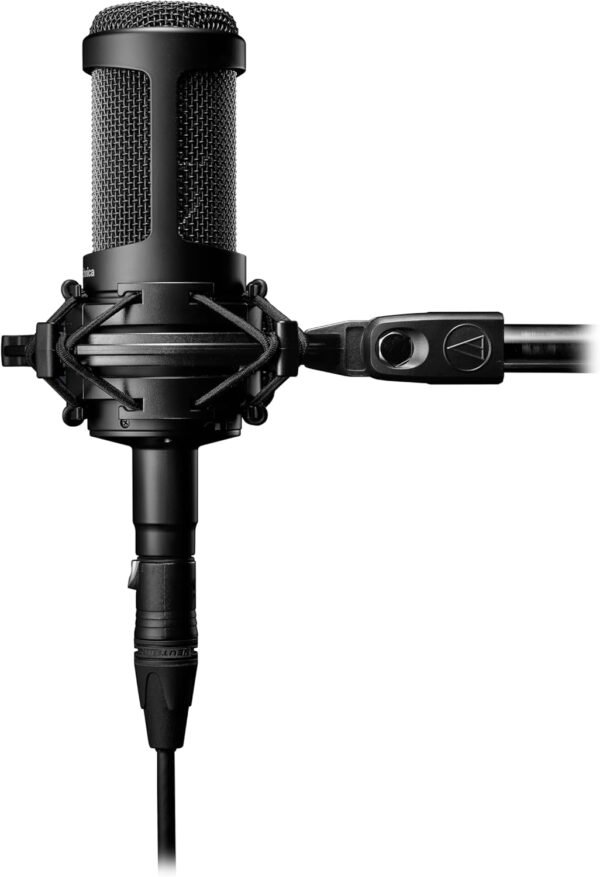
This is the point that catches out first time buyers. A condenser microphone requires 48V phantom power, supplied over the XLR cable by a mixer, an audio interface or a dedicated preamplifier. It cannot be plugged into a computer, a phone or a camera directly. The specification table lists the power source as corded electric, which is misleading: there is no power cord, only an XLR cable carrying phantom power from the connected device.
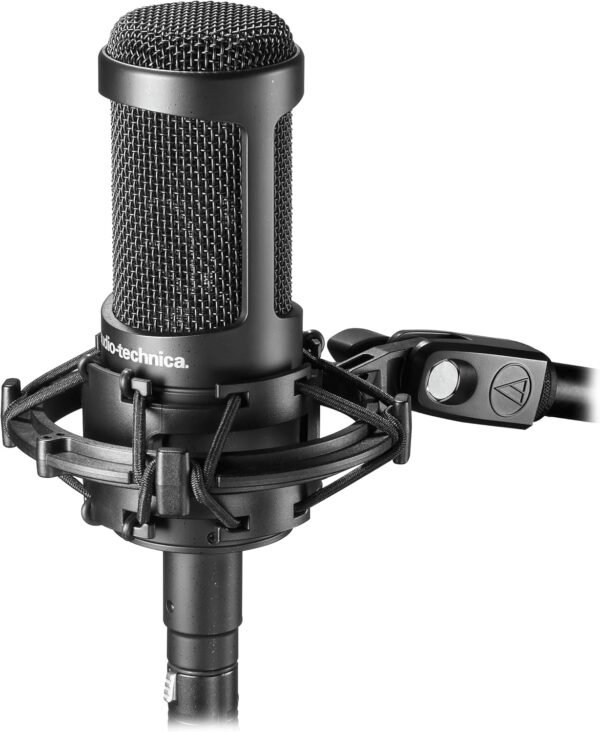
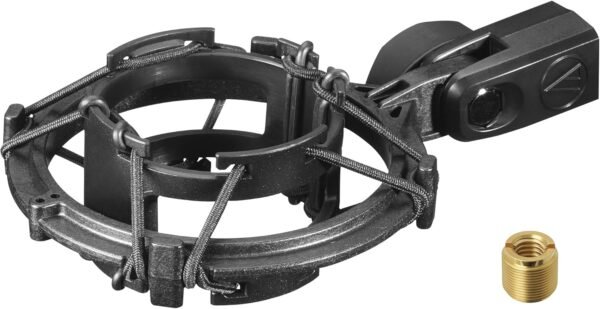
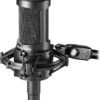
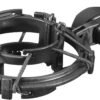
A custom shock mount is included, which is not always the case at this level and is a genuine cost saving. A shock mount suspends the microphone in elastic bands so that vibration through the stand, from footsteps or from desk knocks, does not reach the capsule. On a sensitive condenser this is not optional in practice. A protective pouch is also supplied.
What is not included is a stand or a boom arm, and the AT2035 is heavy enough at 14.1 ounces that a flimsy stand will droop. A proper studio arm such as the RODE PSA1+ is the usual solution for a desk setup. A pop filter is also not included and is effectively required for close vocal work, since a cardioid condenser at close range will register plosive bursts clearly.
The item dimensions of 9.75 by 9.75 by 2.75 inches describe the packaged product rather than the microphone body.
Highlights
- Large diaphragm cardioid capsule with a 10 dB self noise figure for quiet sources.
- Switchable 80 Hz high-pass filter to remove rumble and proximity buildup.
- Switchable 10 dB pad for high sound pressure sources.
- Custom shock mount and protective pouch included in the box.
- Audio-Technica states consistency from unit to unit, which matters for matched pairs.
- 2,898 ratings at 4.7 stars across a listing running since 2009.
Things To Consider
Phantom power is mandatory. A buyer without an audio interface or a mixer that supplies 48V will need to buy one, and that cost should be part of the decision rather than a surprise afterward.
A cardioid condenser in an untreated room will capture the room. The pattern helps, but a reflective space with bare walls will still colour the recording, and acoustic treatment or careful placement does more for the result than the microphone choice does.
No stand, boom arm or pop filter is included. Both a support and a pop filter are practical requirements for vocal work, so the working cost is higher than the microphone alone.
The specification table lists the power source as corded electric, which misrepresents how the microphone is powered, and repeats the signal to noise ratio in scientific notation. The listing also does not state the maximum sound pressure level, the frequency response curve, or the impedance. Buyers comparing against the AKG P120 or the higher tier Audio-Technica AT4040 should work from the manufacturer datasheets.
Who Should Buy It and Who Should Not
The AT2035 is a strong choice for a first serious studio microphone, for a project studio adding a reliable workhorse, or for anyone recording vocals and acoustic instruments who already has an interface with phantom power. The included shock mount, the pad and the filter cover the practical needs of that work directly. Buyers can compare it with other options in the vocal microphones category and with broader studio models in the multipurpose microphones category.
It is the wrong microphone for handheld live vocals, for very loud stage environments where a dynamic model is more forgiving, or for a buyer who wants to plug directly into a laptop with no interface. Those buyers should choose a USB or dynamic microphone instead.